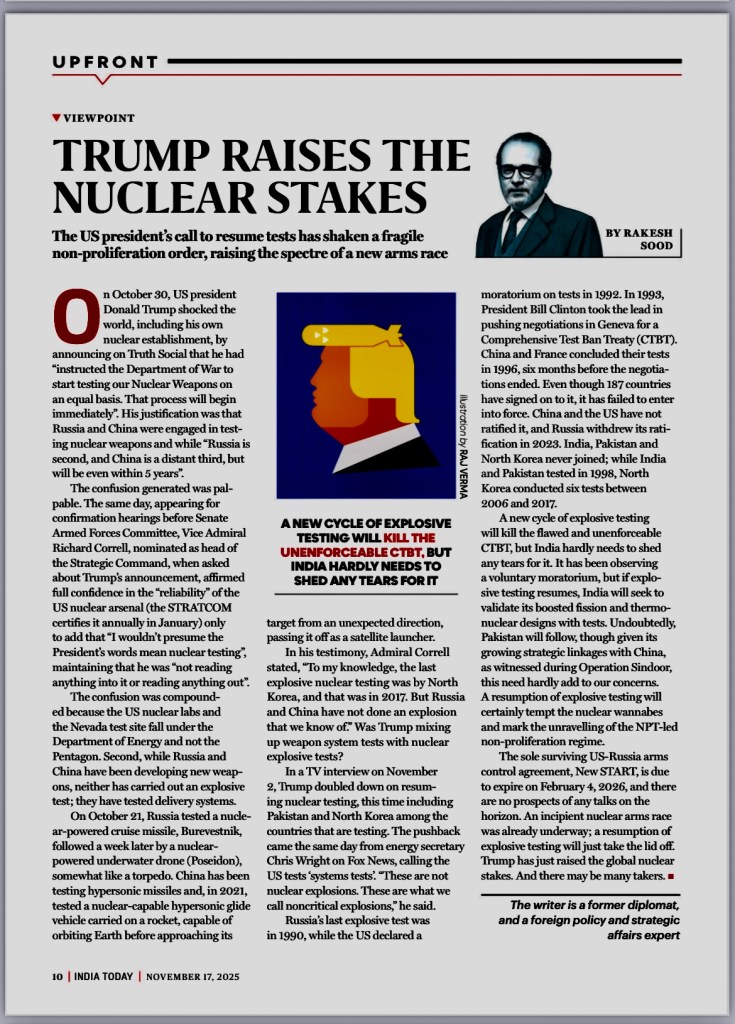
Donald Trump Shakes Up the Global Nuclear Order

Published in the Hindu on November 14, 2025

Today, the global nuclear order offers a curious contradiction – since the bombing of Hiroshima and Nagasaki in 1945, nuclear weapons have not been used during the last 80 years. The global nuclear arsenals have come down from a high of 65000 bombs in late 1970s to less than 12500 today. And, despite concerns in 1960s that by 1980, there may be at least two dozen states with nuclear weapons, the total today remains nine, five (the United States, Russia, The United Ukingdom, France and China) are permanent members of the United Nations Security Council who had tested before the Nuclear Non-Proliferation Treaty (NPT) came into being and four more who developed their nuclear arsenals later (Israel, Pakistan, India, and North Korea).

Looking back, these would seem to be impressive achievements but nobody is celebrating. In fact, the prevailing sentiment is that the global nuclear order is under strain and the U.S. President Donald Trump’s recent announcements may weaken all three elements of the global nuclear order.

Resumption of ‘nuclear tests’

On October 30, 2025, on his way to a meeting with China’s President Xi Jinping in Busan, Mr. Trump announced on Truth Social, “Because of other countries testing programs, I have instructed the Department of War to start testing our Nuclear Weapons on an equal basis. That process will begin immediately.” He added, “Russia is second, China is a distant third, but will be even within 5 years.”

While it was clear that the message was directed at Russia and China, it was unclear whether Mr. Trump was referring to ‘nuclear explosive testing’ or testing of nuclear weapon systems. Second, the nuclear labs (Los Alamos, Lawrence Livermore, and Sandia) and the Nevada testing facilities fall under the Department of Energy and not the Department of War.

It is no secret that China, Russia, and the U.S. are designing and developing new nuclear weapons. On October 21, Russia tested a nuclear-powered cruise missile (Burevestnik) that travelled 14000 kms, following a week later, with a test of an underwater nuclear-powered torpedo (Poseidon). China has been testing hypersonic missiles and, in 2021, tested a nuclear capable hypersonic glide vehicle carried on a rocket, capable of orbiting the earth before approaching its target from an unexpected direction that was passed off as a satellite launcher. The U.S. is producing new warheads – a variable yield B61-13 gravity bomb, a low yield W76-2 warhead for the Trident II D-5 missile, while working on a new nuclear armed submarine launched cruise missile.

Yet they have refrained from explosive testing. Russia’s last explosive test was in 1990 while the US declared a moratorium on tests in 1992. In 1993, the U.S. created a Stockpile Stewardship and Management Programme under the National Nuclear Security Administration to work on warhead modernisation, life extension, and development of new safety protocols in warhead design.  U.S. President Bill Clinton also took the lead in pushing negotiations in Geneva for a Comprehensive Test Ban Treaty (CTBT). China and France concluded their tests in 1996, six months begore the negotiations ended.

Why CTBT lacks a definition

Twenty-nine years later, the CTBT hasn’t entered into force despite 187 countries signing it. Among the necessary ratifications, the U.S., China, Israel, Egypt, and Iran have not done so, Russia did and withdrew its ratification in 2023, and India, Pakistan and North Korea have neither signed nor ratified it. India and Pakistan tested in 1998 and have since observed a voluntary moratorium, and North Korea conducted six tests between 2006 and 2017. Given today’s geopolitics, the prospects for the CTBT entering into force appear bleak.  

Second, the CTBT obliges states “not to carry out any nuclear weapon test explosion or any other nuclear explosion.” The U.S. was opposed to defining the terms, and instead, worked out private understandings with Russia and China on ‘zero-yield-tests;’ this permitted hydro-nuclear tests that do not produce a self-sustaining supercritical chain reaction.

The U.S. had conducted over a thousand nuclear tests and Russia 727 tests, giving them an adequate data base. China though with only 47 tests, also went along with this understanding. Thus, the CTBT delegitimsed only nuclear-explosive testing, not nuclear weapons, the reason why India never joined it.

In 2019-20, the U.S. State Department assessed that Russia and China “may have conducted low yield nuclear tests in a manner inconsistent with the U.S. zero-yield standard” though this was negated by the CTBT organisation that declared that their monitoring network with over 300 monitoring stations spread over 89 countries had not detected any inconsistent activity.

In a TV interview on November 2, Mr. Trump doubled down on resuming nuclear testing, this time including Pakistan and North Korea among the countries testing. A clarification came the same day from energy secretary Chris Wright on Fox News, calling the US tests ‘systems-tests’, “These are not nuclear explosions. These are what we call noncritical explosions,” he said. However, Mr. Trump’s intention remains unclear.

Regional and global implications

The new low-yield warheads being designed make them more usable and the new systems (hypersonics, cruise and unmanned systems) are dual capable systems, leading to renewed research for missile defences like the U.S. ‘golden dome.’ Meanwhile doctrinal changes are being considered to cope with new technological developments in cyber and space domains. This raises doubts about the nuclear taboo in coming decades.  

The sole surviving US-Russia arms control agreement, Ner Strategic Arms Reduction Treaty (New START) that limits the U.S. and Russian strategic forces to 700 launchers and 1550 warheads is due to expire on Feb 4, 2026 with no prospects of any talks on the horizon. China is not a party to any arms control and its nuclear arsenal that had remained below 300, is undergoing a rapid expansion, estimated at 600 today and likely to exceed 1000 by 2030. An incipient nuclear arms race was already underway; a resumption of explosive testing will just take the lid off.

Russia and China have denied Mr. Trump’s allegations regarding clandestine tests but will follow if the U.S. resumes explosive testing; China will be the biggest beneficiary because with only 47 tests (compared to over 1000 by the U.S.), resumed tests will help it to validate new designs and accumulate data.

India has been observing a voluntary moratorium but if explosive testing resumes, India will certainly resume testing to validate its boosted fission and thermonuclear designs, tested only once in 1998. Undoubtedly, Pakistan will follow but given its growing strategic linkages with China witnessed during Op Sindoor, this need hardly add to our concerns.

Though the CTBT is not in force, it did create a norm. But a resumption of explosive testing will lead to its demise. It will also tempt the nuclear wannabes to follow and mark the unravelling of the NPT led non-proliferation regime.

The taboo against use must remain intact

The U.S. has been the most significant player in shaping the global nuclear order; it would be ironical if Mr. Trump’s actions now become the catalyst for its demise. The reality is that the present global nuclear order was shaped by the geopolitics the 20th century; the challenge today is to craft a new nuclear order that reflects the fractured geopolitics of the 21st century while ensuring that the taboo against their use remains intact.  

The UN Secretary General has cautioned that “current nuclear risks are already alarmingly high” and urged nations “to avoid all actions that could lead to miscalculation or escalation with catastrophic consequences.”  But is anyone listening?

*****

The Turmoil in Kathmandu, the Road Ahead for Nepal

Published in the Hindu on Sptember 27, 2025

The Gen Z protests that erupted in Kathmandu on September 8, 2025,  snowballed rapidly, taking the Nepali government by surprise. The excessive police reaction led to an explosion of public anger, and the rapidly evolving situation forced Prime Minister K. P. Sharma Oli to quit the following day, creating a vacuum that even the Gen Z protestors were unprepared for.

Following talks between the Gen Z representatives and the Chief Of Army Staff Gen A. R. Sigdel, former Chief Justice Ms Sushila Karki was sworn in as Interim Prime Minister on September 12, with the mandate to conduct fresh elections within six months. The current parliament has been dissolved, an apolitical cabinet of  experts is taking shape, and calm has returned to the streets.

Elections have been fixed for March 5, 2026 but questions persist. How will the Gen Z organise themselves around a political platform? Will the established political parties be ready? Meanwhile, suggestions are afoot for amending the constitution but this may open a Pandora’s box in the absence of process legitimacy.  

A turbulent phase in India’s neighbourhood

The decade of the 2020s has witnessed political changes in India’s neighbourhood – in February 2021, the experiment with democracy in Myanmar collapsed as the military assumed full control; later in 2021, the Taliban returned to Kabul as the U.S. withdrew from Afghanistan; in mid-2022, the Aragalayamovement in Sri Lanka forced President Gotabaya Rajapaksa to flee the country; in Pakistan in May 2023, the arrest of former Prime Minister Imran Khan led to widespread protests but the military took charge of the situation; and, in August 2024, protests in Bangladesh gathered momentum forcing PM Sheikh Hasina to quit and leave Dhaka. Hardly surprising that analysts would look for patterns that can fit their models or conspiracy theories.

However, each of these changes has its own history. Sheikh Hasina had been in power since 2009 and the recent elections had been disputed even as she cracked down on the opposition. In Sri Lanka, the Rajapaksa family had been ruling since 2004 with a short interregnum. Myanmar and Pakistan have had long spells of military rule; the military has remained in the driver’s seat – openly as in Myanmar or behind the scenes, as in Pakistan. Afghanistan followed the familiar pattern of failed interventions by the United States – since Vietnam in the 1960s, and in 2021, when it had become apparent that continued U.S. presence in Afghanistan would not help matters.  

If there are similarities, these are primarily the dominant role played by the youth in the protests and secondly, the higher levels of youth unemployment compared to the total unemployment in these societies. While overall unemployment levels in Bangladesh, Nepal and Sri Lanka are between 4-5%, youth unemployment is above 16% and in Nepal, above 20%. Politically, Sri Lanka and Bangladesh have had political stability given long tenures of the Rajapaksa brothers and Sheikh Hasina respectively but this led to nepotism, corruption and increasing disdain for democratic accountability.

Nepal’s political transition

In contrast, Nepal’s political trajectory has been different with frequent government changes. Since 2015, when the constitution was adopted, there were seven governments but with the same leaders playing musical chairs, UML leader Oli thrice and both Maoist leader Prachanda and NC leader Sher Bahadur Deuba, each twice. It created a curious internal stability where cronyism, nepotism and corruption flourished, within the outward instability that prevented job growth and economic development.

Nepal’s political transition began 35 years ago. The 1990 Jan Aandolan replaced Panchayati Raj with multi-party democracy and circumscribed the monarchy to a constitutional role. However, intra-party rivalries provided fertile grounds for the monarchy to play favourites. A Maoist insurgency surfaced in 1996 and over a decade, gradually engulfed large parts of the country claiming 17000 lives.

It took 17 years before the political parties came together to work out a peace process that permitted the Maoists to come overground and emerge as a political party. During this period, there were 15 changes of government and one spell of direct rule by King Gyanendra that sparked the second Jan Aandolan in 2006, forcing him to restore parliament and the elected government.

In 2008, an elected Constituent Assembly declared Nepal to be a republic ending the 240-year-old monarchy and began drafting a constitution for a federal republic. Instead of the given two-year deadline, the constitution was promulgated after seven years in 2015. More time was spent on government formations and these seven years witnessed six PMs. Maoist leaders served twice, UML leaders twice, NC once and an interim government was created under Chief Justice Khil Raj Regmi for electing a second constituent assembly in 2013. 

The 1990 and 2006 Jan Aandolans were spearheaded by the political parties to wrest political power from the monarchy but the 2025 Gen Z protests reflect a broader frustration with political leaders of all political parties, for misusing coalition politics for amassing personal wealth.

President Ram Chandra Poudel has reiterated that he will observe the constitution and has sought to justify concerns about the appointment of an Interim PM by citing Article 61. Art 61 merely directs the President to “promote the national unity” and “to abide by and protect the Constitution”. Since a state of national emergency was not declared, Gen Sigdel played a political role in identifying and holding consultations with the Gen Z representatives. The army also moved the targeted leaders and Ministers into military cantonments for their security. Clearly, Mr. Poudel depended on the army because it is the only institution that enjoys social respect.

Ms. Karki has identified three priorities for the Interim Government – to ensure elections on March 5; to fix accountability for the use of excessive force by the police and the arson and vandalism; and to expose and prosecute corruption in high political office. The last two will be difficult as there are reports of politically affiliated gangs infiltrating the Gen Z protests, and fast track prosecutions in Nepali justice system are unheard of.

There is a growing sentiment that the 2015 constitution that introduced a 275 member House of Representatives with First Past The Post (165 seats) and Proportional Representation (110 seats) somehow prevents the emergence of a majority government. Other ideas doing the rounds are to introduce a directly elected executive, and do away with federalism by empowering local bodies. Pushing such ideas through a constitutional commission and national referendums could create more difficulties. Any dilution of federalism or Proportional Representation system is bound to spark protests among the Madhesis, Janjati and Tharu communities.

Such moves into uncharted political territory and questionable legitimacy run contrary to Mr. Paudel’s assurance of abiding by the constitution and may jeopardise the election schedule. The established political parties need time for internal leadership churn that the old timers will resist. New political forces led by youth leaders will emerge and it is likely that some pro-monarchy elements may also sense an opportunity to recover lost ground.

Focus should be on fair elections

Fortunately, India has escaped criticism in Nepali media in connection with the current political turmoil. The restrained official statements and the phone call by Prime Minister Narendra Modi on September 18, to congratulate Ms. Karki, convey condolences at the loss of life, and assure full support to Nepal, keeps communication channels open.  

Peaceful, free and fair elections on March 5 would be best way forward for Nepal; any other ambitious moves by vested interests would only increase uncertainties generating an atmosphere of mistrust and insecurity in which the political gains of the last two decades towards a more democratic and inclusive Nepal would be at risk.

*****

Political Meltdown in Nepal was a Long Time Coming

Published in the Hindustan Times on September 11, 2025


Tens of thousands of demonstrators, describing themselves as Gen Z, converged near the parliament in Kathmandu on Sept 8, to protest against a ban on 26 social media platforms (including Facebook, WhatsApp, X, Instagram, Reddit, LinkedIn, Signal and YouTube) announced last week for failing to register under the new government guidelines. Even as the police resorted to batons, water cannons, and rubber bullets to disperse the protestors, the crowds continued to grow and by the end of the day, 20 young people (including a 12 year old) were dead, with reports of 400 injured.

The following day, anger had spread to other cities and government buildings including the parliament and Singha Dubar were set on fire. Private houses of leading politicians cutting across party lines, were torched, cars burnt and ministers manhandled. Home Minister Ramesh Lekhak had accepted responsibility and resigned on Sept 8 and the ban order was also reversed but the protestors were not satisfied. Finally, Prime Minister K P Sharma Oli realised that he needed to go and he resigned on Sept 9 in the afternoon. There are rumours that he was evacuated in a helicopter by the army to a secure location as his official residence at Baluwatar was considered vulnerable.   

Nepal’s political transition has been a long time in the making and has gone through multiple transitions. It began with the popular uprising in 1990, labelled as Jan Aandolan 1, leading to a new constitution that laid the foundations of multiparty democracy by curbing the role of an absolute monarchy into a constitutionally circumscribed role. However, in mid-1990s, a Maoist insurgency began to take shape in some of the poorer hill areas that gradually took hold and spread. Infighting between the political parties and the Palace provided a permissive environment for the insurgency to spread and by 2006, it had claimed 17000 lives.

In 2005, King Gyanendra declared a state of emergency, dissolved parliament, dismissed the elected government, and assumed direct rule. A popular pushback led to Jan Aandolan 2 in 2006 that forced him to restore parliament. A peace process between the political parties and the Maoists, facilitated by India, led to the Maoists coming overground and emerging as a political party. Elections for a Constituent Assembly (CA) took place in 2008. The 240-year-old monarchy was abolished, Nepal emerged as a republic, and the CA began work on a new constitution for a Naya (new) Nepal.

After seven years, Nepal adopted its new constitution but the promise of a New Nepal remains a distant dream. A key reason has been weak economic development, lack of employment opportunities, growing corruption, and frequent changes of government. In the 17 years since it became a republic, Nepal has had 15 governments. The situation didn’t improve even after 2015 when the new constitution was adopted, with the last decade accounting for nine of the 17 governments.

Part of the reason is that in none of the elections since 2008 did any party manage to obtain a clear majority necessitating coalitions. This explains the political instability of short-lived coalitions. However, there has been a strange stability too, in that the leaders of the three major parties, Nepali Congress (NC), United Marxist Leninist (UML), and Maoist Centre, have been taking turns in leading the incestuous coalitions and garner the loaves and fishes of office. In the process, corruption grew visibly and the groundswell of public disenchantment was just waiting for a spark that was provided by the ill-conceived ban on the 26 social media platforms, leading to Jan Aandolan 3.   

However, there are differences. The earlier two Jan Aandolans were spearheaded by the political parties, primarily the NC and the UML and had the clear objective of wresting political power from the Monarchy and had an identifiable leadership. The Jan Aandolan 3 rejects the leaders of all political parties and there have been calls for dissolution of the parliament and even revising the constitution.

Second, there is no visible leadership. The 35-year-old Balen Shah, a rapper turned electoral phenomenon, the surprise winner to be elected Mayor of Kathmandu in 2022, is trying to emerge as a leader in Jan Aandolan 3. On September 7, he conveyed support to the protestors and after keeping quiet for a day, came out after PM Oli’s resignation urging restraint.

Another name doing the rounds is the 38-year-old Sudan Gurung, who founded the NGO Hami Nepal (Our Nepal) in 2015 following the devastating earthquake to ensure that humanitarian assistance was delivered efficiently where it was most needed by mobilising youth volunteers. During the past decade, his NGO has been successful in mobilising resources for communities impacted by floods and landslides that take place with depressing regularity. Hami Nepal was heard as a slogan during the protests.

Other than conveying sorrow at the loss of innocent lives, wishing a speedy recovery to the injured, India has expressed hope that “all concerned will exercise restraint and address any issues through peaceful means and dialogue.” To ensure security and with an eye to the forthcoming Bihar elections, the border has been sealed. For the present, this is adequate even as the government remains vigilant and monitors developments to see the political actors that emerge out of the political churn of Jan Aandolan 3.

*****

India US Ties: Up Close, and Personal

Published in Hindustan Times on August 13, 2025

Six months ago, at the White House, President Donald Trump and Prime Minister (PM) Narendra Modi were describing each other as ‘great’ and ‘dear’ friends, recalling the reverberating echoes of Howdy Modi in Houston (2019) and Namaste Trump in Ahmedabad (2020), and outlined an ambitious vision of India-US relations in an over 3000 word long Joint Statement.

Even as Canada rubbished Trump’s call for it to become the 51st state, NATO, Japan, and South Korea wondered about the credibility of the US nuclear umbrella, and Europeans did their best to reassure a beleaguered Volodymyr Zelensky in Kyiv, the February visit reassured India that the Modi-Trump relationship was intact and India-US ties were on a positive trajectory. Opinion polls across the world noted that Indians were the most optimistic about Trump’s second term.

Bilateral trade talks began soon after. Five rounds have taken place but trade deals take long, years at times. But Trump’s qualities do not include patience and subtlety. To push the Indians, he added a 25% tariff with a deadline of July 31.

Also, his second term was promising to be very different from his first. In his inaugural speech, he had talked of ending wars, of leaving behind a legacy as a ‘unifier and peacemaker.’ It soon became clear that in addition to deploying his favourite policy tool – tariffs, to get his trade deals, his goal was the Nobel Peace prize, preferably in the first year itself.

His tactics seemed to be working. The US has announced new trade deals with the EU, UK, Japan, and South Korea, covering more than 25% of US foreign trade, though details haven’t been worked out. In addition, negotiations are underway with over a dozen countries. China is playing hardball, and using its leverage to restrict exports of rare earth magnets. Canada and Mexico have their own leverages. China’s tactics may be working as the US has already relaxed its export controls on H20 chips to China.

On his peace-President agenda, progress has been slower. The two big conflicts that Trump had promised to sort out quickly, Ukraine and Gaza, have proved difficult. Both Russian President Vladimir Putin and Israeli PM Benjamin Netanyahu have their own ideas about their objectives and have been stringing Trump along. However, Trump has been nominated for the peace Nobel jointly by the presidents of Azerbaijan and Armenia and by Prime Minister Hun Manet of Cambodia for brokering the ceasefire between Thailand and Cambodia. The White House has also highlighted his role in ending the conflicts between Rwanda and the Democratic Republic of Congo, Serbia and Kosovo, and Egypt and Ethiopia. And somewhat cheekily, for the ceasefire between Israel and Iran especially after Trump came to Israel’s help by firing Tomahawk missiles and deploying B2 bombers to deliver the GBU 57 bombs on Iranian targets.

Netanyahu has mollified Trump by nominating him for his role in the 2020 Abraham Accords that enabled Israel to normalise relations with the UAE, Bahrain, Morocco, and Sudan. Putin is now scheduled to have a bilateral meeting with Trump in Alaska on August 15 but Ukraine and the Europeans are not invited. Meanwhile, secondary sanctions on Russia’s oil exports have been introduced and India (collateral damage) will attract a 25% penalty, effective August 27.

However, India-Pakistan crisis is perhaps where Trump feels let down by his ‘great friend Modi.’ India was upset at Trump pre-empting the ceasefire announcement on 10 May and claiming credit as a “US brokered ceasefire.” Since then, he has repeated the claim more than 25 times adding how he prevented a nuclear war, and he employed the threat of cutting trade if they continued. Each time, it was denied by Indian foreign office and military officials, and most recently by the external affairs minister S. Jaishankar and defence minister Rajnath Singh, in parliament.

Meanwhile, Pakistan was quick to thank Trump for his positive role and expressed the hope that he could continue to remain engaged and mediate on Kashmir, while nominating him for the Nobel Peace prize. Encouraged by Pakistan, Trump invited Modi to the White House on June 18 on his way back from the G-7 meeting in Canada but was turned down. Trump was presumably trying to set up a meeting with Pakistan army chief Field Marshal Munir who was invited to lunch that day at the White House. With so much happening, its easy to lose sight of the big picture.

Relations between States are governed by national interests and patient negotiations. Good ties between leaders can help but cannot be the principal driver. That’s why neither Modi nor Trump is going to pick up the phone to resolve their misunderstanding.

The end of the Cold War provided the impetus for the shift in India-US relations when President George H W Bush (41) and PM PV Narsimha Rao took the initiative in 1992 to initiate a dialogue on nuclear issues and the first baby steps for defence cooperation were taken. Gradually, despite ups and downs, and changes in governments in both countries, the positive trajectory continued and a bipartisan consensus based on mutual trust and converging interests evolved. If the nuclear tests in 1998 marked a low point, the Strobe Talbott-Jaswant Singh dialogue, and the positive US intervention in 1999 during the Kargil conflict restored trust. The story was repeated after the parliament attack in 2001 and during Balakot when US facilitated the quick release of Wg Cdr Abhinandan from Pakistani custody.

There is a difference between back-channel diplomacy and public diplomacy. While Trump has a fondness for TruthSocial, India’s geography dictates prudence. US is larger than Trump just as India is larger than Modi, and there is life after Trump and there is life after Modi. This becomes clearer if interests are given primacy as foreign policy drivers. It also helps avoid the trap of believing one’s own propaganda. The simple question is – is it in national interest to sustain relations with the US. The answer should be obvious.

*****