Transforming India’s Nuclear Power Landscape

Published in the Hindu on April 6, 2026

In the 2025-26 Budget speech, Finance Minister Nirmala Sitharaman announced that India’s installed nuclear power generation capacity would rise from 8180 MW  to 100,000 MW (100 GW) by 2047. She also signalled transformative legislative changes, leading to the introduction and rapid passage of the Sustainable Harnessing and Advancement of Nuclear Energy for Transforming India (SHANTI) Bill in December 2025.

The scope of change envisaged is dramatic. All nuclear activity had hitherto been the exclusive preserve of the Department of Atomic Energy (DAE). The SHANTI Act promises a transformation of India’s nuclear energy landscape by bringing in private companies to build, own and operate nuclear power plants, provides a statutory status to the Atomic Energy Regulatory Board (AERB), and revises the liability framework to encourage private and even foreign investment. The 1962 Atomic Energy Act and the 2010 Civil Liability for Nuclear Damage Act (CLNDA) stand repealed and replaced by the SHANTI Act (2025).

However, to realise the promise of 100 GW will need putting the nuts and bolts of implementation in place, the notification of supportive Rules and Regulations, consonant with the transformative spirit underlying the SHANTI Act.

Driving the reforms

 Two key pronouncements drive the reform: achieving  Viksit Bharat (Developed India) by 2047 and net zero emissions by 2070. As society moves up the development ladder, the nature of energy consumption shifts to electricity from the traditional modes of energy like firewood, fossil fuels for transport and heating, and coal for industry. Consequently, the “net zero” target also imposes a parallel shift away from fossil fuel-based power generation towards renewables and other low carbon options.

In 2024, India’s per capita electricity generation was 1418 kWh (kilo-watt-hour) compared to 7097 kWh for China and 12701 kWh for the  United States. The OECD average is a little above 8000 kWh. This indicates the distance India needs to travel to achieve the goal of Viksit Bharat. The second goal of “net zero” imposes its own conditionalities. In 2024, India’s per capita energy consumption was 7893 kWh, indicating that only one-fifth of the energy consumption is from electricity.

In June 2025, India’s electricity generating capacity reached 476 GW (giga-watt) and approximately 50 percent was non-fossil fuel sources. Renewable sources made up 227 GW, consisting of solar power 111 GW, wind power 51 GW, hydro power 48 GW with an additional 5GW from micro-hydel projects and bioenergy 12 GW. In addition, nuclear power – which is seen as low carbon and not strictly renewable as it consumes fissile material as fuel – was 8.8 GW. Thermal power, primarily based on coal accounted for 240 GW. India has committed to increasing the installed capacity of renewables to 500 GW by 2030.  

However, the installed capacity does not reveal the full picture. Renewable sources generation depends on the time of day, climatic and seasonal conditions and geography. India generated a total of 1824 TWh (tera-watt-hours) during 2024-25. The renewable sources accounted for 403 TWh (solar 144 TWh, wind 83 TWh, hydro power 160 TWh and bioenergy 16 TWh). Nuclear power accounted for 57 TWh while thermal power generation was 1363 TWh. Thermal power therefore accounted for 75% of the electricity generated with 50% of the generating capacity compared to 50% renewables capacity providing 22%, while nuclear power contributed 3% with 1.8% of generating capacity. The reason is that thermal and nuclear sources provide for steady baseload power. For renewables to provide at scale, large investments in energy storage become essential. This is why renewables capacity growth is now facing headwinds with projects of 40 GW languishing without power-purchase contracts.

India’s nuclear power journey and options

Conservative estimates indicate that India will need to grow its electricity generating capacity to over 2000 GW to reach Viksit Bharat levels. Even with more efficient and cheaper battery storage, renewables like solar and wind farms are about ten times more land intensive compared to thermal power plants; since coal is inconsistent with “net zero”, nuclear power remains the preferred baseload means to achieve “net-zero.”

India’s first nuclear power reactor went operational in 1969 in Tarapur. Today, Nuclear Power Corporation (NPCIL) is managing 24 nuclear power plants with an installed capacity of 8780 MW (one reactor in Rawatbhata has been shut down). The two oldest are Boiling Water Reactors (BWR), two at Kudankulum are Russian design VVERs (PWR) and the balance are Pressurised Heavy Water Reactors (PHWR). The original design was 220 MW; this has been successfully indigenised and adapted to 540 MW and 700 MW designs.

The DAE budget has averaged between Rs. 24000 and 26000 crores during the last three years. India’s 700 MW PHWR construction cost is $2 million per MW, among the lowest globally for nuclear power. To add 90 GW over the next two decades would need an outlay of over $200 billion (Rs 18 lakh crores), only feasible with private investment; both domestic and foreign.

In 2017, government gave administrative and financial approval for building 10 reactors of 700 MW each in fleet mode but work hasn’t begun. The logic of fleet mode was to streamline production to gain economies of scale. Three other locations, Jaitapur for six reactors of 1650 MW each based on a French (EdF) design, Mithi Virdi and Kovvada to have six reactors each of 1000 MW capacity with Westinghouse-Toshiba and GE-Hitachi designs, have been mentioned for over a decade. The likely power generation costs from these unproven designs are likely to be over $5 million per MW.

Many industries have captive power plants, ranging from 10 MW to 200 MW and most of these are fossil fuel based. Current estimates for the installed capacity are 90 GW with plants of 100 MW and above accounting for two-thirds capacity. The government has allocated Rs. 20000 crores to research and develop five indigenous models of Small Modular Reactors (SMR) of 5 MW, 55 MW and 200 MW capacity by 2033. Meanwhile, the indigenised 220 MW PHWR model (15 are currently operational), can be a reliable work horse. With efficient project management, some amount of modularisation, and economies of scale, the time from first pour-of-concrete to going-on-stream can be reduced to 40 months. Steel, primary metals, cement, petrochemicals and paper industries and now, the data centres, have shown interest.

Three-front nuclear strategy

To achieve the 100 GW target requires careful planning across three fronts. The EdF and Westinghouse designs are comparatively new and will need to be indigenised to bring down costs. China has demonstrated this by building a supporting industry base, and plans to build 33 reactors of 1000 MW each at below $2 million per MW over 10 years. Second, DAE should identify institutions to accelerate R&D for the indigenous SMRs, especially of the Molten Salt Reactor design. Another research area is use of Thorium cladding with HALEU (High Assay Low Enriched Uranium) that can provide an alternative to the Breeder Reactor route in order to permit early exploitation of India’s thorium reserves. Third, the indigenised 220 MW PHWR model is ready to be modularised as an economically viable replacement for a number of captive power plants and some Indian private sector companies (L&T, TCE, Kirloskar etc.) have the requisite design, fabrication, and construction experience.  Since nuclear power generation requires high upfront capital costs but low operating costs over a long (60 years) operating life, an appropriate financing model will need to be worked out. Existing exclusion zone regulations, intended for multiple reactors at one site will need to be modified for captive single unit reactors.

Conceptually, the SHANTI Act attempts a division between the strategic and defence related nuclear activities and the civilian power generation; now the Rules and Regulations to be issued must make this clear. Issues of nuclear power tariffs, ownership of nuclear fuel, waste management, insurance and liability, dispute settlement mechanism, and an autonomous regulator will need to be dealt with in a transparent manner. Only then will the SHANTI Act deliver on its promise.

******
Making Sense of the Political Tsunami in Nepal

Published in The Hindu (online) on March 14, 2026

As a landlocked country, Nepal has gone through both geological and political earthquakes in recent years but the snap election held on March 5 has been nothing short of a political tsunami. The old political parties have barely scraped through and the Rashtriya Swatantra Party (RSP), which is less than five years old, has won 125 seats out of the 165 first-past-the-past FPTP seats; with 57 proportional representation (PR) seats, it has a total tally of 182, just two short of the two-thirds mark, an unprecedented outcome in a Nepali election. Most of the political leaders who have dominated the Kathmandu scene for the last quarter century will be missing when the new House is convened. However, the RSP leaders now face a bigger challenge – of converting a stable majority into institution-based policy formulation and good governance team to deliver on the high expectations generated.

Crisis after crisis

Barely had the 21st century begun when Nepal went through its first major political crisis. On June 1, 2001, at a family dinner at the Narayanhiti Palace, Crown Prince Dipendra killed nine members of the royal family, including his father, King Birendra, and his mother, Queen Aishwarya. As Nepal mourned, he died three days as a result of a self-inflicted gun wound. King Gyanendra took over, marking a turning point for the two-century old Shah dynasty.

Meanwhile, Nepal was also struggling with a Maoist insurgency that finally ended by 2006 with the political mainstreaming of the Maoists. In the Terai, the Madhesi movement had gained momentum, backing demand for a federal structure. During his seven years, King Gyanendra changed prime-ministers six times and even abolished the National Assembly to impose direct rule. However, the political parties were able to lead a Jan Aandolan that forced him to retreat.

A Constituent Assembly (CA) was elected in 2008 that voted to abolish the monarchy marking Nepal’s second major political change. The CA’s mandate was to draft a constitution for a federal democratic Nepal in two years. The process turned out to be politically difficult and took considerably longer. After another CA election mandated by the Supreme Court in 2013, a new constitution was finally adopted in 2015.   These seven years saw six prime-ministers. The reason was simple. Both the 2008 and the 2013 elections failed to throw up clear majorities, and the leaders of the political parties – Nepali Congress (NC), Communist Party of Nepal -United Marxist Leninist (UML), Maoists and the Madhesi parties – devoted their time to jockeying for positions in the coalition governments.

The 2015 constitution marked Nepal’s third political turning point but the expectations of the much-awaited dawn of a naya Nepal were soon belied. From 2015 to 2025, Nepal saw seven prime-ministers but the faces were the same – UML leader K P Sharma Oli thrice, NC leader Sher Bahadur Deuba twice, and Maoist leader Pushpa Kamal Dahal Prachanda twice.

The lavish lifestyles of the political elite went viral on social media accompanied by tales of corruption and impunity of ‘nepo-babies’. The disconnect between a young Nepal with a median age of 26 years and a self-absorbed political leadership in its 70s, was combustible. The spark came when the Oli government banned 26 social media websites (including Facebook, X, WhatsApp, LinkedIn, Signal, YouTube, and Instagram) on September 4 for failing to comply with domestic regulations. Resentment erupted as Gen Z protests on 8-9 September, leading to widespread looting and arson across Nepal. With 77 deaths due to police firings, Prime Minister Oli was forced to resign.  

Former Chief Justice Sushila Karki was sworn in on September 12 to head an interim government. According to the Constitution, an interim leader should have been from the Assembly but given the anger against all the political parties, President Ram Chandra Poudel’s choice was guided by public sentiment. Ms. Karki made it clear that her goal was to ensure inclusive and peaceful elections within six months and she has delivered on her promise by bringing Nepal back on the constitutional path.

Message of the 2026 election

The Gen Z protests brought down the Oli government. The decimation of the old political forces in the 2026 elections mark 21st century Nepal’s fourth political transformational moment. Beginning 2008, when Nepal introduced PR seats along with FPTP to ensure a more balanced political representation, none of the last four elections (in 2008, 2013, 2017 and 2022) saw any political party manage a clear majority. Most Nepali observers had blamed the PR system for political instability and unwieldy coalitions. However, RSP’s victory puts that myth to rest.

The number of MPs, under 40, has gone up to 61 out of 165 FPTP members, and 52 are from RSP. NC has slipped from 89 seats in 2022 to 18 and UML from 78 to 9. Both parties had seen calls for leadership changes after the Gen Z protests. In the UML, K P Sharma Oli managed to stave it off leading to his ignominious defeat in his home constituency that he had represented since 1991, by 35-year-old Balendra (Balen) Shah, a former mayor of Kathmandu, fighting his first assembly election. NC managed an organisational reshuffle with 51-year-old Gagan Thapa easing out 79-year-old five-time PM Sher Bahadur Deuba but it happened too late to improve NC’s prospects. All the pro-Monarchy and Madhes parties have been wiped out. Evidently, identity politics (Madhes/Pahad, Khas Arya/Janjati, secularism/Hindu rashtra) was not a factor in 2026.

The credit for RSP’s victory goes to its founder chairman Rabi Lamichhane and Mr. Shah who joined the party in December-end on the understanding that while Mr. Lamichhane would continue as the party chairman, he (Balen) would be the party candidate for PM. He, together with the party symbol ghanti, became the face of the RSP campaign. It was a politically sound decision because Mr. Lamichhane’s short stint in government following the 2022 elections, as Deputy PM was marked by controversies. The first was on account of the fact that he hadn’t renounced his U.S. citizenship, and the second is an ongoing criminal case regarding financial embezzlement from a number of cooperative societies. But such was the pro-RSP wave that out of its tally of 125, 42 MPs are those who defected from other parties less than eight weeks before the elections.

Success raises its own challenges. The RSP spelt out ambitious targets in its manifesto – ensuring 7% annual growth, doubling the per capita income to $3000 and GDP to $100 billion, creating 1.2 million formal jobs to curb the daily youth migration running at 3300, delivering universal health insurance and integrated social security, and reforming public education.

Among the promised administrative and political reforms are – reducing ministries from 25 to 18, bringing in experts as ministers so that MPs only exercise oversight, merit-based bureaucracy and judiciary, a review of assets of all public officials since 1990, and constitutional amendments for a directly elected Executive with a fully PR parliament. Mr. Lamichhane and Mr. Balen will have to show that they can work together to prioritise elements from this list and put together a core team that can deliver.

Managing external relations

On the foreign policy front, establishing ground rules for relations with India, China and the U.S. will be another challenge. As Mayor of Kathmandu, Mr. Shah has been temperamental and kept aloof from media, relying instead on his social media outreach. In a country with a population of 30 million, he enjoys a following of 3.7 million on Facebook and a million on Instagram. Even during the election campaign, he spoke at only five events, for a total of 27 minutes. He is a Madhesi by birth, speaks Maithili but did not exploit it. His messaging doesn’t rely on speeches and TV interviews but social media.

His outbursts can be mercurial; last November his Facebook, “F…America F…India F…China F…UML F…congress F…RSP F…RPP F…Maobaadi You Guys all Combined can do Nothing (Smiley)” generated criticism before he deleted it. In 2023, in response to the unveiling of the mural of Akhand Bharat in India’s new parliament building, he put up a map of Greater Nepal in his office that showed parts of Uttarakhand, Himachal Pradesh and West Bengal as part of Nepal. He declared that “India called its parliamentary map a cultural one, so we put up a historical map of Greater Nepal. No one should object”.

Prime Minister Narendra Modi has spoken to both Mr. Shah and Mr. Lamichhane to congratulate them and both sides have conveyed their intention to strengthen and deepen bilateral relations. Mr. Lamichhane has talked of Nepal pursuing the path of “development diplomacy”. Given the changes in Nepal, India will need to be careful about reiterating the old mantras of cultural, historical and religious ties and invoking tropes of Ayodhya-Janakpur, Kashi-Pashupatinath and, roti-beti ka rishta; it should now invest in developing a new idiom of responding to the naya Nepal. 

*****

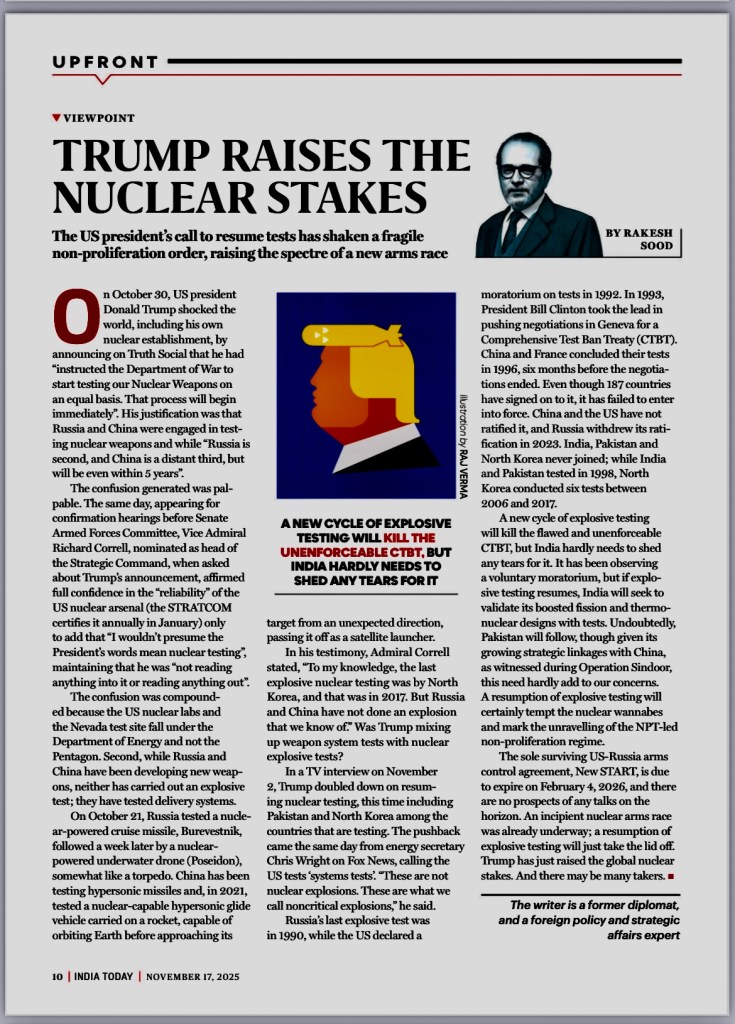
Donald Trump Shakes Up the Global Nuclear Order

Published in the Hindu on November 14, 2025

Today, the global nuclear order offers a curious contradiction – since the bombing of Hiroshima and Nagasaki in 1945, nuclear weapons have not been used during the last 80 years. The global nuclear arsenals have come down from a high of 65000 bombs in late 1970s to less than 12500 today. And, despite concerns in 1960s that by 1980, there may be at least two dozen states with nuclear weapons, the total today remains nine, five (the United States, Russia, The United Ukingdom, France and China) are permanent members of the United Nations Security Council who had tested before the Nuclear Non-Proliferation Treaty (NPT) came into being and four more who developed their nuclear arsenals later (Israel, Pakistan, India, and North Korea).

Looking back, these would seem to be impressive achievements but nobody is celebrating. In fact, the prevailing sentiment is that the global nuclear order is under strain and the U.S. President Donald Trump’s recent announcements may weaken all three elements of the global nuclear order.

Resumption of ‘nuclear tests’

On October 30, 2025, on his way to a meeting with China’s President Xi Jinping in Busan, Mr. Trump announced on Truth Social, “Because of other countries testing programs, I have instructed the Department of War to start testing our Nuclear Weapons on an equal basis. That process will begin immediately.” He added, “Russia is second, China is a distant third, but will be even within 5 years.”

While it was clear that the message was directed at Russia and China, it was unclear whether Mr. Trump was referring to ‘nuclear explosive testing’ or testing of nuclear weapon systems. Second, the nuclear labs (Los Alamos, Lawrence Livermore, and Sandia) and the Nevada testing facilities fall under the Department of Energy and not the Department of War.

It is no secret that China, Russia, and the U.S. are designing and developing new nuclear weapons. On October 21, Russia tested a nuclear-powered cruise missile (Burevestnik) that travelled 14000 kms, following a week later, with a test of an underwater nuclear-powered torpedo (Poseidon). China has been testing hypersonic missiles and, in 2021, tested a nuclear capable hypersonic glide vehicle carried on a rocket, capable of orbiting the earth before approaching its target from an unexpected direction that was passed off as a satellite launcher. The U.S. is producing new warheads – a variable yield B61-13 gravity bomb, a low yield W76-2 warhead for the Trident II D-5 missile, while working on a new nuclear armed submarine launched cruise missile.

Yet they have refrained from explosive testing. Russia’s last explosive test was in 1990 while the US declared a moratorium on tests in 1992. In 1993, the U.S. created a Stockpile Stewardship and Management Programme under the National Nuclear Security Administration to work on warhead modernisation, life extension, and development of new safety protocols in warhead design.  U.S. President Bill Clinton also took the lead in pushing negotiations in Geneva for a Comprehensive Test Ban Treaty (CTBT). China and France concluded their tests in 1996, six months begore the negotiations ended.

Why CTBT lacks a definition

Twenty-nine years later, the CTBT hasn’t entered into force despite 187 countries signing it. Among the necessary ratifications, the U.S., China, Israel, Egypt, and Iran have not done so, Russia did and withdrew its ratification in 2023, and India, Pakistan and North Korea have neither signed nor ratified it. India and Pakistan tested in 1998 and have since observed a voluntary moratorium, and North Korea conducted six tests between 2006 and 2017. Given today’s geopolitics, the prospects for the CTBT entering into force appear bleak.  

Second, the CTBT obliges states “not to carry out any nuclear weapon test explosion or any other nuclear explosion.” The U.S. was opposed to defining the terms, and instead, worked out private understandings with Russia and China on ‘zero-yield-tests;’ this permitted hydro-nuclear tests that do not produce a self-sustaining supercritical chain reaction.

The U.S. had conducted over a thousand nuclear tests and Russia 727 tests, giving them an adequate data base. China though with only 47 tests, also went along with this understanding. Thus, the CTBT delegitimsed only nuclear-explosive testing, not nuclear weapons, the reason why India never joined it.

In 2019-20, the U.S. State Department assessed that Russia and China “may have conducted low yield nuclear tests in a manner inconsistent with the U.S. zero-yield standard” though this was negated by the CTBT organisation that declared that their monitoring network with over 300 monitoring stations spread over 89 countries had not detected any inconsistent activity.

In a TV interview on November 2, Mr. Trump doubled down on resuming nuclear testing, this time including Pakistan and North Korea among the countries testing. A clarification came the same day from energy secretary Chris Wright on Fox News, calling the US tests ‘systems-tests’, “These are not nuclear explosions. These are what we call noncritical explosions,” he said. However, Mr. Trump’s intention remains unclear.

Regional and global implications

The new low-yield warheads being designed make them more usable and the new systems (hypersonics, cruise and unmanned systems) are dual capable systems, leading to renewed research for missile defences like the U.S. ‘golden dome.’ Meanwhile doctrinal changes are being considered to cope with new technological developments in cyber and space domains. This raises doubts about the nuclear taboo in coming decades.  

The sole surviving US-Russia arms control agreement, Ner Strategic Arms Reduction Treaty (New START) that limits the U.S. and Russian strategic forces to 700 launchers and 1550 warheads is due to expire on Feb 4, 2026 with no prospects of any talks on the horizon. China is not a party to any arms control and its nuclear arsenal that had remained below 300, is undergoing a rapid expansion, estimated at 600 today and likely to exceed 1000 by 2030. An incipient nuclear arms race was already underway; a resumption of explosive testing will just take the lid off.

Russia and China have denied Mr. Trump’s allegations regarding clandestine tests but will follow if the U.S. resumes explosive testing; China will be the biggest beneficiary because with only 47 tests (compared to over 1000 by the U.S.), resumed tests will help it to validate new designs and accumulate data.

India has been observing a voluntary moratorium but if explosive testing resumes, India will certainly resume testing to validate its boosted fission and thermonuclear designs, tested only once in 1998. Undoubtedly, Pakistan will follow but given its growing strategic linkages with China witnessed during Op Sindoor, this need hardly add to our concerns.

Though the CTBT is not in force, it did create a norm. But a resumption of explosive testing will lead to its demise. It will also tempt the nuclear wannabes to follow and mark the unravelling of the NPT led non-proliferation regime.

The taboo against use must remain intact

The U.S. has been the most significant player in shaping the global nuclear order; it would be ironical if Mr. Trump’s actions now become the catalyst for its demise. The reality is that the present global nuclear order was shaped by the geopolitics the 20th century; the challenge today is to craft a new nuclear order that reflects the fractured geopolitics of the 21st century while ensuring that the taboo against their use remains intact.  

The UN Secretary General has cautioned that “current nuclear risks are already alarmingly high” and urged nations “to avoid all actions that could lead to miscalculation or escalation with catastrophic consequences.”  But is anyone listening?

*****

The Turmoil in Kathmandu, the Road Ahead for Nepal

Published in the Hindu on Sptember 27, 2025

The Gen Z protests that erupted in Kathmandu on September 8, 2025,  snowballed rapidly, taking the Nepali government by surprise. The excessive police reaction led to an explosion of public anger, and the rapidly evolving situation forced Prime Minister K. P. Sharma Oli to quit the following day, creating a vacuum that even the Gen Z protestors were unprepared for.

Following talks between the Gen Z representatives and the Chief Of Army Staff Gen A. R. Sigdel, former Chief Justice Ms Sushila Karki was sworn in as Interim Prime Minister on September 12, with the mandate to conduct fresh elections within six months. The current parliament has been dissolved, an apolitical cabinet of  experts is taking shape, and calm has returned to the streets.

Elections have been fixed for March 5, 2026 but questions persist. How will the Gen Z organise themselves around a political platform? Will the established political parties be ready? Meanwhile, suggestions are afoot for amending the constitution but this may open a Pandora’s box in the absence of process legitimacy.  

A turbulent phase in India’s neighbourhood

The decade of the 2020s has witnessed political changes in India’s neighbourhood – in February 2021, the experiment with democracy in Myanmar collapsed as the military assumed full control; later in 2021, the Taliban returned to Kabul as the U.S. withdrew from Afghanistan; in mid-2022, the Aragalayamovement in Sri Lanka forced President Gotabaya Rajapaksa to flee the country; in Pakistan in May 2023, the arrest of former Prime Minister Imran Khan led to widespread protests but the military took charge of the situation; and, in August 2024, protests in Bangladesh gathered momentum forcing PM Sheikh Hasina to quit and leave Dhaka. Hardly surprising that analysts would look for patterns that can fit their models or conspiracy theories.

However, each of these changes has its own history. Sheikh Hasina had been in power since 2009 and the recent elections had been disputed even as she cracked down on the opposition. In Sri Lanka, the Rajapaksa family had been ruling since 2004 with a short interregnum. Myanmar and Pakistan have had long spells of military rule; the military has remained in the driver’s seat – openly as in Myanmar or behind the scenes, as in Pakistan. Afghanistan followed the familiar pattern of failed interventions by the United States – since Vietnam in the 1960s, and in 2021, when it had become apparent that continued U.S. presence in Afghanistan would not help matters.  

If there are similarities, these are primarily the dominant role played by the youth in the protests and secondly, the higher levels of youth unemployment compared to the total unemployment in these societies. While overall unemployment levels in Bangladesh, Nepal and Sri Lanka are between 4-5%, youth unemployment is above 16% and in Nepal, above 20%. Politically, Sri Lanka and Bangladesh have had political stability given long tenures of the Rajapaksa brothers and Sheikh Hasina respectively but this led to nepotism, corruption and increasing disdain for democratic accountability.

Nepal’s political transition

In contrast, Nepal’s political trajectory has been different with frequent government changes. Since 2015, when the constitution was adopted, there were seven governments but with the same leaders playing musical chairs, UML leader Oli thrice and both Maoist leader Prachanda and NC leader Sher Bahadur Deuba, each twice. It created a curious internal stability where cronyism, nepotism and corruption flourished, within the outward instability that prevented job growth and economic development.

Nepal’s political transition began 35 years ago. The 1990 Jan Aandolan replaced Panchayati Raj with multi-party democracy and circumscribed the monarchy to a constitutional role. However, intra-party rivalries provided fertile grounds for the monarchy to play favourites. A Maoist insurgency surfaced in 1996 and over a decade, gradually engulfed large parts of the country claiming 17000 lives.

It took 17 years before the political parties came together to work out a peace process that permitted the Maoists to come overground and emerge as a political party. During this period, there were 15 changes of government and one spell of direct rule by King Gyanendra that sparked the second Jan Aandolan in 2006, forcing him to restore parliament and the elected government.

In 2008, an elected Constituent Assembly declared Nepal to be a republic ending the 240-year-old monarchy and began drafting a constitution for a federal republic. Instead of the given two-year deadline, the constitution was promulgated after seven years in 2015. More time was spent on government formations and these seven years witnessed six PMs. Maoist leaders served twice, UML leaders twice, NC once and an interim government was created under Chief Justice Khil Raj Regmi for electing a second constituent assembly in 2013. 

The 1990 and 2006 Jan Aandolans were spearheaded by the political parties to wrest political power from the monarchy but the 2025 Gen Z protests reflect a broader frustration with political leaders of all political parties, for misusing coalition politics for amassing personal wealth.

President Ram Chandra Poudel has reiterated that he will observe the constitution and has sought to justify concerns about the appointment of an Interim PM by citing Article 61. Art 61 merely directs the President to “promote the national unity” and “to abide by and protect the Constitution”. Since a state of national emergency was not declared, Gen Sigdel played a political role in identifying and holding consultations with the Gen Z representatives. The army also moved the targeted leaders and Ministers into military cantonments for their security. Clearly, Mr. Poudel depended on the army because it is the only institution that enjoys social respect.

Ms. Karki has identified three priorities for the Interim Government – to ensure elections on March 5; to fix accountability for the use of excessive force by the police and the arson and vandalism; and to expose and prosecute corruption in high political office. The last two will be difficult as there are reports of politically affiliated gangs infiltrating the Gen Z protests, and fast track prosecutions in Nepali justice system are unheard of.

There is a growing sentiment that the 2015 constitution that introduced a 275 member House of Representatives with First Past The Post (165 seats) and Proportional Representation (110 seats) somehow prevents the emergence of a majority government. Other ideas doing the rounds are to introduce a directly elected executive, and do away with federalism by empowering local bodies. Pushing such ideas through a constitutional commission and national referendums could create more difficulties. Any dilution of federalism or Proportional Representation system is bound to spark protests among the Madhesis, Janjati and Tharu communities.

Such moves into uncharted political territory and questionable legitimacy run contrary to Mr. Paudel’s assurance of abiding by the constitution and may jeopardise the election schedule. The established political parties need time for internal leadership churn that the old timers will resist. New political forces led by youth leaders will emerge and it is likely that some pro-monarchy elements may also sense an opportunity to recover lost ground.

Focus should be on fair elections

Fortunately, India has escaped criticism in Nepali media in connection with the current political turmoil. The restrained official statements and the phone call by Prime Minister Narendra Modi on September 18, to congratulate Ms. Karki, convey condolences at the loss of life, and assure full support to Nepal, keeps communication channels open.  

Peaceful, free and fair elections on March 5 would be best way forward for Nepal; any other ambitious moves by vested interests would only increase uncertainties generating an atmosphere of mistrust and insecurity in which the political gains of the last two decades towards a more democratic and inclusive Nepal would be at risk.

*****