Neighbourhood First Series – The Afghanistan Peace Process
Reply

Published in The Hindu on 10th October, 2020
All elections are unpredictable and American presidential elections are no exception. Yet, such is power of incumbency that there have been only four occasions since 1900 where a sitting and elected President has been defeated by his challenger for a second term. The 2020 election was shaping up to be cliff-hanger when President Donald Trump announced Friday last week that he and First Lady Melania Trump had tested positive for COVID-19, further darkening the clouds of uncertainty. He returned to the White House after three days of hospitalisation but question marks persist.
One term presidencies
In 1912, Democratic challenger Woodrow Wilson scored a decisive victory over President William Taft, seeking his second term. However, the reason was a divided Republican vote. President Theodore Roosevelt, the US president from 1901 to 1909 had supported Taft for his first term. Subsequently, he got disenchanted and eventually split the Republican party, running as the candidate of newly established Progressive party, and coming second in the race. Taft, already weakened with the infighting in the Republican party, emerged a distant third.
The second one-term president was Herbert Hoover, defeated in a landslide victory by his Democratic challenger Franklin Roosevelt in 1932. This election was fought against the backdrop of the Great Depression. Roosevelt won on the promise of the New Deal and then went on to win in 1936, 1940 and 1944. By the time he began his fourth term in January 1945, he was already suffering from high blood pressure and congestive heart disease and died three months later. Till then, there was no restriction on the number of terms for president; the two-term limit was introduced with the 22nd constitutional amendment in 1951.
In 1976, Democratic challenger Jimmy carter defeated President Gerald Ford who had taken over the presidency after president Nixon resigned when faced with the threat of impeachment. He had earlier been appointed (not elected) Vice-President in 1973 when Vice-President Spiro Agnew resigned. In US history, Ford is the only one to have held both positions of Vice-President and President without having won an election to either.
1970s was a decade marked by an energy crisis sparked by oil price hikes, high inflation, economic downturn and rising unemployment. The US Embassy hostage crisis in Tehran in 1979 following the Islamic revolution in Iran became emblematic of eroding confidence among the people that made it easier for Republican challenger Ronald Reagan to trounce Democratic incumbent President Jimmy Carter in 1980. Democratic party was already polarised as Senator Ted Kennedy had challenged President Carter in the party primaries.
Both 1932 and 1980 also marked deeper power shifts; in 1932, Democrats took back Congress continuing till 1950s, introducing social security; the 1980s saw the return of the Republicans with promises of tax cuts and supply side economics.
The last one term president in the 20th century was George H W Bush who had won easily in 1988 after being Reagan’s Vice President for eight years. He lost his re-election bid to rank newcomer, Democratic challenger Bill Clinton in 1992 despite having notched up a series of foreign policy successes during the first term – Soviet withdrawal from Afghanistan followed by the unification of Germany and the break-up of the Soviet Union. “It’s the economy, stupid”, became the catchphrase of the successful Clinton campaign.
Unresolved questions
The handling of the COVID-19 pandemic was going to be an issue but President Trump testing positive raised a bunch of fresh questions – about implications for continuity for government, and, for the election campaign leading to polling on 3 November and its follow-through till the winner takes office on 20 January 2021.
Presidential succession to ensure continuity of government was addressed in the 25th constitutional amendment (1967), triggered by the 1963 assassination of President Kennedy. In case a president dies, resigns or is otherwise incapacitated, the succession moves to the Vice President, and then on to the Speaker of the House, the president pro tempore of the Senate and the members of the Cabinet beginning with the Secretary of the State.
Campaign continuity is more uncertain. Elections are held every four years in November on the Tuesday after the first Monday of the month. Changing the date would need bipartisan consensus, hardly likely when the country is in the throes of a campaign. This year, the popular election on 3 November will be followed by the 538-member Electoral College voting on 14 December.
Congress will certify the Electoral College vote on 6 January 2021 officially declaring the president (and vice-president) who will assume office at the inauguration on 20 January. During this, when exactly does the winning candidate become “president-elect” is a question on which legal experts still differ.
There is no legal guidance in case a candidate dies or is unable to campaign shortly before the November polling or anytime thereafter. For 2020, in any event, the ballot papers are already printed and millions of postal ballots were cast when the question surfaced.
Were a vacancy to arise after 3 November, the Electoral College will be guided by the two political parties since the primaries process of anointing candidates is their jealously guarded preserve. Under the circumstances they may just find it expedient to bump up the VP to fill the presidential slot but how the VP slot will then be filled remains uncertain.
Tight race or landslide
How will this uncertainty play out in 2020? President Trump returned to the White House on 5 October and two days later was back in the Oval Office announcing that he had recovered fully. Doctors described the cocktail of drugs administered to the president as an experimental therapeutic.
Trump has refused to participate in any virtual TV debates with Biden, a decision announced by the bipartisan Commission on Presidential Debates after he tested positive. The first TV debate had been variously described as “chaotic”, “a shit show” and a “wrestling bout in a mud-pit”, none an edifying label.
More than once, Trump expressed scepticism about the integrity of postal balloting warning that the issue would have to be decided by the Supreme Court. When asked about a peaceful transition of power, he generated controversy with, “we are going to have to see what happens”. This is one reason that Trump is keen to push through the appointment of Judge Amy Coney Barrett to the Supreme Court to replace late Judge Ginsburg, widely seen as a moderate and a liberal voice.
Earlier, ratification of federal judicial appointments was approved not by a simple majority but a larger (filibuster proof) majority of 60. This invariably meant getting support from across party aisles. However, growing polarisation and politicisation of judicial appointments in recent decades often led to prolonged impasses and nominations had to be withdrawn. In 2013, then Democratic Senate majority leader Harry Reid worked out a deal to permit judicial appointments for Circuit and Appeal Courts to be cleared by simple majority of 51. It boomeranged when the Republican Senate leader Mitch McConnell employed the same ‘nuclear option’ to approve the appointment of Judge Neil Gorsuch to the Supreme Court in 2017 and is threatening to use it again.
Surveys and reality
In all four instances of single term presidencies, the challenger won a decisive victory and in three instances, a landslide victory. Most opinion polls indicate a lead (not landslide) for Democratic candidate Joe Biden but polls can be notoriously misleading; even in 2016, Hillary Clinton led in the polls even winning more popular votes but losing the electoral college.
It is also impossible to predict whether the pandemic will catalyse a cyclical shift seen in 1932 and 1980. Just as there are old time Republicans who wish they had another candidate instead of Trump, many staunch Democrats wonder whether Biden will be sufficiently committed to their progressive agenda. Which party is more fractured internally remains speculative.
Amid the growing uncertainty, only a decisive victory on 3 November will show that US democracy has developed immunity from COVID-19.
Published in The Hindu on 29th of September, 2020
I first met Jaswant Singh in the days following India’s nuclear tests on 11 and 13 May 1998. As the MEA official dealing with nuclear issues, I was to draft PM Vajpayee’s address to parliament due to open on 27 May while handling the flood of communications with our Embassies and outreach with Delhi-based Embassies and media.
Every few days, Vajpayee would convene a meeting to take stock of the international fallout and Jaswant Singh, then Deputy Chairman of the Planning Commission, was a permanent invitee. As the draft speech and the nuclear policy paper went back and forth, Vajpayee’s trust and regard for him soon became evident. Jaswant Singh had spent under a decade in the army but clearly had studied and thought deeply about India’s security dilemmas and challenges. He also had a vision of 21 st -century India that Vajpayee shared. Hardly surprising, then, that the following month, he was entrusted with the responsibility of opening dialogue with the USA, a daunting task because the Clinton administration had come down heavily on India, taking the lead in the UN Security Council in drafting a highly critical resolution and imposing sanctions.
Bill Clinton had originally planned a visit to India in early 1998, postponed to late 1998 because of the elections that brought the Vajpayee government to power. The nuclear tests left the US administration stunned and embarrassed. Jaswant Singh was visiting New York for a UN meeting in early June; a message was conveyed to the White House that he would be available to come to
Washington for talks. While he was not Foreign Minister, he held cabinet rank as Deputy Chairman of the Planning Commission. Secretary of State Madeleine Albright was travelling, so it was appropriate that Deputy Secretary of State Strobe Talbott (who would be acting Secretary) could engage the visitor.
And thus began the dialogue between India and the USA, an engagement that is best described as the most intense, the most inconclusive and yet, the most productive. After 16 meetings between June ’98 and September 2000 in seven cities, the tide turned with the highly successful Clinton visit in March 2000 and Vajpayee’s return visit in September when Clinton hosted his largest state dinner at the White House. From “estranged democracies”, India and the US became “natural partners for the 21st century”. I was privileged to be a part of the team and consider it a masterclass in diplomatic negotiations.
The US position was guided by progress on five benchmarks for India that were also part of the UN Security Council resolution – sign the Comprehensive Test Ban Treaty that had been concluded in 1996; join the Fissile Material Cut-off Treaty negotiations being pushed in Geneva; accept a freeze on developing nuclear arsenal; tighten export controls on sensitive materials and technologies; and engage in dialogue to reduce tensions with Pakistan.
Jaswant Singh took Vajpayee’s speech and the nuclear policy paper tabled in parliament as his reference frame. He elaborated on India’s security concerns, elements of credible minimum deterrence as evidence of India’s restraint, adoption of a no-first-use use policy to ensure stability, voluntary declaration of a moratorium on further nuclear testing and India’s continuing commitment to responsible non-proliferation despite not being party to the NPT.
While both agreed that neither was looking for short cuts, Strobe emphasised compliance with the benchmarks while Jaswant focussed on securing better appreciation of India’s security compulsions that would compel any democratic government to do what India had.
Ramrod straight, beetle-browed, wearing his trademark army-style khaki bush shirt, Jaswant Singh’s most distinctive feature was his resonant baritone that he used equally skilfully, to make a short, decisive point and close a discussion or to spin long, complex sentences to stymie an inquisitive journalist or leave his interlocutor pondering.
Another hallmark was his recourse to homespun aphorisms. In the early days of his dialogue with Strobe, Jaswant cited an old saying, “There is merit in asking for directions only if we know the village we are going to”. As Strobe later acknowledged, “Jaswant’s strategy was more directional than destinational” and laid the grounds for the lifting of sanctions, introducing the Next Steps in Strategic Partnership leading to the 2008 civilian nuclear deal.
On another occasion in Manila in July 1998, we had our first meeting since the tests with the Chinese on the margins of the ASEAN Regional Forum. The meeting began frostily, with Foreign Minister Tang Jiaxuan blaming India for itsprovocative actions. He added, “There is an old Chinese saying – he who ties a knot must untie the knot”. Jaswant arched his eyebrows and said, “In my
village in Rajasthan, we too have a saying – it takes two hands to untie a knot”.
The meeting with Tang, scheduled to last for 20 minutes lasted an hour. Before the end of the year, I was in Beijing to lay the ground for a new security dialogue between the two countries.
Rest in peace, valiant soldier, for you did your country proud.
Published in The Hindu on 19th September, 2020
Last week, on 12 September the much awaited intra-Afghan talks between the Taliban and the Afghan High Council for National Reconciliation opened in Doha, nineteen years after the 9/11 attacks on US homeland that stunned the world and marked the beginning of the US war in Afghanistan against Al Qaeda and the Taliban, its local sponsors. The initiation of intra-Afghan talks was a key element in the US-Taliban peace deal signed in Doha on 29 February between US Special Representative for Afghanistan Reconciliation Ambassador Zalmay Khalilzad and Taliban deputy leader Mullah Abdul Ghani Barader. Originally planned to begin on 10 March, the process had to overcome many hurdles along the way providing a small glimpse of the difficult road that lies ahead.
US-Taliban deal
The Trump administration soon realised that its 2017 policy of breaking the military stalemate by a small increase in US troops was not working and soon reverted to seeking a managed exit. As the former Defence Secretary General Mattis put it, “the US doesn’t lose wars, it loses interest”. Political optics demanded a re-labelling of the withdrawal.
Direct negotiations with the Taliban began two years ago with Ambassador Khalilzad’s appointment as Special Envoy. Actually, it became a three-way negotiation. The Doha track was with the Taliban, a second track was with Islamabad/Rawalpindi to cajole the Pakistan Army to lean on the Taliban to get them to the negotiating table and the third was with Kabul to ensure that the Afghan government would accept the Doha outcome.
Originally Ambassador Khalilzad had spelt out four objectives – an end to violence by declaring a ceasefire, an intra-Afghan dialogue for a lasting peace, Taliban cutting ties with terrorist organisations like Al Qaeda, and US troop withdrawal. Within months, the Taliban had whittled these down to just the last one with some palliatives regarding the third. Instead of an Afghan led,
Afghan owned and Afghan controlled reconciliation, it had become a US led and Taliban controlled process with nobody claiming ownership or responsibility.
Time lines were fixed for the US drawdown by mid-June (followed by complete withdrawal by April 2021) and for removal of Taliban from the UN Security Council sanctions list by end-May. The Taliban have released 1000 members of Afghan security forces and the Afghan authorities have freed over 5000 Taliban from their custody. This process took longer than originally foreseen but has now been completed. The two elements that remained open ended in the US- Taliban deal are the ceasefire declaration and the intra-Afghan talks.
The uncertainties ahead
By end-June, US had reduced its troop presence to 8600 as promised and in early September, CENTCOM commander Gen Kenneth McKenzie indicated that by November the numbers would be down to 4500. Despite two brief 3 day truces in May and August for Eid al Fitr and Eid al Adha, the levels of violence showed no respite. Speaking the Doha at the opening session, Dr Abdullah
Abdullah, Chairman of the High Council regretted that more than 12000 Afghans had been killed and another 15000 injured since end-February. The number of attacks on government security forces and installations averaged over eighty a week.
A report by the US Special Inspector General for Afghanistan Reconstruction issued in July covering the second quarter of 2020 assessed that “the Taliban has calibrated the use of violence to continue undermining the Afghan National Defence and Security Forces while keeping it at a level that encourages the US troops to leave”. The report expressed scepticism about whether the Taliban had cut ties with Al Qaeda and stated that “the Islamic State-Khorasan retains the ability to conduct mass casualty attacks”. A UN Sanctions Monitoring Team Report concerning IS and Al Qaeda also issued in July concluded that “Al Qaeda in Indian Subcontinent continues to operate
under the Taliban umbrella in Nimroz, Helmand and Kandahar provinces with 400-600 fighters in the country”.
Perhaps nothing reflects the challenges facing the intra-Afghan negotiations more starkly than the title of the US-Taliban Doha deal – “Agreement for Bringing Peace to Afghanistan Between the Islamic Emirate of Afghanistan which is not recognised by the US as a state and is known as the Taliban and the USA”. This awkward phrase is repeated more than a dozen times in the Agreement. The leader of the Haqqani Network Sirajuddin Haqqani who is also the second in command of the Taliban happens to be on the US wanted list with a reward of $10 million for information leading to his capture or death. All this is difficult to reconcile with the notion that US considers the Taliban a partner in counter-terrorism operations against the IS and other terrorist groups.
In an op-ed in the Washington Post on 14 August, President Ashraf Ghani wrote that “the Afghan people want peace” and that is why the government “made the decision to take another risk for peace”. Calling on the Taliban to sit across from Afghan representatives to arrive at a political resolution, he added that “we acknowledge the Taliban as part of our reality” and urged that “the Taliban must, in turn, acknowledge the changed reality of today’s Afghanistan”.
The current reality is that 74 percent of Afghan population is below 30 and has lived, for most part, in a conservative but open society. However, the Taliban continue to maintain the Kabul administration as an imported Western structure for continued American occupation. Senior members of the Afghan government continue to be targeted including Vice President Amrullah Saleh who narrowly escaped an IED attack on his motorcade (9 September) even as 11 innocent Afghans lost their lives.
Evolving Indian position
Addressing the opening session of the Doha meeting, EAM Dr Jaishankar reiterated that the peace process must be “Afghan led, Afghan owned and Afghan controlled” but Indian policy has evolved from its earlier hands-off approach to the Taliban. Speaking to Indian media a few months ago on separate occasions, both Ambassador Khalilzad and Russian Special Envoy Ambassador Zamir Kabulov bluntly pointed out that if India had concerns regarding anti-India activities of terrorist groups, it must engage directly with the Taliban. In other words, if India wanted to be invited to the party, it must be prepared to get up and dance.
The reality is major powers have limited interests. For the US, the peace talks provide President Trump an exit opportunity weeks before his re-election bid. EU has made it clear that its financial contribution will depend on the security environment and the human rights record. China can always lean on Pakistan to preserve its security and connectivity interests. For Russia, blocking the drug supply and keeping its southern periphery secure from extremist influences is key. That is why no major power is taking ownership for the reconciliation talks but merely content with being facilitators.
A report issued last month by the Heart of Asia Society, a Kabul based think tank observes that “the prospect for peace in Afghanistan depends on regional consensus to support the peace process as much as it depends on actual progress in the intra-Afghan talks”. India’s vision of a sovereign, united, stable, plural and democratic Afghanistan is one that is shared by a large constituency in Afghanistan, cutting across ethnic and provincial lines. A more active engagement will enable India to work with like minded forces in the region to ensure that the vacuum created by the US withdrawal does not lead to an unravelling of the gains registered during the last two decades.
Publication for Institute for South Asian Studies
Summary
India and Nepal enjoy a close, yet complicated relationship. This has, however, gone downhill with the recent border controversy after the latter decided to redraw its map. The increasing dominance of China in the Himalayan state has led to further impediments. It is time for India to employ a broader communication strategy and have a transparent approach to restore the ‘special relationship’ with Nepal which is today interpreted differently by both sides.
Introduction
No two countries enjoy as close and as complicated a relationship as India and Nepal. In recent times though, it is the ‘complicated’ part that has been more on display. On every such occasion, Nepali political leaders invoke the spirit of nationalism with India getting blamed for being insensitive or, worse still, a bully and interfering in Nepal’s internal affairs. A pattern repeated over decades, this has strengthened an anti-Indian sentiment and also distorted perceptions of the positive aspects of the relationship. Both countries need to find a way out of this negative spiral. Partial tinkering will not resolve matters; what is needed is a thorough review enabling a reset that will be beneficial for both countries in the 21st century.
Kalapani Controversy
Recent months have seen a downturn in the relationship, this time triggered by the boundary issue of Kalapani. In May 2020, the Nepal government took an unprecedented step of issuing a new map of the country, that incorporated not only the 60 sq km of territory (Kalapani) on its western border, to which Nepal had first raised a claim in 1996 and about which both countries have had inconclusive discussions, but also added another adjoining 330 sq km by unilaterally changing the tributary of Kali river that constitutes the boundary between the two countries as defined in the 1816 Treaty of Sugauli between Nepal and the East India Company.
After the revised map was issued on 20 May 2020, it was introduced as a constitutional amendment proposal and adopted with overwhelming support. On 18 June 2020, President Bidhiya Devi Bhandari signed it into law. Any suggestions that such an irrevocable move would shrink any room for talks with India were swept aside in the rising swell of Nepali nationalism. Most of the opposition parties also voted in support of the amendment.

The immediate provocation was the virtual inauguration of an 80-kilometre long road from Ghatibagar to Lipulekh pass at 17,000 feet on the India-Tibet boundary. The track has long been the traditional route for Indian (and Nepali) pilgrims to reach Mount Kailash and Mansarovar lake in Tibet. It is also the pass for border trade between India and China since 1954. The road was in the making for a decade and at no stage had Nepal protested about its alignment.
After India issued new maps last November following the changed status of the state of Jammu and Kashmir into two separate union territories of Ladakh and Jammu and Kashmir, Nepal revived its request for holding bilateral talks on the Kalapani issue. Since the new map only dealt with the internal alignment of a provincial boundary and nothing changed in so far as the boundary with Nepal was concerned, the Indian response was lukewarm. India later suggested that meetings could take place after the COVID-19 crisis was over and regular travel between the two countries was restored. Since the road passes through Kalapani, Nepal interpreted it in May 2020 as a ploy by India to claim Kalapani.
Politics and History of Kalapani
However, the politics and history for Kalapani, like for most controversies in India-Nepal relations, is a little more complicated. K P Sharma Oli was sworn in as Nepal’s Prime Minister on 15 February 2018. His autocratic governance style had led to growing unhappiness among the opposition and within his own party but under the new Nepali constitution, a no-confidence motion cannot be admitted for the first two years. Political rumblings began in March 2020 and gradually, a move began within the Nepal Communist Party (NCP) to implement a one-person-one-post rule which would require Oli (who is Co-chair of the NCP and Prime Minister) to relinquish one of the posts. In end-April 2020, Oli issued two ordinances designed to help him out of his predicament but mounting public criticism forced him to withdraw these. A temporary truce with other NCP leaders was managed, with Chinese Ambassador Hou Yanqi playing a visibly active role in the rapprochement.
At such a moment, the controversy with India over territory was a political lifeline for a beleaguered Oli. He promptly donned the mantle of Nepali nationalism, vowing to restore Nepal’s territory. As a result, rumblings within the NCP subsided but these are likely to resurface and Oli will once again blame India for plotting his ouster.
Oli’s relationship with India is marred by mistrust. India had brokered the deal following the 2013 election between the Nepali Congress and the United Marxist Leninist (then headed by Oli) that split the prime ministership period between the two. However, India’s urging in September 2015 to delay the adoption of the new constitution to accommodate Madhesi demands was seen by Oli as a turnaround by India. He manoeuvred a deal with the Maoist party (the two merged before the 2017 election to form the NCP) and first took over a prime minister in October 2015. Faced with growing Madhesi protests, which often turned violent in the Terai (areas bordering India), against the constitution, movement of trucks from India to Nepal came to a halt. Oli accused India of mounting an economic blockade while India called it a disruption in supplies caused by the deteriorating security situation. The result was an acute shortage of essentials like liquefied petroleum gas, petrol, diesel, medical supplies and so on. As a landlocked country, Oli turned to China to negotiate access routes. After a few months, India relented and the situation was restored. In 2017, Oli successfully used his Nepali nationalist credentials of having stood up to India and led the NCP to a convincing electoral victory.
The history of Kalapani is equally mixed up. In the early years of the 19th century, Nepal’s territorial expansion brought it into conflict with British India and the resulting Anglo-Nepal war ended with the 1816 Treaty of Sugauli. The western boundary is defined as the Kali river which arises in the Himalayan mountains. No maps or coordinates are attached. The problem arises north of Garbyang village where a number of tributaries join to flow southward as Kali. Which of these tributaries is to be labelled as Kali? Survey maps of this period have kept changing with improved techniques and access to the remote area. However, as early as 1817, an exchange of letters makes it clear that Nepal’s attempt to lay claim to the villages Nabi and Kuti by using the western tributary as the Kali river was rejected (See Annex A). The subsequent survey maps indicated that the origin of the Kali river was the Kalapani springs, thereby giving the river its name.
“The whole of Kumaon became British territory and the only point in dispute was a small and unimportant tract to the north. By treaty the Kali was made the boundary on the east, and this arrangement divided into two parts parganah Byans, which had hitherto been considered as an integral portion of Kumaon as distinguished from Doti and Jumla. In 1817, the Nepal Darbar, in accordance with the terms of the letter of the treaty, claimed the villages of Tinkar and Changru lying to the east of the Kali in parganah Byans, and after inquiry had shown that the demand was covered by the terms of the treaty possession was given to Bam Sah, who was then Governor of Doti. But not satisfied with this advantage, the Nepalese claimed the villages of Kunti and Nabhi as also lying to the east of the Kali, averring that the Kunti Yankti or western branch of the head-waters should be considered the main stream as carrying the larger volume of water. Captain Webb and others showed that the lesser stream flowing from the sacred fountain of Kalapani had always been recognised as the main branch of the Kali and had in fact given its name to the river during its course through the hills. The Government therefore decided to retain both Nabhi and Kunti, which have ever since remained attached to British Byans.” (1)

However, Nepali narrative often suggests that British India wanted to keep the Lipulekh pass with it in order to control Tibetan trade and hence redrew survey maps later. Nepal was not in a position to do much about it.
A new complication arose when the Nepali royalist regime, nervous after Maoist China’s takeover of Tibet in 1950, sought Indian assistance to man the Nepal-Tibet border. Eighteen border posts were set up and Nepal maintains that India removed all except one and this was on the basis of a tacit understanding between King Mahendra and Prime Minister Jawaharlal Nehru. However, this seems unlikely because King Mahendra was quite adept at balancing India and China. With deteriorating relations between India and China from 1959 onwards, he moved in 1961 to settle Nepal’s boundary with China which begins near Tinkar pass. This point is about 10 km further east of Lipulekh pass, reflecting the Indian perception of the India-Nepal boundary alignment.
The ground reality is that India and Nepal share an open border that allows for the free movement of people. Given the lack of infrastructure, the road would be seen as benefitting people on both sides of the border and consequently, its alignment did not raise concerns during the decade-long construction phase but became a convenient emotive issue at a time of domestic political instability. The inauguration of the road by the Indian Defence Minister, Rajnath Singh, on 8 May 2020 provided a ready catalyst.
Political Instability and Brinkmanship
The Kalapani background provides an illustration of how Nepal’s relations with India often get woven into its domestic politics and result in brinkmanship with India. This tendency is more visible in times of political uncertainty. Nepal’s political transition to a multiparty democracy, which began in 1990 has been a tortuous process. The tussle between political parties and the Palace, a decade long Maoist insurgency and emergence of new political forces finally led to a new constitution in 2015. The 250-year-old monarchy was abolished and Nepal was declared a federal republic with seven newly created provinces. The first election under the new constitution, held in 2017 made Oli the 26th Prime Minister in these 27 years, a clear indicator of the turbulent domestic politics of Nepal’s transition to democracy.
Yet, these peculiar aspects have been part of the relationship from the outset; it is just that these have now become more toxic. All political leaders when facing domestic persecution have found asylum in India, including the Maoist leaders when they were underground. This is not a new phenomenon. King Tribhuvan, whose powers had been constrained by the Rana regime, had sought asylum in the Indian Embassy with his family in 1950. However, this is what draws India into Nepal’s domestic politics. Hence, there is no surprise that the peace deal to end the decade-long Maoist insurgency in 2005-06 was brokered by India.
The Palace was adept at using the cover of Nepali nationalism for its manipulations of political factions in Nepal, frequently painting inconvenient politicians as “pro-Indian”. However, the Palace took care to maintain a relationship with Indian elites to ensure that communication channels remained open and brinkmanship did not make a situation irretrievable. It provided a degree of continuity in the relationship even with frequent changes of prime ministers. This is one reason why the 1950 Treaty of Peace and Friendship came into being and the unique institutional ties between the armies of both countries have contributed to the special relationship.
India-Nepal Special Relationship
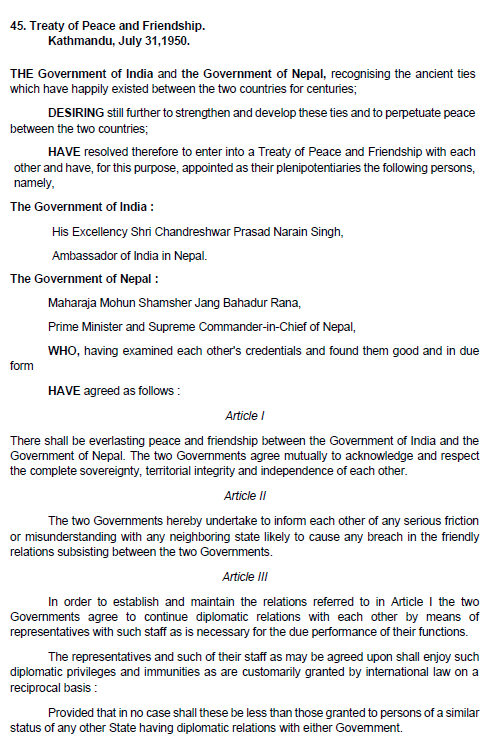
The strong people-to-people relationships are rooted in a shared religion, language and culture and further cemented with ties of kinship. At a political level, it is reflected in the 1950 Treaty of Peace and Friendship. Today, this treaty is resented by large sections of the Nepali population who consider it an unequal treaty. Most Nepalis are unaware that it was Nepal’s rulers who had pushed for this treaty in order to maintain special ties with independent India that they had enjoyed with British India. A key driver was that Nepal’s security concerns had been heightened by the Maoist revolution in China in 1949 and its subsequent takeover of Tibet.
This treaty provides for an open border between India and Nepal and enables Nepali nationals to work in India without a work permit and enjoy ‘national treatment’ with regard to engaging in commercial and economic activity such as purchase of property, opening of bank accounts etc. Nepali citizens are allowed to apply for all government jobs in India except for the Indian Foreign Service, Administrative Service and the Police Service. Nepali citizens can join the Indian armed forces as commissioned officers and they have risen to the ranks of two-star generals. These provisions are extended to Nepali nationals on a non-reciprocal basis. Informal estimates put the number of Nepalis working and living in India at five million.
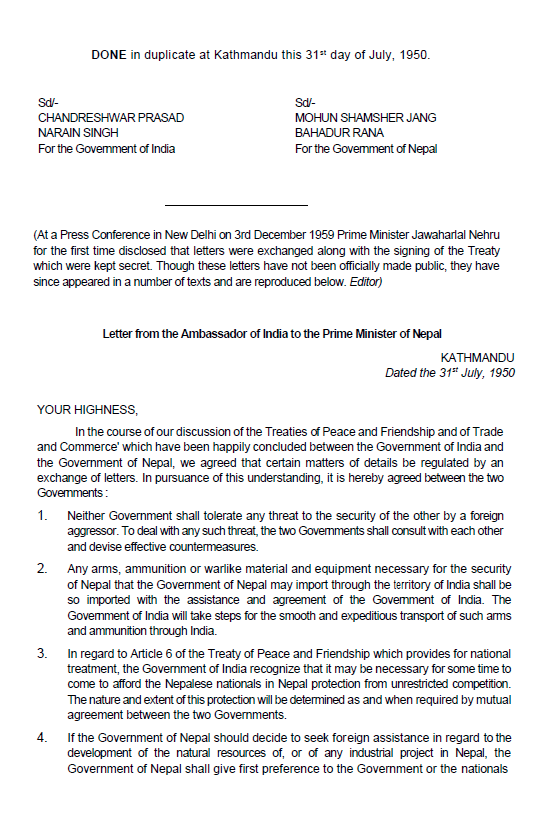
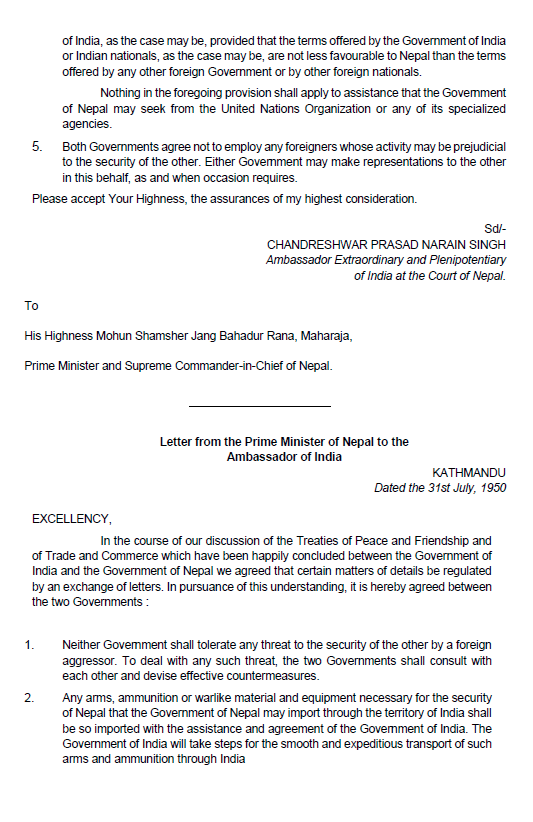
The treaty also has ‘secret’ side letters that were exchanged which have no longer been secret for over 50 years (See Annex B). These letters required Nepal to consult India on its defence requirements and provided India with the right of first refusal for projects relating to exploitation of natural resources, both of which Nepalis perceive as unfair. In actual practice, these provisions are no longer observed. For over a quarter century, India has repeatedly agreed to requests by successive Nepali prime ministers to review and update the treaty. Yet, each time the issue is suggested for inclusion in a bilateral agenda, Nepal prefers to sidestep the issue.
The 1950 treaty was drawn primarily from the 1923 treaty between Nepal and British India. The difference is that British India was an imperial entity. India inherited the role in 1947. However, it was not a super power as imperial Britain but a large poor country struggling to build its institutions and also a democracy that wanted to be perceived as a good neighbour. The dichotomy has proven difficult to reconcile, often leading to ups and down in India’s relations with Nepal. Interestingly, the same dichotomy has existed with respect to Bhutan but has been managed more successfully. The 1949 Treaty of Friendship with Bhutan was a legacy document and was replaced by a new treaty in 2007 with the introduction of a parliamentary democracy in Bhutan.
Another unique aspect of the close ties is the institutional relationship between the defence forces of the two countries. British India had begun recruiting Gurkhas into its army after the 1816 Treaty of Sugauli. In 1947, four of the 11 regiments became part of the British army and the other seven became part of the Indian army. A trilateral agreement between the United Kingdom, India and Nepal, signed in 1947. enabled India to continue recruiting Nepali Gurkhas for these regiments, which today consist of 39 battalions. The Maoists had sought to block this but local demand forced them to revise their stand. While annual recruitment is approximately 1,300, there are 125,000 ex-soldiers in Nepal who receive pensions and other benefits routed through the Indian Embassy in Nepal. Since 1950, both sides have a tradition of the Army Chief of one country being made an honorary general of the other army too.
Till the 1990s, there were no Nepali security personnel deployed on the 1,751 kilometre-long border. In 1996, Nepal deployed 410 army personnel to protect customs offices and other sub-offices in the Terai from Maoist insurgents. In 2001, India deployed a para-military force, Sashastra Seema Bal (SSB) on the India-Nepal border to enhance a sense of security in the border region, tackle problems of smuggling, narcotics, fake currency, trafficking of women, illicit weapons and also cross border movement of criminals. With the establishment of its Armed Police Force, Nepal set up 22 border observation posts in 2007 to coordinate activity with the 450 SSB posts. Today, Nepal has 123 posts and after issuing the new map, announced a decision to increase these by 100 next year and then gradually up to 500, to match the 533 posts currently maintained by the SSB. The growing presence of the security forces is bound to create an irritant for the people who have been used to free and unfettered movement.
Notwithstanding the political ups and downs, economic ties historically determined by geography and connectivity have grown. Two-thirds of Nepal’s foreign trade is with India, which also accounts for half the foreign direct investment into Nepal. The Nepali currency is pegged to the Indian rupee, giving it greater stability. India provides over 3,000 scholarships every year to Nepali students for high school, college and university education.
India has also maintained an extensive development cooperation programme in Nepal, building roads and highways, optical fibre links, medical colleges, trauma centres, polytechnics, schools, health centres, bridges and solar electrification in remote villages. For flood protection and embankment construction in Nepal, India provides more than US$10 million (S$13.9 million) every year. To facilitate cross-border movement of people and goods, India is providing US$40 million (S$55.7 million) to build four Integrated Check Posts on the border, US$100 million (S$139.3 million) to extend five railway lines into Nepal and another US$100 million (S$139.3 million) to enhance the road network in the Terai region, where rivers and streams during monsoon months hamper movement.
A lot of Indian assistance is geared to reach out into the rural areas. A three decade-long programme of providing iodised salt to be distributed to the remotest areas has virtually eliminated iodine deficiency disorders like goitre that were widespread. Every year, Indian doctors conduct more than 400 diagnostic and surgical camps in rural areas for treating cataract and trachoma patients. Nearly 500 ambulances and 100 school buses have been given to primary health centres and schools in remote areas.
Disbursements of pensions, medical and social welfare programmes to the 125,000 ex- servicemen and their families cost US$1.7 billion (S$2.3 billion) annually. Following the 2015 earthquake, Indian disaster relief teams became the first responders, reaching the affected areas within two days, while the Indian government pledged US$1 billion (S$ 1.3 billion) for reconstruction. Such programmes ensure a positive people-to-people relationship which is in contrast to the anti-Indian narrative that periodically emerges from Kathmandu; aggravated during periods of political infighting.
Nepali Nationalism and a New China
Nepal’s mountainous geography has made for a highly diverse and stratified society. It has traditionally been ruled by the hill upper castes (Bahuns and Chettris) that constitute 29 per cent of the population. Together with the five per cent of Newars, these are the more prosperous, urbanised elite. The indigenous hill tribes (Magars, Gurungs, Rais, Limbus and Tamangs) are 30 per cent. The Terai based population is 25 per cent Madhesis (with similar caste structures as on the Indian side of the border leading to close kinship ties), four per cent Muslims and seven per cent Tharus (indigenous plains tribals). Till 1958, the Madhesis needed a permit to enter the Kathmandu valley. Leadership of the traditional political parties has invariably been drawn from the hill elites. Rising political consciousness among the Madhesis and tribals became the driving force behind identity politics in recent decades and behind the demand for a federal structure when the new constitution was being drafted.
Frequent recourse to the anti-Indian narrative by Nepali politicians when they are in opposition and the need to blame the government for being pro-India has imposed an economic cost because the roles of government and opposition get reversed fairly soon and the story keeps repeating. An example is the hydel sector. Nepal today has a power generation capacity of 1,000 megawatts (MW) and needs to import 500 MW from India to meet domestic demand even though it has a hydel potential of over 50,000 MW. On the other hand, Bhutan has an installed generating capacity of 1,500 MW and exports three-fourths to India, which has boosted its per capita income to four times that of Nepal.
One aspect that has changed in Nepal is China’s growing presence and role. Nepali leaders, beginning with King Mahendra in the 1960s, have been adept at playing the China card to extract a better bargain from India. China maintained good relations with the Palace and this enabled it to address its security concerns regarding the Tibetan refugee community’s activities. For the rest, its consistent advice to Nepali leaders was to maintain good relations with India, given its close links. With the abolition of the monarchy, China has been actively pursuing outreach with the political parties and has begun to play a visible role in domestic politics. Its growing economic weight positions it as a potential development partner and Nepal has enthusiastically joined in the Belt and Road Initiative. Oli’s marked tilt towards China has taken place at a time when China is actively expanding its presence in South Asia and the Indian Ocean region, heightening India’s concerns. This makes it clear that India needs to invest more deeply in its policy towards Nepal as any neglect will extract a higher political cost than was the case earlier.
Need for a Review
The time has come for India to undertake a thorough re-assessment of its Nepal policy and the premises on which it was based. Political instability and a young democracy, abolition of the monarchy, federalism, rising discontent among the Madhesis (and other marginalised groups), a youthful population with a median age of 24 years and a growing Chinese role, have altered the ground realities of Nepal. The current impasse over the new maps has made early resumption of dialogue unlikely. Perhaps this is just as well for it provides India with time to reflect on how it wants to shape its relationship with Nepal to mutual advantage.
Political brinkmanship and frequent recourse to Nepali nationalism has contributed to the narrative of anti-Indianism that India can no longer afford to ignore. Earlier, opposition leaders would whip up nationalist emotions to accuse their government of being pro-Indian and then privately explain it to Indian leaders as the route to gain power while assuring them of fully backing stronger India-Nepal relations once they were in authority. Once in power, as the honeymoon period ends, they would find it difficult to deliver on their assurances, blaming the opposition for queering their pitch. Nepal’s failure to exploit its hydel power potential is a pertinent example of how this has stymied development in this critical sector. In the age of social media, the old ‘wink-and-nod’ style of diplomacy no longer works. Brinkmanship tips over the point of no return as the case of the Kalapani map demonstrates.
Nepal’s intellectual elite attributes its new found assertiveness to its young democracy. Recalling the ‘special relationship’ is often seen as a throwback to earlier years when issues were managed behind the scenes. Frequent reiteration of shared religious, cultural and linguistic ties is perceived as a stifling closeness. Invoking the rhetoric of ‘roti beti ka rishta’ (ties of sharing bread and through cross-border marriages) is increasingly associated with the Madhesis though the hill elites also enjoy significant kinship ties across the border. India needs to employ a more innovative communication strategy based on transparency. Only then can the cobwebs of myths surrounding the ‘unfair’ treaties of the past be removed.
This does not mean disengagement but actually implies engagement at multiple levels, conscious of a new Nepal’s sensitivities. It also means that India should refrain from actions that antagonise the people of Nepal as it learnt in 2015 when the Narendra Modi government was blamed for the ‘blockade’ causing widespread economic hardship. There are two other lessons that India needs to draw from 2015. Rising Madhesi political consciousness has led the hill elite to tag them as Indian ‘fifth columnists’ which does the Madhesis a disservice. Oli successfully projected the Indian blockade as further evidence of Indian links with the Madhesis as they were the ones protesting against the new constitution. Too close an identification with any group that accounts for 25 per cent of the population is not a good position for India to be placed in. The second lesson is that Nepal should be seen as a foreign country and not as a factor to be used in India’s domestic politics. There was a widespread assumption that with Assembly elections in Bihar scheduled for November 2015, a pro-Madhesi posture would help the Bharatiya Janata Party (BJP) which had been trailing. As it transpired, the strategy did not work and when India relented because of widespread criticism, some Madhesi leaders accused India of letting them down.
Some pro-Hindutva elements linked to the BJP believe that shared ties of Hinduism, invoked by talking about Kashi Vishwanath in Varanasi to Pashupatinath in Kathmandu (both old Shiva temples) or Ayodhya in India and Janakpur in Nepal (birthplaces of Ram and Sita), are the permanent glue that bind the two countries. However, this is a delusion. Nepal is a sovereign state and Nepalis are not swayed by religious sentiments when it comes to sensitive sovereignty-related issues. It is worth recalling that an innocuous comment by a popular Bollywood actor Madhuri Dixit some years ago that Nepal seemed much like India was criticised as being a sign of Indian expansionism or that riots had erupted in Nepal when it was alleged that another popular actor, Hrithik Roshan, had made anti-Nepali remarks in a television interview, an allegation that later turned out to be baseless.
The beginning has to be made with the 1950 Treaty of Peace and Friendship which is seen by a majority of Nepalis as a symbol of what is wrong in India-Nepal relations and is at the core of the ‘special relationship’. India should stop going along with the Nepali tactics of blaming India for an ‘unfair treaty’ but shying away from discussing what to do about it because it would push them to acknowledge the special advantages that it provides to Nepal. As the larger country, India needs to make it clear that it will be generous and that it is not seeking to impose reciprocity.
However, all issues arising from the special relationship will need to be put on the table. These would include open borders and visa free travel, non-reciprocal privileges available to Nepali nationals, trade and transit issues, linkages between institutions like the two armies, joint river embankment and flood management, security cooperation if there are going to be border controls and so on. While not all can be covered in a single treaty, how these will be dealt with will depend on how the two sides agree to recast the fundamental premises of the bilateral relationship.
The primary negotiations will be among political leaders and officials but India will need to employ a much broader communication strategy, consisting of appropriately tailored measures, to address all sections of the Nepali population. A more transparent approach is necessary so that a balance can be restored to the ‘special relationship’ which today is interpreted differently by both sides. The political leaders will have to take their respective parliaments into confidence. Hopefully, this will provide a clearer measure of the benefits to people on both sides while removing those contentions that have accumulated a baggage of mistrust. It is an exercise that needs political maturity but will stand both countries in good stead in meeting the challenges of the 21st century.
NOTES
(1) Excerpt from The Himalayan gazetteer, vol. 2, part. 2, by Atkinson, Edwin T. (1884), page 679e.
Annex A
Appendix-IV
Letter of the Government of India to Commissioner of Kumaon, September 5, 1817.
To
G.W. Traill Esqr.
Commissioner for Kemaon.
Sir,
I am directed to acknowledge the receipt of your dispatch of the 20th August with the several documents stated to be enclosed.
I have the honour to be
On the ganges Signed I Addam
Above Allahabad Secy, to the Governer General
5th September 1817
A True Copy
Sd / –
Secy to the Gov. General.
Annex B
Treaty of Peace and Friendship and Letter of Exchanges, extracted from Bhasin, A. S. (2005). Nepal-India, Nepal-China Relations: Documents 1947-June 2005. Nepal-India.
Volume-I, page 94-98


 RAKESH SOOD