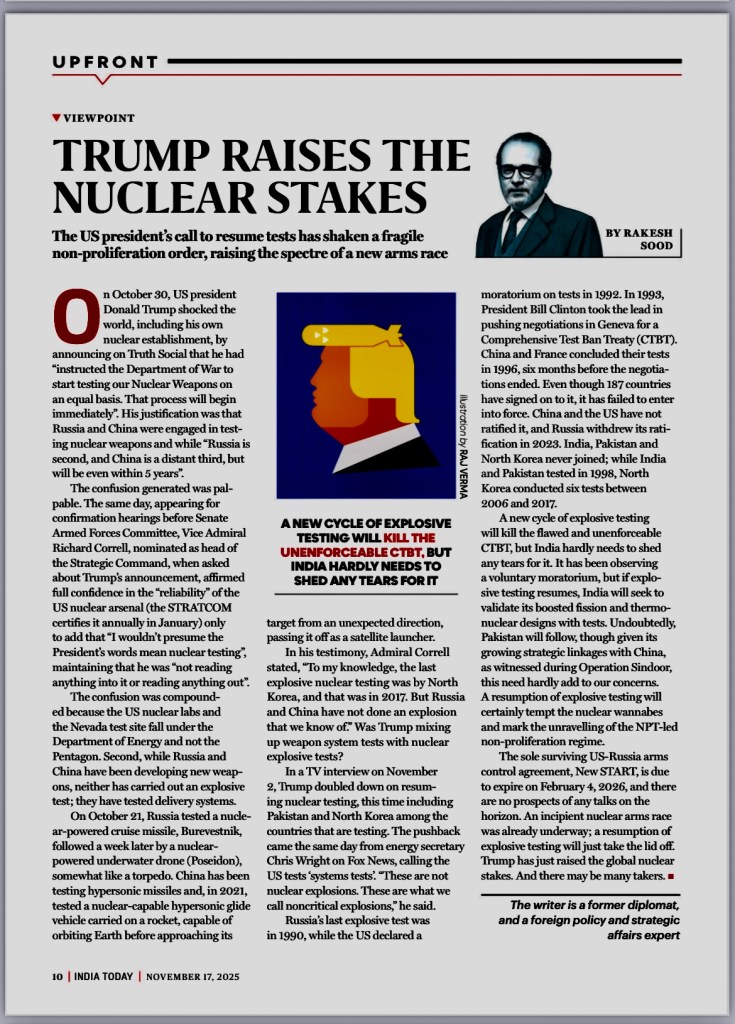
Donald Trump Shakes Up the Global Nuclear Order

Published in the Hindu on November 14, 2025

Today, the global nuclear order offers a curious contradiction – since the bombing of Hiroshima and Nagasaki in 1945, nuclear weapons have not been used during the last 80 years. The global nuclear arsenals have come down from a high of 65000 bombs in late 1970s to less than 12500 today. And, despite concerns in 1960s that by 1980, there may be at least two dozen states with nuclear weapons, the total today remains nine, five (the United States, Russia, The United Ukingdom, France and China) are permanent members of the United Nations Security Council who had tested before the Nuclear Non-Proliferation Treaty (NPT) came into being and four more who developed their nuclear arsenals later (Israel, Pakistan, India, and North Korea).

Looking back, these would seem to be impressive achievements but nobody is celebrating. In fact, the prevailing sentiment is that the global nuclear order is under strain and the U.S. President Donald Trump’s recent announcements may weaken all three elements of the global nuclear order.

Resumption of ‘nuclear tests’

On October 30, 2025, on his way to a meeting with China’s President Xi Jinping in Busan, Mr. Trump announced on Truth Social, “Because of other countries testing programs, I have instructed the Department of War to start testing our Nuclear Weapons on an equal basis. That process will begin immediately.” He added, “Russia is second, China is a distant third, but will be even within 5 years.”

While it was clear that the message was directed at Russia and China, it was unclear whether Mr. Trump was referring to ‘nuclear explosive testing’ or testing of nuclear weapon systems. Second, the nuclear labs (Los Alamos, Lawrence Livermore, and Sandia) and the Nevada testing facilities fall under the Department of Energy and not the Department of War.

It is no secret that China, Russia, and the U.S. are designing and developing new nuclear weapons. On October 21, Russia tested a nuclear-powered cruise missile (Burevestnik) that travelled 14000 kms, following a week later, with a test of an underwater nuclear-powered torpedo (Poseidon). China has been testing hypersonic missiles and, in 2021, tested a nuclear capable hypersonic glide vehicle carried on a rocket, capable of orbiting the earth before approaching its target from an unexpected direction that was passed off as a satellite launcher. The U.S. is producing new warheads – a variable yield B61-13 gravity bomb, a low yield W76-2 warhead for the Trident II D-5 missile, while working on a new nuclear armed submarine launched cruise missile.

Yet they have refrained from explosive testing. Russia’s last explosive test was in 1990 while the US declared a moratorium on tests in 1992. In 1993, the U.S. created a Stockpile Stewardship and Management Programme under the National Nuclear Security Administration to work on warhead modernisation, life extension, and development of new safety protocols in warhead design.  U.S. President Bill Clinton also took the lead in pushing negotiations in Geneva for a Comprehensive Test Ban Treaty (CTBT). China and France concluded their tests in 1996, six months begore the negotiations ended.

Why CTBT lacks a definition

Twenty-nine years later, the CTBT hasn’t entered into force despite 187 countries signing it. Among the necessary ratifications, the U.S., China, Israel, Egypt, and Iran have not done so, Russia did and withdrew its ratification in 2023, and India, Pakistan and North Korea have neither signed nor ratified it. India and Pakistan tested in 1998 and have since observed a voluntary moratorium, and North Korea conducted six tests between 2006 and 2017. Given today’s geopolitics, the prospects for the CTBT entering into force appear bleak.  

Second, the CTBT obliges states “not to carry out any nuclear weapon test explosion or any other nuclear explosion.” The U.S. was opposed to defining the terms, and instead, worked out private understandings with Russia and China on ‘zero-yield-tests;’ this permitted hydro-nuclear tests that do not produce a self-sustaining supercritical chain reaction.

The U.S. had conducted over a thousand nuclear tests and Russia 727 tests, giving them an adequate data base. China though with only 47 tests, also went along with this understanding. Thus, the CTBT delegitimsed only nuclear-explosive testing, not nuclear weapons, the reason why India never joined it.

In 2019-20, the U.S. State Department assessed that Russia and China “may have conducted low yield nuclear tests in a manner inconsistent with the U.S. zero-yield standard” though this was negated by the CTBT organisation that declared that their monitoring network with over 300 monitoring stations spread over 89 countries had not detected any inconsistent activity.

In a TV interview on November 2, Mr. Trump doubled down on resuming nuclear testing, this time including Pakistan and North Korea among the countries testing. A clarification came the same day from energy secretary Chris Wright on Fox News, calling the US tests ‘systems-tests’, “These are not nuclear explosions. These are what we call noncritical explosions,” he said. However, Mr. Trump’s intention remains unclear.

Regional and global implications

The new low-yield warheads being designed make them more usable and the new systems (hypersonics, cruise and unmanned systems) are dual capable systems, leading to renewed research for missile defences like the U.S. ‘golden dome.’ Meanwhile doctrinal changes are being considered to cope with new technological developments in cyber and space domains. This raises doubts about the nuclear taboo in coming decades.  

The sole surviving US-Russia arms control agreement, Ner Strategic Arms Reduction Treaty (New START) that limits the U.S. and Russian strategic forces to 700 launchers and 1550 warheads is due to expire on Feb 4, 2026 with no prospects of any talks on the horizon. China is not a party to any arms control and its nuclear arsenal that had remained below 300, is undergoing a rapid expansion, estimated at 600 today and likely to exceed 1000 by 2030. An incipient nuclear arms race was already underway; a resumption of explosive testing will just take the lid off.

Russia and China have denied Mr. Trump’s allegations regarding clandestine tests but will follow if the U.S. resumes explosive testing; China will be the biggest beneficiary because with only 47 tests (compared to over 1000 by the U.S.), resumed tests will help it to validate new designs and accumulate data.

India has been observing a voluntary moratorium but if explosive testing resumes, India will certainly resume testing to validate its boosted fission and thermonuclear designs, tested only once in 1998. Undoubtedly, Pakistan will follow but given its growing strategic linkages with China witnessed during Op Sindoor, this need hardly add to our concerns.

Though the CTBT is not in force, it did create a norm. But a resumption of explosive testing will lead to its demise. It will also tempt the nuclear wannabes to follow and mark the unravelling of the NPT led non-proliferation regime.

The taboo against use must remain intact

The U.S. has been the most significant player in shaping the global nuclear order; it would be ironical if Mr. Trump’s actions now become the catalyst for its demise. The reality is that the present global nuclear order was shaped by the geopolitics the 20th century; the challenge today is to craft a new nuclear order that reflects the fractured geopolitics of the 21st century while ensuring that the taboo against their use remains intact.  

The UN Secretary General has cautioned that “current nuclear risks are already alarmingly high” and urged nations “to avoid all actions that could lead to miscalculation or escalation with catastrophic consequences.”  But is anyone listening?

*****

India in the South Asian Neighbourhood: Friendship or Friction?

Published in Frontline dated January 26. 2024

The economic shock of COVID-19 in 2020-21 and subsequent escalating debt burdens, the ongoing Ukraine war now in its third year, and, in 2023, the eruption of the Gaza conflict, repeatedly jolted the economies of all countries in South Asia. The smaller and more vulnerable economies of all of India’s neighbours have been hit hard, leading to countrywide protests and, in some instances, even street violence in 2023. Maldives just had its election in September and in 2024, all South Asian countries (except Afghanistan and Nepal) are scheduled to go to the polls, adding a degree of political uncertainty to the mix.  

Of all the forthcoming elections, perhaps the Indian election is the most predictable. Most political pundits concur that Prime Minister Narendra Modi is headed for a historic third term though opinions differ on how many seats the BJP will win in the Lok Sabha and whether it will need coalition partners. In January, Bhutan is heading for a change of government; Sheikh Hasina is likely to stay put in Bangladesh though polarisation has risen significantly; Pakistan’s outcome in February is more uncertain given the role that the courts and the military may play; and in Sri Lanka, elections will only take place in September or later.

This churn in the region is occurring when there are fundamental structural shifts underway. Three relationships will be observed carefully by the neighbours: first, the US-China rivalry at the global level; second, the India-US emerging partnership; and finally, India-China relations that have not recovered since the nosedive it took in 2020 following Galwan. How these evolve and how India’s neighbours respond will influence India’s neighbourhood policies.

Legacy of British India

Historically, India has had difficult relations with its neighbours, in large part because of the legacy of the multiple partitions that it went through. Following three Anglo-Burmese wars over a span of nearly sixty years, from 1886 to 1937 Burma became a province of British India and thereafter a separate colony till its independence in 1948. The British East India Company’s conquest of Sri Lanka began during the last decade of the 18th century with the coastal areas and in 1802, it became a Crown colony, administered from Madras. Over the next two decades, the British gained control over the entire island introducing plantation crops like tea, coffee, and rubber for which large numbers of indentured Indian labour were brought in. Eventually, Sri Lanka became an independent country in 1948. The most traumatic partition was in 1947 that led to the creation of Pakistan in the name of a separate homeland for the Muslims of the sub-continent. Even after East Pakistan seceded in 1971 to become Bangladesh, Pakistan remains the second largest country in the region and remains locked in a hostile relationship with India. Lasting hostility has in turn cast a shadow on any developments at a regional level.  

Afghanistan, Bhutan, and Nepal were always independent and had a long tradition of trade relations and people-to-people exchanges with the neighbouring Indian states over the centuries. However, all three kingdoms had run-ins leading to wars with British India during the 18th and early 19th centuries. These conflicts ended with the establishment of boundaries between the three kingdoms and British India and in the process, the three relinquished sovereignty over their ‘defence and foreign affairs’ by accepting British ‘guidance’ through the appointment of plenipotentiary Political Agents, who in turn reported to the Viceroy in India.

This is the legacy that India inherited in 1947 as all the newly independent states struggled to consolidate their new found sovereignty.

Independent India’s challenges

As a buffer state between India and Afghanistan, Pakistan inherited the borderlands with Afghanistan and the problems of the Durand Line that divided the Pashtun homelands. The treatment of Hindu, Madhesi, and Tamil minorities with Pakistan (and post-1971 Bangladesh), Nepal, and Sri Lanka respectively, often became a domestic preoccupation for India. In the northeast, the restive tribes often sought to set up camps across the border in Myanmar as the Indian state sought to integrate these into the national mainstream, an unfinished exercise as recent developments in Manipur have shown. What this means is that India’s neighbourhood policies were, and remain, more intimately connected with our domestic policy than is often appreciated. On the flip side, societal and identity conflicts in India’s border states aroused interests in these countries that caused resentment in Delhi. Merely drawing lines on maps does not create sovereignties. British India was the paramount military power in the region and could enforce its will; a fragmented independent India, preoccupied with consolidating its own sovereignty over the 500 plus princely states and a war with Pakistan in 1947, has never enjoyed that unquestioned authority.  

The partitions also divided the economic space for a newly independent India. The creation of East Pakistan made India’s north-eastern states more distant and remote while the jute-based economy of the region was shattered. In the west, the sources of all the rivers flowing through Pakistan lie in India (and for the Kabul River, in Afghanistan) creating dependencies. India’s northern rivers basins of the Ganges and Yamuna are almost entirely fed by the rivers originating in the Nepal Himalayan ranges flowing southwards and then eastwards into the Bay of Bengal.

This legacy meant that Indian diplomacy in the neighbourhood lacked both the economic and the military resources to deliver on its policy objectives that it inherited as the successor state to British India. As these countries struggled with their own sovereignty issues, their internal political squabbles often attracted Indian involvement. These involvements also left long term scars on the relationships. The creation of Bangladesh in 1971 would not have happened without Indian political and material support and yet, less than five years after, there was a growing anti-India sentiment that was exploited by the military regimes that succeeded Sheikh Mujibur Rehman.

The struggle by the Tamils for their rights in Sri Lanka led to a violent insurgency, and the ill-advised deployment of the Indian Peace Keeping Force (IPKF) in Sri Lanka (from 1987-90 following the signing of the Indo-Sri Lanka Peace Accord) still rankles deeply. In Nepal, every political movement towards democracy has somehow involved India because it was the natural refuge for the asylum seekers, from King Tribhuvan in 1950 to the Nepali Congress leaders seeking democratic reform. None of the Maoists who waged a decade-long insurgency from the mid-1990s onwards ever sought refuge in China but took advantage of the open border with India. And yet, there remains an anti-India sentiment that surfaces repeatedly, stoked, and exploited by local politicians to demonstrate their nationalist credentials. Events like the 2015 economic squeeze by India (Nepalis call it a blockade) after Nepal adopted its new constitution leading to protests by the Madhesis in the Terai will remain a lasting pain point. Indian diplomats are often accused of arrogance and lacking empathy, earning them the unflattering sobriquet of a Viceroy or Pro-Consul.

The near-permanent hostility with Pakistan has meant that proposals for regional cooperation that are floated by India’s neighbours (SAARC was proposed by Bangladesh Gen Ziaur Rehman) often arouse Indian apprehensions. Even when India has overcome its reservations (especially under the Gujral Doctrine of “non-reciprocity”) and offered constructive proposals, these have often floundered, leaving India to come up with sub-regional initiatives. It is a good reminder of Tulsidas’s line from Ramcharitmanas when Lord Ram realises and declares: Bhay bin hoye nahin preet (there cannot be love/respect without a modicum of fear).

Modi’s India and ‘neighbourhood first’

On taking over as Prime Minister a decade ago, Modi declared a “neighbourhood first” foreign policy. He followed it up with his first two foreign visits to Bhutan and Nepal. These visits were successful but follow-up and economic delivery was lacking. Modi’s personalised diplomacy with Prime Minister Nawaz Sharif in Pakistan and President Xi Jinping soon ran aground and since then, India’s neighbourhood policy has been episodic. The sole definitive action with respect to the neighbourhood from the Modi government has been the repeated postponements of the SAARC summit since 2016 after the Uri attack. However, the sub-regional initiatives like BIMSTEC (The Bay of Bengal Initiative for Multi-Sectoral Technical and Economic Cooperation) and BBIN The Bangladesh, Bhutan, India, Nepal Initiative) promoted by India have been neither particularly noteworthy nor majorly successful.

One key reason is that India has not put forward a coherent policy for South Asia in any consistent fashion, preferring instead to deal with each neighbour bilaterally as this put India at an advantage. For the neighbours too, there were not many options. India was wary of any superpower presence in the region though Pakistan had joined SEATO and CENTO, two U.S. led military alliances. Development projects funded by India proceeded at the same leisurely pace as in India. The situation began to change with the growth of regionalisation, followed by globalisation. More significantly, China began to emerge as a global economic power and its footprint expanded, including in South Asia.

China had enjoyed close strategic ties with Pakistan since the 1960s but it also began to emerge as an economic investor. Now the other neighbours had a choice. A decade ago, China launched the Belt and Road Initiative (BRI) to fund strategic infrastructure like roads, railways, ports and power stations and transmission networks. Its deeper pockets and more efficient implementation made it an attractive partner. The economic presence was soon followed by political influence. During the Cold War, India had practised its own variant of the Monroe doctrine in the region but it becomes more difficult when its own neighbour that shared land borders with Afghanistan, Pakistan, Nepal, Bhutan, and Myanmar emerges as an economic superpower. Further, China did not have the complicated legacy of British India in the region and the intertwined minority ties with South Asia. This enables it to have a less emotive and a more transactional approach towards the region. In the last three years, there is a noticeable backlash against BRI in South Asia and elsewhere but Chinese presence in the region is now a reality.

During the last decade, Modi has been changing India’s image and how it is perceived. From kinetic retaliation for terrorist attacks originating from Pakistani territory to the alleged targeted assassinations of Khalistani terrorists on foreign soil, from doing away with Article 370 to an open espousal of majoritarianism and Hindutva, Modi wants to be the architect of transforming a soft, indecisive India into a more self-confident, assertive, and muscular Bharat. A third Modi term will sharpen and strengthen these trends. India’s neighbours are sensitive to the changes, as these are filtered through our neighbourhood policies.

Election season in 2024

The Maldives election last September brought in for President Mohamed Muizzu who had fought on an “India out” platform to distinguish him from his predecessor Ibrahim Solih, who had governed with an “India first” policy. Muizzu’s first announcement was to seek removal of the 70-odd Indian military personnel deployed there to maintain and operate two helicopters and a Dornier aircraft gifted by India. In December, he decided to pull out of the 2019 bilateral agreement for cooperation in hydrology, following it up by skipping the Colombo Security Conclave that includes India, Sri Lanka and Mauritius. Since the introduction of multiparty democracy in Maldives nearly two decades ago, every elected President’s first foreign visit has been to Delhi; Muizzu has already visited Turkey and Dubai and is now scheduled to visit China. Parliamentary elections due in 2024 might offer India some comfort, but it is too soon to predict.

Sheikh Hasina is poised to win a historic fourth term in Bangladesh in the elections scheduled on January 7. The main opposition party BNP is boycotting the polls and has mounted street protests. A harsh government crackdown has provoked criticism in the West. India has three key demands – protection of minorities’, no support to anti-India elements, and connectivity. Sheikh Hasina has been responsive, in varying degrees, on all three. At the same time, she has maintained close ties with China. As India-China rivalry sharpens, her challenge will be to avoid too close an embrace with either while not crossing India’s red lines.

The final round of Bhutan’s parliamentary elections is due on January 9 and the options will be between former PM Tshering Tobgay (2013-18) or former civil servant-turned-politician Dasho Pema Chewang. The question here is the progress in boundary talks with China that resumed last year after being frozen since the Doklam crisis. October also saw the first ever visit by the Bhutanese Foreign Minister to China. Meanwhile, Bhutan is also strengthening economic ties with India by planning a 1,000 sq km international city on the Assam border, connected by road and rail links. Gelephu is expected to be a green township with zero-emission industries. Bhutan’s opening to the world has so far been calibrated but there appears to a slight quickening of the pace to create economic opportunities for its youth who have been migrating out in recent years.

Pakistan has been grappling with multiple challenges that have forced it to turn inwards. Imran Khan remains behind bars and his party has seen many departures. Conventional wisdom indicates that Nawaz Sharif, who returned from exile with the blessings of the Army should get his fourth term. His earlier terms were cut short each time because of deteriorating relations with the Army. Has he mellowed and will the Army trust him are questions that will be clearer after the elections on February 8. Mr. Sharif will be keen to improve relations with India but the Modi government’s interest is limited to managing relations rather than moving towards resolution of historical issues.

Sri Lanka’s elections, in the last quarter of 2024, will take place in a polarised atmosphere. President Ranil Wickremesinghe, sworn in last year after President Gotabaya Rajapakse was forced to quit after a historic aragalaya (struggle) that galvanised the country, is his party’s sole MP and continues only with the support of the Rajapakse’s SLPP (Sri Lanka Podujana Peramuna). SLPP is adept at whipping up nationalist sentiment among the majority Sinhala middle class but the current preoccupation for the people is the economic challenges. Mr. Wickremesinghe is pushing for reforms and favours talks with minorities to bring about devolution that makes SLPP uncomfortable. The other two mainstream parties SJB (Samagi Jana Balawegaya) and SLFP (Sri Lanka Freedom Party) are mired in internal disarray.

Relations with the Taliban regime in Kabul are limited after India reopened its embassy in 2022, calling it a technical mission to coordinate Indian humanitarian assistance. The Afghan embassy in Delhi is shuttered and so far, India has not agreed to let Taliban post people to man it. Visas remain suspended. In Nepal, elections are due in 2027. The Maoist-UML coalition that took power in end-2022 proved short-lived. Within three months, Communist Party of Nepal (Unified Marxist-Leninist) or the UML, had quit and Maoist Prime Minister Prachanda found a new coalition partner in the NC. Under the constitution, there cannot be a vote of confidence for the first two years and any political jockeying is likely to begin only towards end-2024.

Myanmar is caught up in its internal struggles after the military takeover in February 2021. The pushback this time has been much stronger in the past, possibly because even the limited political, economic, and social freedoms that had existed for a decade prior enabled the emergence of a middle class. The resistance this time cuts across ethnicities and in the north, has support from China. India has continued to work with the junta to promote its connectivity projects.

Regional elections are not the only source of uncertainty for South Block. On January 13, Taiwan elects a new president and another DPP (Democratic Progressive Party) victory will sharpen tensions with Beijing, impacting US-China relations. In Canada, Prime Minister Justin Trudeau will be struggling to win a third term in June and towards the year end, the UK will have a new Prime Minister. The US election on November 5 remains the most anticipated, especially if Donald Trump wins the Republican nomination. Election forecasters have their hands full in 2024, as do Indian diplomats.

*****

‘Bharat Natyam’ in Indian Diplomacy

Published in the Hindu on March 16. 2022

The late Jyotindra Nath Dixit (Mani Dixit to his many friends and admirers) took over as Foreign Secretary on December 1, 1991. He retired 26 months later, on January 31, 1994 – 58 years was then the retirement age.

Republics and Moscow

Those were times of change. On December 25, 1991, Soviet Union’s General Secretary Mikhail Gorbachev resigned, the flag of USSR was lowered for the last time at the Kremlin and the following day, USSR was formally dissolved. In its place, 15 republics emerged. India accepted the challenge and set about opening new embassies to build new relationships with these countries in Central Asia, South Caucasus and Central Europe while maintaining its traditional ties with Moscow.

In January 1992, India and Israel established full diplomatic relations, announcing the opening of embassies and exchanging ambassadors for the first time, opening the door to a relationship that has blossomed into one of India’s most significant strategic partnerships in the last three decades.

Path to the nuclear deal

On January 31, 1992, Prime Minister P V Narsimha Rao participated in the first ever meeting of the UN Security Council at summit level (India was a member in 1991-92), presided by British Prime Minister John Major. On the side-lines, Mr. Rao had a bilateral meeting with U.S. President George H. W. Bush where the two leaders decided that in the changing world, India and the U.S. needed to have frank exchanges on issues that had divided them during the Cold War; the issue identified was ‘nuclear proliferation and disarmament’; the first meeting took place during Mr. Dixit’s visit to Washington two months later, sowing the seeds of the dialogue that continued through ups and downs, leading to the path-breaking India-U.S. Civil Nuclear Cooperation Agreement in 2008.

At the Association of Southeast Asian Nations (ASEAN) summit on January 28, 1992, Prime Minister Rao’s ‘Look East’ policy began to take shape as India and ASEAN embarked on a sectoral-dialogue partnership. By end-1995, this had matured into a full-dialogue partnership and in 1996, India joined the security dialogue platform – ASEAN Regional Forum. Since 2002, the relationship has strengthened further with the annual India-ASEAN summit.

On China and Taiwan

Following intense negotiations, during Mr. Rao’s visit to China in September 1993, the two sides initiated the first of the many confidence-building-measures, notably the Agreement on the Maintenance of Peace and Tranquillity Along the Line of Actual Control in the India-China Border Areas. It laid the foundation of the relationship for two decades.

Simultaneously, India and Taiwan negotiated to open Economic and Cultural Centres; Taiwan opened its office first in Mumbai in 1992 before shifting to Delhi while Indian established the India-Taipei Association office in 1995.

The above gives an idea of how India was responding to the changes taking place around us and in the wider world. As a junior colleague who had the privilege of working closely with Mr. Dixit during these years, I often heard him engage patiently with foreign diplomats and respond to questions from inquisitive journalists seeking to make sense of the about-turns in Indian foreign policy.

Relaxing as he puffed on his pipe, in a private aside to his friends, he would tell us, “In Indian diplomacy, sometimes, you need to do a bit of Bharat Natyam”. The point was simple – you may appear in different forms to others but after you have first secured your interests.

UN vote dynamics

In recent weeks, the debates and discussions in Indian media and TV talk-shows about India’s stand on the Ukraine conflict and India’s votes in the UN Security Council and General Assembly are an appropriate moment to reflect on the Dixit principle.

Evidently, the Indian government has chosen to ‘abstain’, based on an assessment of its core interests. However, there is a cardinal principle associated with Security Council votes on issues in such charged times. A ‘for’ or ‘against’ vote is intended to convey a blunt message of ‘support’ or ‘opposition’. It is a black or white choice, and once exercised, the messaging is clear.

On the other hand, ‘abstention’ takes us into a grey zone because it is the middle path. It can either be seen as fence-sitting (which is a sign of helplessness) or create space for diplomatic manoeuvre (which is a successful outcome). In the Ukraine instance – the West should feel satisfied that India ‘abstained’ because they perhaps expected us to oppose their draft proposals given our traditional ties with Russia while Russia should also feel satisfied at our ‘abstention’ because they perhaps expected us to give in to Western persuasion.

The second outcome is a positive one but to appear in different forms at the same time, we need to revive the kind of Bharat Natyam that Mr. Dixit used so effectively to navigate those turbulent times, even as he helped set the course for Indian foreign policy three decades ago.

*****

At The Edge Of A New Nuclear Arms Race

Published in The Hindu on 27th April, 2020

Last week, a report issued by the US State Department on “Adherence to and Compliance with Arms Control, Disarmament and Non-Proliferation Agreements and Commitments” raised concerns that China might be conducting nuclear tests with low yields at its Lop Nor test site, in violation of its Comprehensive Test Ban Treaty (CTBT) undertakings.

The US report also claims that Russia has conducted nuclear weapons experiments that produced a nuclear yield and were inconsistent with ‘zero yield’ understanding underlying the CTBT though it was uncertain about how many such experiments had been conducted.

Russia and China have rejected US claims but with growing rivalry among major powers, the report is a likely harbinger of new nuclear arms race which would also mark the demise of the CTBT that came into being in 1996 but has failed to enter into force even after a quarter century.

What does the CTBT ban
For decades, a ban on nuclear testing was seen as the necessary first step towards curbing the nuclear arms race but Cold War politics made it impossible. A Partial Test Ban Treaty was concluded in 1963 banning underwater and atmospheric tests but this only drove testing underground. By the time the CTBT negotiations began in Geneva in 1994, global politics had changed. The Cold War was over and the nuclear arms race was over. USSR had broken up and its principal testing site, Semipalatinsk, was in Kazakhstan (Russia still had access to Novaya Zemlya near the Arctic circle). In 1991, Russia declared a unilateral moratorium on testing, followed by the US in 1992. By this time, US had conducted 1054 tests and Russia, 715.

Negotiations were often contentious. France and China continued testing claiming that they had conducted far fewer tests and needed to validate new designs since the CTBT did not imply an end to nuclear deterrence. France and US even toyed with the idea of a CTBT that would permit testing at a low threshold, below 500 tonnes of TNT equivalent. This was one-thirtieth of the 15000 tonne Little Boy, the bomb US dropped on Hiroshima on 6 August 1945. Civil society and the non-nuclear weapon states reacted negatively to such an idea and it was dropped. Some countries proposed that the best way to verify a comprehensive test ban would be to permanently shut down all test sites, an idea that was unwelcome to the nuclear weapon states.

Eventually, US came up with the idea of defining the “comprehensive test ban” as a “zero yield” test ban that would prohibit supercritical hydro-nuclear tests but not sub-critical hydrodynamic nuclear tests. Once UK and France came on board, US was able to prevail upon Russia and China to accept this understanding. After all, this was the moment of US’ unipolar supremacy. At home, the Clinton administration satisfied the hawks by announcing a Science Based Nuclear Stockpile Stewardship Programme, a generously funded project to keep the nuclear labs in business and the Pentagon happy. Accordingly, the CTBT prohibits all parties from carrying out “any nuclear weapon test explosion or any other nuclear explosion”; these terms are neither defined nor elaborated.

Why the CTBT lacks authority
Another controversy arose regarding the entry-into-force provisions (Article 14) of the treaty. After India’s proposals for anchoring the CTBT in a disarmament framework did not find acceptance, in June 1996, India announced its decision to withdraw from the negotiations. Unhappy at this turn, UK, China and Pakistan took the lead in revising the entry-into-force provisions. The new provisions listed 44 countries by name whose ratification was necessary for the treaty to enter into force and included India. India protested that this attempt at arm twisting violated a country’s sovereign right to decide if it wanted to join a treaty but was ignored. The CTBT was adopted by a majority vote and opened for signature.

Of the 44 listed countries, to date only 36 have ratified the treaty. China, Egypt, Iran, Israel and USA have signed but not ratified. China maintains that it will only ratify it after US does so but the Republican dominated Senate had rejected it in 1999. In addition, North Korea, India and Pakistan are the three who have not signed. All three have also undertaken tests after 1996; India and Pakistan in May 1998 and North Korea six times between 2006 and 2017. The CTBT has therefore not entered into force and lacks legal authority.

Nevertheless, an international organisation to verify the CTBT was established in Vienna with a staff of about 230 persons and an annual budget of $ 130 million. Ironically, US is the largest contributor with a share of $17 million. The CTBTO runs an elaborate verification system built around a network of over 325 seismic, radionuclide, infrasound and hydroacoustic (underwater) monitoring stations. The CTBTO has refrained from backing the US allegations.

A new nuclear arms race
The key change from the 1990s is that US’ unipolar moment is over and strategic competition among major powers is back. US now identifies Russia and China as ‘rivals’. Its Nuclear Posture Review asserts that US faces new nuclear threats because both Russia and China are increasing their reliance on nuclear weapons. US therefore has to expand the role of its nuclear weapons and have a more usable and diversified nuclear arsenal. The Trump administration has embarked on a 30-year modernisation plan with a price tag of $1.2 trillion, which could go up over the years. Readiness levels at Nevada test site that has been silent since 1992 are being enhanced to permit resumption of testing at six months notice.

Russia and China have been concerned about US’ growing technological lead particularly in missile defence and conventional global precision strike capabilities. Russia has responded by exploring hypersonic delivery systems and theatre systems while China has embarked on a modernisation programme to enhance the survivability of its arsenal which is considerably smaller. In addition, both countries are also investing heavily in offensive cyber capabilities.

The new US report stops short of accusing China for a violation but refers to “a high level of activity at the Lop Nor test site throughout 2019” and concludes that together with its lack of transparency, China provokes concerns about its intent to observe the zero-yield moratorium on testing.

US claims that Russian experiments have generated nuclear yield but is unable to indicate how many such experiments were conducted in 2019. It suggests that Russia could be testing in a manner that releases nuclear energy from an explosive canister, generating suspicions about its compliance.

The New START agreement limits US and Russian arsenals but will expire in 2021 and President Trump has already indicated that he does not plan to extend it. Instead, the Trump administration would like to bring China into some kind of nuclear arms control talks, something China has avoided by pointing to the fact that US and Russia still account for over 90 percent of global nuclear arsenals.

Both China and Russia have dismissed US allegations pointing to Trump administration’s backtracking from other negotiated agreements like the Iran nuclear deal or the US-Russia INF Treaty. Tensions with China are already high with trade and technology disputes, militarisation in the South China Sea and most recently, with the Coronavirus pandemic. US could also be preparing the ground for resuming testing at Nevada.

The Cold War rivalry was already visible when the nuclear arms race began in the 1950s. New rivalries have already emerged. Resumption of nuclear testing may signal the demise of the ill-fated CTBT, marking the beginnings of a new nuclear arms race.