Donald Trump Shakes Up the Global Nuclear Order

Published in the Hindu on November 14, 2025

Today, the global nuclear order offers a curious contradiction – since the bombing of Hiroshima and Nagasaki in 1945, nuclear weapons have not been used during the last 80 years. The global nuclear arsenals have come down from a high of 65000 bombs in late 1970s to less than 12500 today. And, despite concerns in 1960s that by 1980, there may be at least two dozen states with nuclear weapons, the total today remains nine, five (the United States, Russia, The United Ukingdom, France and China) are permanent members of the United Nations Security Council who had tested before the Nuclear Non-Proliferation Treaty (NPT) came into being and four more who developed their nuclear arsenals later (Israel, Pakistan, India, and North Korea).

Looking back, these would seem to be impressive achievements but nobody is celebrating. In fact, the prevailing sentiment is that the global nuclear order is under strain and the U.S. President Donald Trump’s recent announcements may weaken all three elements of the global nuclear order.

Resumption of ‘nuclear tests’

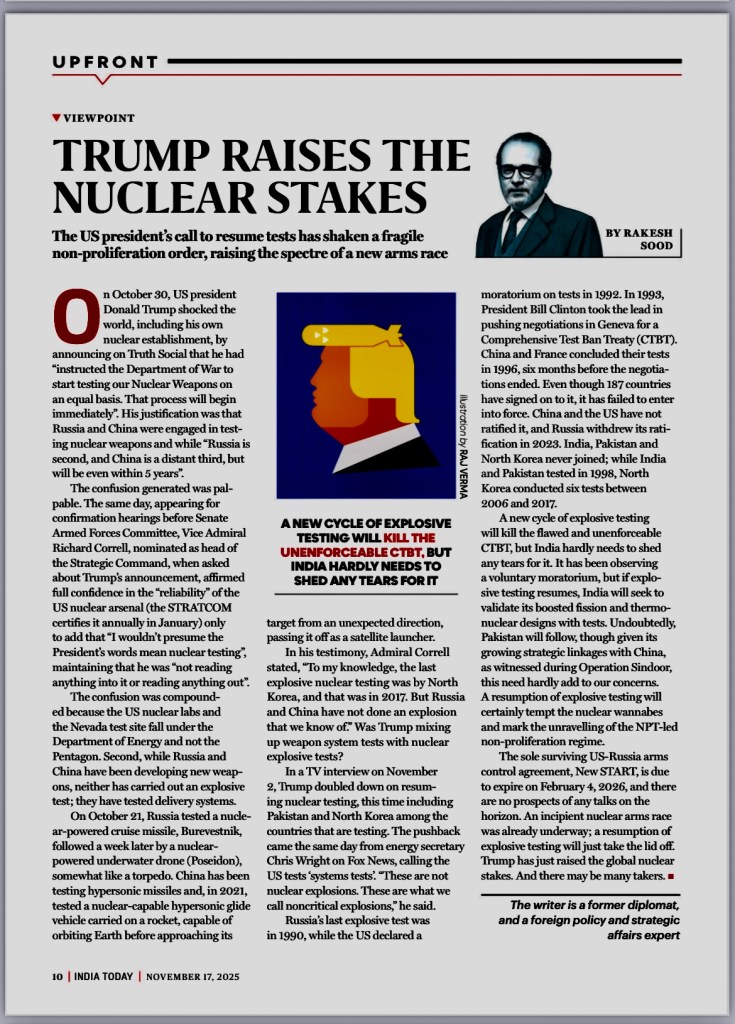
On October 30, 2025, on his way to a meeting with China’s President Xi Jinping in Busan, Mr. Trump announced on Truth Social, “Because of other countries testing programs, I have instructed the Department of War to start testing our Nuclear Weapons on an equal basis. That process will begin immediately.” He added, “Russia is second, China is a distant third, but will be even within 5 years.”

While it was clear that the message was directed at Russia and China, it was unclear whether Mr. Trump was referring to ‘nuclear explosive testing’ or testing of nuclear weapon systems. Second, the nuclear labs (Los Alamos, Lawrence Livermore, and Sandia) and the Nevada testing facilities fall under the Department of Energy and not the Department of War.

It is no secret that China, Russia, and the U.S. are designing and developing new nuclear weapons. On October 21, Russia tested a nuclear-powered cruise missile (Burevestnik) that travelled 14000 kms, following a week later, with a test of an underwater nuclear-powered torpedo (Poseidon). China has been testing hypersonic missiles and, in 2021, tested a nuclear capable hypersonic glide vehicle carried on a rocket, capable of orbiting the earth before approaching its target from an unexpected direction that was passed off as a satellite launcher. The U.S. is producing new warheads – a variable yield B61-13 gravity bomb, a low yield W76-2 warhead for the Trident II D-5 missile, while working on a new nuclear armed submarine launched cruise missile.

Yet they have refrained from explosive testing. Russia’s last explosive test was in 1990 while the US declared a moratorium on tests in 1992. In 1993, the U.S. created a Stockpile Stewardship and Management Programme under the National Nuclear Security Administration to work on warhead modernisation, life extension, and development of new safety protocols in warhead design.  U.S. President Bill Clinton also took the lead in pushing negotiations in Geneva for a Comprehensive Test Ban Treaty (CTBT). China and France concluded their tests in 1996, six months begore the negotiations ended.

Why CTBT lacks a definition

Twenty-nine years later, the CTBT hasn’t entered into force despite 187 countries signing it. Among the necessary ratifications, the U.S., China, Israel, Egypt, and Iran have not done so, Russia did and withdrew its ratification in 2023, and India, Pakistan and North Korea have neither signed nor ratified it. India and Pakistan tested in 1998 and have since observed a voluntary moratorium, and North Korea conducted six tests between 2006 and 2017. Given today’s geopolitics, the prospects for the CTBT entering into force appear bleak.  

Second, the CTBT obliges states “not to carry out any nuclear weapon test explosion or any other nuclear explosion.” The U.S. was opposed to defining the terms, and instead, worked out private understandings with Russia and China on ‘zero-yield-tests;’ this permitted hydro-nuclear tests that do not produce a self-sustaining supercritical chain reaction.

The U.S. had conducted over a thousand nuclear tests and Russia 727 tests, giving them an adequate data base. China though with only 47 tests, also went along with this understanding. Thus, the CTBT delegitimsed only nuclear-explosive testing, not nuclear weapons, the reason why India never joined it.

In 2019-20, the U.S. State Department assessed that Russia and China “may have conducted low yield nuclear tests in a manner inconsistent with the U.S. zero-yield standard” though this was negated by the CTBT organisation that declared that their monitoring network with over 300 monitoring stations spread over 89 countries had not detected any inconsistent activity.

In a TV interview on November 2, Mr. Trump doubled down on resuming nuclear testing, this time including Pakistan and North Korea among the countries testing. A clarification came the same day from energy secretary Chris Wright on Fox News, calling the US tests ‘systems-tests’, “These are not nuclear explosions. These are what we call noncritical explosions,” he said. However, Mr. Trump’s intention remains unclear.

Regional and global implications

The new low-yield warheads being designed make them more usable and the new systems (hypersonics, cruise and unmanned systems) are dual capable systems, leading to renewed research for missile defences like the U.S. ‘golden dome.’ Meanwhile doctrinal changes are being considered to cope with new technological developments in cyber and space domains. This raises doubts about the nuclear taboo in coming decades.  

The sole surviving US-Russia arms control agreement, Ner Strategic Arms Reduction Treaty (New START) that limits the U.S. and Russian strategic forces to 700 launchers and 1550 warheads is due to expire on Feb 4, 2026 with no prospects of any talks on the horizon. China is not a party to any arms control and its nuclear arsenal that had remained below 300, is undergoing a rapid expansion, estimated at 600 today and likely to exceed 1000 by 2030. An incipient nuclear arms race was already underway; a resumption of explosive testing will just take the lid off.

Russia and China have denied Mr. Trump’s allegations regarding clandestine tests but will follow if the U.S. resumes explosive testing; China will be the biggest beneficiary because with only 47 tests (compared to over 1000 by the U.S.), resumed tests will help it to validate new designs and accumulate data.

India has been observing a voluntary moratorium but if explosive testing resumes, India will certainly resume testing to validate its boosted fission and thermonuclear designs, tested only once in 1998. Undoubtedly, Pakistan will follow but given its growing strategic linkages with China witnessed during Op Sindoor, this need hardly add to our concerns.

Though the CTBT is not in force, it did create a norm. But a resumption of explosive testing will lead to its demise. It will also tempt the nuclear wannabes to follow and mark the unravelling of the NPT led non-proliferation regime.

The taboo against use must remain intact

The U.S. has been the most significant player in shaping the global nuclear order; it would be ironical if Mr. Trump’s actions now become the catalyst for its demise. The reality is that the present global nuclear order was shaped by the geopolitics the 20th century; the challenge today is to craft a new nuclear order that reflects the fractured geopolitics of the 21st century while ensuring that the taboo against their use remains intact.  

The UN Secretary General has cautioned that “current nuclear risks are already alarmingly high” and urged nations “to avoid all actions that could lead to miscalculation or escalation with catastrophic consequences.”  But is anyone listening?

*****
Remaking the Nuclear Order in West Asia

Published in The Hindu on July 8, 2025

While both the U.S. and Israel agree that Iran cannot be allowed to have a bomb, Mr. Netanyahu goes one step forward to deny Iran any nuclear capabilities. However, for Iran, nuclear deterrent assumes a greater importance now, even if there is a change of regime

There is hardly any political leader who understands the laws of political survival better than Israeli Prime Minister Benjamin Netanyahu. Realising that he is in a morass with respect to Gaza where Hamas has not yet been dismantled even though its leaders have been killed, and all hostages have not been brought home resulting in growing domestic pressure, Mr. Netanyahu employed an old tactic – to distract attention from a crisis you cannot get out off, create another crisis.

Israel’s surprise strikes on Iran, launched on June 13, created a new and larger crisis. The military action has been spectacularly successful, with the U.S. finally coming on board. For the moment, PM Netanyahu is firmly back in the driver’s seat, but this has also opened a Pandora’s Box of what next.

Israel’s calculations

Mr. Netanyahu wants to keep Israel as the only nuclear power in the region. He is convinced that the Libyan model, where the nuclear programme was completely dismantled, is the only acceptable option, preferably with a change of regime. In 2015, he opposed the Joint Comprehensive Plan of Action (JCPOA) primarily because it conceded a limited uranium enrichment right to Iran.  

Since mid-April, five rounds of talks took place between U.S. Special Envoy Steve Witkoff and Iranian Foreign Minister Abbas Aragchi, with a sixth round due on June 15 in Muscat. After stumbling over the issue of Iran insisting on its right to enrichment as a party of to the Nuclear Non-Proliferation Treaty (NPT), some progress was registered on the idea of a regional nuclear fuel consortium to provide fuel for the reactors in the region. Its location remained under discussion, making Mr. Netanyahu nervous.

On June 11, PM Netanyahu barely survived a motion tabled by the opposition seeking to dissolve parliament, leading to early elections that are currently due in October 2026. PM Netanyahu has been facing domestic opposition since early 2023 due to his attempts at pushing though controversial judicial reforms that were widely seen as curbing judicial independence. The Hamas attack on October 7 had provided a reprieve that has lasted nearly two years. Given Mr. Netanyahu’s multiple domestic legal challenges, a continuing war is his “get-out-of-jail” card.

During the 20-month war, the leadership of Hamas and Hezbollah has been decapitated, and a change of regime in Damascus last December doused Iran’s “ring of fire.” On two occasions in 2024, Israel directly engaged Iran and, in the process, knocked out its air defences around Tehran and other critical installations.

Having buried the two-state-solution, and with Iran at its weakest, Mr. Netanyahu must have felt that this was the ideal time to neutralise Iranian nuclear and missile threats. The Iranians are known for their frustratingly convoluted negotiating style and given U.S. President Donald Trump’s impatience, Mr. Netanyahu was able to convince him that a little military pressure would make them more accommodating.

Iran’s miscalculations

As recently as March 26, U.S. Director of National Intelligence Tulsi Gabbard in her annual intelligence threat assessment to Congress stated, “the Intelligence Community continues to assess that Iran is not building a nuclear weapon and Supreme Leader Khamenei has not authorised the nuclear weapons programme that he suspended in 2003”. This gave Iran’s leadership a misplaced confidence that as long as the negotiations continued on the idea of a regional enrichment facility, the U.S. would block any military strike by Israel.

However, the International Atomic Energy Agency (IAEA) report in May criticising “Iran’s general lack of cooperation” and the near doubling of its stockpile of 60% enriched uranium to over 400 kgs since February proved to be more damaging that Iran anticipated. This heightened Iranian concerns about the threat of sanctions-snapback by the UN Security Council, which was waived in 2015 following the adoption of the JCPOA.  

Iran knew that given its ageing air force, it was dependent on its stocks of drones and missiles. Despite the debacles of the Hamas and the Hezbollah leaderships, Iran underestimated the extent of Mossad’s penetration of its systems, evidenced by the targeted assassinations of its key military leaders and nuclear and missile scientists.

The entry of the U.S.

When the U.S. began to withdraw non-essential staff from its embassies in the region in early June, it was anticipating Israel’s likely military action. In the past, U.S. reluctance to get involved had prevented Israel from military strikes but this time, Mr Netanyahu took a gamble and it paid off. Impressed with the success of the Israel’s military actions, Mr. Trump ordered supportive strikes on June 22, with B-2 bombers dropping GBU-57 ‘bunker-busters’ on Fordow and Natanz, and Tomahawk cruise missiles hitting Isfahan. Some advance notice was provided to Iran, possibly via Qatar. Following token retaliation by Iran the following day, Mr. Trump declared an end to the “12-day-war”.

Israel thus claimed victory, Mr. Trump declared the underground sites “obliterated,” the Gulf states heaved a sigh of relief, and for Iran’s Supreme Leader, regime survival was a victory. Iran suffered over 600 casualties, and all its air defences and half its stock of missile launchers, were destroyed. It failed to take down a single Israeli aircraft though it did bring down some drones. Of the 500 missiles that Iran fired, over 30 were able to get through causing 30 casualties.

While Mr Netanyahu’s suggestion that sustained military pressure may bring about a regime change in Tehran has some support from the Iran-hawks in Washington, it is anathema to Mr. Trump’s MAGA support base, wary of entanglements abroad. The U.S. interventions in Afghanistan and Iraq in 2001 and 2003 respectively, were messy and costly, leaving behind a legacy of instability. Iran is three times larger, and Iranians are a people with a deep sense of nationalism based on their civilisational history. The current theocratic regime may be weak and its replacement may be less religious, but no less nationalist, and would therefore push ahead with the nuclear deterrent. Mr. Netanyahu may not be averse to a forced regime change but the U.S. and the Gulf Arabs would not want to open this Pandora’s box.

Iran’s nuclear capability

Iran has had an ambitious civilian nuclear programme going back to the 1950s. It joined the NPT in 1970. Initially, the Islamic regime was uninterested in the nuclear programme, seeing it as a part of Western influence. This changed after the Iran-Iraq war and in the 1990s, it began developing a clandestine enrichment capability.  The 2002 disclosures by a group of Iranian exiles, followed by the U.S. invasion of Iraq in 2003, led the Supreme Leader to shift direction and aim for threshold status rather than develop a full-fledged nuclear weapon. The centrifuges and higher levels of enrichment also provided for bargaining space as Iran could negotiate for sanctions relief with the U.S.

Today, the situation has changed. Iran’s proxies (except for the Houthis) have been decimated and its missile and drone capabilities found wanting. The threshold state is no longer a safe place. Therefore, a nuclear deterrent assumes greater importance, even if there is a change of regime.

Questions remain about the extent of damage to the underground centrifuge sites as well as the fate of the 400 kg of the 60% enriched uranium stockpile. While the scale of the attacks makes resumption of Iran-U.S. talks tricky, Iran has raised the stakes by terminating IAEA inspector’s access to its nuclear sites.  Mr. Trump would like to conclude a deal with Iran to build on his success with the ceasefire. He would do well to remember the U.S. scholar Thomas Schelling’s advice that successful coercion requires both a credible threat as well as credible reassurance, if Iran is to be ‘persuaded’ during any future talks.

There has always been a difference between the U.S. and Israeli positions – both agree that Iran cannot be allowed to have a bomb, but Mr Netanyahu goes one step further to deny Iran any nuclear capabilities. However, since Mr. Trump has obliged him with the June 22 strikes, he may find it difficult to deny Mr. Trump his Iran deal provided the Iranians play the game.

*****

Iran is learning the hard way that being a nuclear threshold state isn’t safe anymore

Published in The Print on June 24, 2025

Israeli Prime Minister Benjamin Netanyahu is delighted that his gamble has paid off. After decimating Iran’s proxies – Hamas and Hezbollah, and substantially weakening Iranian air defences through air strikes last year, Netanyahu was convinced that this was the most opportune moment to target Iran’s nuclear and missile programmes. The challenge was to get US President Donald Trump to join him in the exercise.

And Trump did. In the early hours of June 22, the US targeted three nuclear locations in Iran: Fordaw, Natanz (another enrichment site), and Isfahan (a uranium conversion site). After declaring that the nuclear sites were “totally and completely obliterated,” Trump added, “NOW IS THE TIME FOR PEACE.”

Hours later, Iran responded with a missile strike on US forces at the Al Udeid air base in Qatar, causing no damage or casualties. The move appears to have been a choreographed exercise, reminiscent of Iran’s retaliation in January 2020after Quds Force General Qassem Soleimani was killed in Iraq. Meanwhile Trump has declared that “a full and complete ceasefire” will be in effect shortly, though neither Iran nor Israel has confirmed it yet.

Iran’s nuclear programme – a long journey

Iran’s nuclear journey has been long and tortuous. It began under the Shah’s regime in the 1950s with a civil nuclear cooperation agreement signed with the U.S. and the first research reactor went critical in 1967. Since then, the nuclear programme has been seen as a symbol of scientific progress and a source of nationalist pride.

Iran became an original state party to the Nuclear Non-Proliferation Treaty (NPT) in 1970 when it entered into force, placing all its activities under International Atomic Energy Agency (IAEA) safeguards. The Shah embarked on an ambitious civil nuclear power generation programme signing cooperation agreements with Germany and France. Siemens began work on the Bushehr power reactors (2x1200MW) in 1975 but later withdrew. The plants finally went online in 2011 with Russian assistance.

After the Islamic Revolution, nuclear activity came to a standstill as the clerical regime saw it as a source of Western influence. However, sometime in the 1990s, opinions changed and gradually, nuclear research activities were gradually revived. By then, nuclear controls had tightened, curbing exports of enrichment and reprocessing technologies, though these remained permitted under the NPT. Iran revived its civilian nuclear power projects and, also began establishing a clandestine enrichment facility. It received assistance from the A. Q. Khan network as also from China to develop capabilities across the entire nuclear fuel cycle. In parallel, Iran began developing missiles.

In 2002, the nuclear activity was exposed by a group of Iranian exiles. It became clear that the regular IAEA inspections had failed to detect the clandestine programme. Negotiations began in 2003, initially with the three European powers and later including the U.S. These collapsed when President Mahmoud Ahmedinejad took over and starting in 2006, Iran was subjected to successive UN Security Council sanctions. By this time Iran had established its first enrichment facility at Natanz.

Around that time, Supreme Leader Ali Khamenei issued a fatwa against nuclear weapons, describing them as un-Islamic. The general assessment is that while the fatwa was respected, Iran pursued the technical capabilities to become a nuclear threshold state. As recently as March 26, the U.S. Director of National Intelligence stated in an official briefing to the Congress: “The Intelligence Community continues to assess that Iran is not building a nuclear weapon and Supreme Leader Khamenei has not authorised the nuclear weapons programme that he suspended in 2003”. This assessment has also been made by Rafael Grossi, Director General of the IAEA.

Can Iran remain a nuclear threshold state?

In 2009, a hitherto secret underground enrichment facility at Fordaw was exposed. Israel and the U.S. cooperated in the 2008 Stuxnet covert operation, which destroyed a large number of centrifuges before the Iranians discovered the computer malware in 2010. Thereafter, Iran expanded its uranium enrichment programme, leading eventually to talks that culminated in the Joint Comprehensive Plan of Action (JCPOA) in 2015.

Under the JCPOA, Iran accepted rigorous IAEA inspections and permanent camera monitoring. However, beginning 2019 – one year after the U.S. withdrew from the JCPOA – Iran began scaling back its adherence to the additional inspection measures, observing only the basic safeguards mandated by the NPT. On May31, an IAEA report revealed that Iran had rapidly increased its stockpile of 60% enriched uranium to 408 kg, enough to be enriched further relatively quickly to weapons-grade (90%) levels, and sufficient for approx. 8-10 bombs. On June 12, the IAEA declared – for the first time in over 20 years – that Iran was non-compliant with its nuclear obligations under the NPT. Israel, which is not a party to the NPT, struck on June 13, and the U.S. followed on June 22.

All major nuclear sites – including the research reactor in Tehran, enrichment facilities at Natanz and Fordaw, the heavy water reactor at Arak, the fuel fabrication and research reactor at Isfahan, and the suspected military site at Parchin – have been repeatedly targeted. There are questions about the extent of damage to the centrifuges, particularly at the underground sites at Fordaw and Mt Kolang Gaz La near Natanz. The whereabouts of the 408 kg of 60% enriched uranium also remain a matter of speculation. IAEA monitoring has not detected any enhanced radioactivity around the sites. Further details will only emerge after the IAEA resumes inspections, contingent on renewed talks between Iran and the U.S. and the prospect of a new deal.

Meanwhile, Iran’s leaders are likely to conclude that remaining a nuclear threshold state is a dangerous position to be in, especially when the adversary is a nuclear-armed state. The Ukraine war and the use of nuclear sabre rattling further underscores this lesson. Other countries in Asia are also likely to draw their own conclusions, revealing the growing fragility of the global nuclear regime.

*****