How and Why D&ISA Division was Created in MEA

I write for India’s World Vol 1 Issue 1

In early 1992, after five and a half years posted abroad, I returned to India with a growing realization of the shifting geopolitical equations, its impact on South Asia, and the challenges it would pose for Indian foreign policy that had been crafted during the Cold War years. These realisations were also shared by the Foreign Secretary and the political leadership, eventually leading to the birth of the Disarmament & International Security Affairs Division in the Ministry of External Affairs.

A faraway view

My five and a half years were split between two postings: Geneva, where I served as First Secretary (Disarmament) at the Permanent Mission of India, and then Islamabad, where I was Counsellor (Political) at the High Commission of India.

Both postings provided a ringside view of changing geopolitics and its impact on South Asia.

In Geneva, the negotiations for the Chemical Weapons Convention began to register progress as the Soviet delegation softened its position on on-site and challenge inspections. Mandatory and consultative verification was accepted by the United States and the Soviet Union in the bilaterally concluded 1987 Intermediate-Range Nuclear Forces Treaty (INF) Treaty. The Soviet withdrawal from Afghanistan was completed in February 1989 and in November, the Berlin Wall came down. In Vienna, talks began on for setting limits on conventional forces leading to the 1990 Conventional Armed Forces in Europe (CFE) Treaty the following year.

In 1990, tensions between India and Pakistan began to rise with growing incidents of violence and terrorism in Jammu and Kashmir. The camps in Pakistan that had trained the mujahideen for jihad against the Soviets in Afghanistan were ready for new recruits. Following a crisis in summer of 1990, talks between the Foreign Secretaries were initiated to develop Confidence Building Measures, the first such talks since the Agreement on Prohibition of Attack against Nuclear Installations/Facilities, concluded in 1988. This led to the operationalising of the Hotline between the Director General of Military Operations (DGMOs) and another was set up between the Indian Coast Guard and the Pakistan Maritime Security Agency. Two significant conventional Confidence-Building Measures (CBMs) concluded in 1991 were the Agreement on Advance Notices on Military Exercises, Manoeuvres, and Troop Movements and an Agreement on Prevention of Air Space Violations and for Permitting Overflights and Landings by Military Aircrafts.

Coming home

By early 1992, I was back in Delhi and took charge as Director in the United Nations Division, responsible for dealing with Disarmament issues (UND). The work related to the UN in New York (General Assembly, Disarmament Commission), Geneva (negotiations in the Conference on Disarmament and other review conferences), and Vienna (International Atomic Energy Agency, IAEA). However, the world was changing rapidly, with new challenges and opportunities.

In December 1991, the Soviet Union broke up into fifteen states with Russia as the successor state. The bipolar world of the Cold War, came to an end. For the first time since its creation in 1945, the United Nations Security Council (UNSC) met at summit level (Prime Minister Narsimha Rao participated as India was a non-permanent member) to take stock of the global security environment and concluded, inter-alia, that proliferation posed a major threat to regional and global security.

On the margins of the UNSC meeting in New York, Prime Minister Rao and President George H W Bush held a bilateral meeting, concluded that the end of the Cold War provided India and the U.S. an opportunity to overcome their differences, agreeing to open a dialogue on strategic and nuclear issues that had been a source of friction since the 1974 peaceful nuclear explosion (PNE) by India.

 The dialogue commenced a few months later and continued through various ups and downs, culminating in the 123 Agreement permitting civilian nuclear cooperation in 2008.

Meanwhile restrictions on dual use items began to get tightened. In 1991, the Nuclear Suppliers Group convened after more than a decade and the following year, added Part 2 to their Guidelines covering nuclear-related-dual-use items and technologies that, in addition to having non-nuclear applications, could also contribute to the nuclear fuel cycle. In 1992, the Missile Technology Control Regime (MTCR) met to add to its Category 2 lists by adding more dual-use items and technologies, as also Unmanned Aerial Vehicles (UAVs) above a certain threshold. Indian Space Research Organisation (ISRO) had concluded an agreement with a Russian entity Glavkosmos, for transfer of technology relating to cryogenic rocket engines. Despite the fact that cryogenic technology is for satellite launches and not for missiles, the U.S. sanctioned both ISRO and Glavkosmos, reflecting the focus on non-proliferation.

In 1992, India announced full diplomatic recognition to Israel with the opening of embassies in Delhi and Tel Aviv. Under the multi-track Arab-Israeli peace process underway, India became an extra-regional participant in the Arms Control and Regional Security track that worked on CBMs.

Within weeks of returning from Islamabad as Director (UND), I found that nearly three-fourths of my time was devoted not to UN related disarmament agendas but national and regional security and strategic dialogues as well as handling non-proliferation related sanctions and licensing issues for dual use items, especially relating to civilian nuclear and space programmes.

To take stock of the changes under way, an Eminent Persons Group was set with Prime Minister Rao’s approval in mid-1992, with serving and former heads of nuclear, space and Defence Research and Development Organisation (DRDO) departments.

Around this time, I put up a note to Foreign Secretary J. N. Dixit, explaining that the designation UND no longer described the changing nature of the work and proposed the establishment of a new division that would, in addition to the disarmament negotiations and the UN and IAEA related work, also deal with national security, non-proliferation and access to dual-use technology related issues. The proposal found acceptance and following some discussions, the new division was named Disarmament & International Security Affairs Division (D&ISA Division).

The nuclear dialogue with the U.S. was the first of many that followed. Discussing threat perceptions was a novel challenge for the Ministry of External Affairs (MEA) and required much closer coordination with the Ministry of Defence. Soon, D&ISA Division had to get a Military Advisor and a Science Adviser deputed from the Services and DRDO respectively.

The evolution of an idea

Over the years, D&ISA Division also became the nodal division for handling the Association of Southeast Asian Nations (ASEAN) Regional Forum, a security dialogue platform, that India was invited to join as part of our “Look East” policy. As the global norm of non-proliferation gained greater traction, D&ISA division began to highlight the need for sensitising our private sector entities as some of them had been found exporting dual-use chemicals that led to adverse commentary in international media and US sanctions, even though these companies had not violated any Indian laws. An empowered group was established to develop lists of dual-use materials, equipments and technologies whose exports should be licensed only after due diligence and end-use assurances, laying the foundation for non-proliferation related export controls administered by the Ministry of Commerce.

India signed the Chemical Weapons Convention in 1993 and D&ISA Division became responsible for coordinating industry outreach with the Ministry of Chemicals and Fertilisers and with DRDO about winding down our chemical weapons programme.

The opening of the Comprehensive Test Ban Treaty (CTBT) negotiations in Geneva added the responsibility of developing the national negotiating position in close coordination with the Department of Atomic Energy. By 1995, it became clear that in order to keep India’s nuclear option viable, India could not rely on the 1974 PNE and needed to carry out a new series of nuclear tests. Withdrawing from the CTBT negotiations in 1996 followed by the nuclear tests in 1998 and working the negotiating strategy for India’s emergence as a responsible nuclear power added to D&ISA Division’s work load. Together with the concerned territorial divisions, it handled the strategic dialogues with a number of countries including France, UK, Israel etc. that eventually led to the establishment of long-standing strategic partnerships.

An institution in itself

In late 2000, after nearly a nine-year stint, I left Delhi on a new assignment. India had established a new position of an Ambassador for Disarmament in Geneva and it was my privilege to set up the new office.

Over a quarter century later, it is gratifying to see that D&ISA Division has thrived as has the position of Ambassador for Disarmament. Many of my young colleagues who I had the privilege to work with, went on to serve in Geneva and Vienna, and head the D&ISA Division, (D B Venkatesh Verma, Suchitra Durai, G Dharmendra, Amandeep Singh Gill) with great distinction.

*****
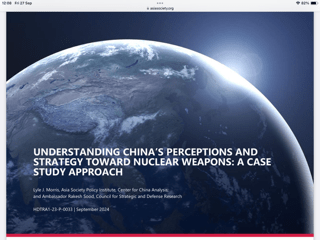
Understanding China’s Perceptions and Strategy Towards Nuclear Weapons

My paper on the India-China Border is in the Appendix at pages 16-31. Other case studies are the Korean War (1950-53), Taiwan crises (1954-55 and 1958), Cuban missile crisis(US-Soviet Union in 1962) and Sino-Soviet border conflict(1969). Since China went nuclear only in 1964, the first three only indicate evolving Chinese thinking on nuclear weapons.

The India-China experience does not square with other case studies and its conclusions because the character of threat perception is different and both India and China have declared a more restrained no-first-use policy.

The Global Nuclear Order is Under Strain

Published in the Hindu on January 3, 2024

To gain legitimacy, any global order needs to fulfil two conditions. First, a convergence among the major powers of the day; and, second, successfully presenting the outcome as a global public good to the rest of the world. The global nuclear order (GNO) was no exception but, today, it is under strain.

Lessons of the Cold War

The GNO was created in the shadow of the Cold War, with the U.S. and the U.S.S.R., leading the Western and the Socialist blocs, respectively. Following the 1962 Cuban Missile Crisis, when the two came perilously close to launching a nuclear war, both President John F. Kennedy and General Secretary Nikita Khrushchev understood two political realities. First, as the two nuclear super-powers, they needed bilateral mechanisms to prevent tensions from escalating to the nuclear level. And, second, nuclear weapons were dangerous and, therefore, their spread should be curbed. This convergence created the GNO.

During the Cuban crisis, a secret back-channel between President Kennedy’s brother Robert Kennedy and Soviet Ambassador Anatoly Dobrynin, helped resolve the crisis. The first bilateral measure was the Hot Line, established in 1963, to enable the leaders to communicate directly. The Hot Line (later upgraded into Nuclear Risk Reduction Centres) was followed by arms control negotiations as the two nuclear superpowers sought to manage their nuclear arms race and maintain strategic stability.

To control proliferation, the U.S. and the U.S.S.R. initiated multilateral negotiations in Geneva in 1965 on a treaty to curb the spread of nuclear weapons. Three years later, the Nuclear Non-Proliferation Treaty (NPT), opened for signature. It began modestly with less than sixty parties but today, it is widely described as the cornerstone of the global nuclear order with 191 adherents.

The third element of the global nuclear order came into existence in 1975. India had chosen not to sign the NPT, and in 1974, stunned the world by conducting an underground nuclear explosion, or PNE. Seven countries (the U.S., U.S.S.R., U.K., Canada, France, Japan, and West Germany) held a series of meetings in London and concluded that ad-hoc export controls were urgently needed to ensure that nuclear technology, transferred for peaceful purposes, not be used for PNEs. London Club (as it was originally known) sounded inappropriate and later transformed into the Nuclear Suppliers Group, consisting of 48 countries today, which observe common guidelines for exporting nuclear and related dual-use materials, equipment, and technologies. Though Soviet Union and India enjoyed close relations, having signed the Indo-Soviet Friendship Treaty in 1971, U.S.S.R. was committed to upholding the GNO, and a founding member of the London Club.  

Sustaining the nuclear order

The GNO has held reasonably well, particularly on two fronts. First, the taboo against nuclear weapons has held since 1945. It is a matter of debate how far the U.S.-U.S.S.R. arms control process helped preserve the taboo or whether it was just plain luck but the fact is that humanity has survived 75 years of the nuclear age without blowing itself up.

Second, non-proliferation has been a success. Despite dire predictions of more than twenty countries possessing nuclear weapons by the 1970s, (there were five in 1968 – the U.S., U.S.S.R., U.K., France, and China) only four countries have since gone nuclear, i.e., India, Israel, North Korea, and Pakistan. Even after the Cold War ended, non-proliferation remained a shared objective and Moscow and Washington cooperated to ensure that Belarus, Ukraine, and Kazakhstan that hosted Soviet nuclear weapons and possessed some capabilities, were denuclearised. In 1995, the NPT, originally concluded for 25 years, was extended into perpetuity.

On other counts, the record is mixed. Arms control did not end the U.S.-U.S.S.R. nuclear race; in fact, their arsenals grew from 28,000 bombs in 1962 to over 65,000 bombs in the early 1980s but the dialogue and some agreements provided a semblance of managing the arms race. Agreements like SALT I and II, ABM treaty, INF Treaty, START I and the New START were concluded. Since the late 1980s, the U.S. and Soviet arsenals have declined sharply, to below 12,000 bombs today, though much of this can be attributed to the end of the Cold War rivalry and the breakup of the U.S.S.R.

The two nuclear hegemons shared a notion of ‘strategic stability’ based on assured second strike capability, guaranteed by the enormous arsenals that both had built up. This eliminated any incentive to strike first ensuring deterrence stability. Arms control negotiations led to parity in strategic capacities creating a sense of arms race stability, and fail-safe communication links provided crisis management stability. These understandings of nuclear deterrence in a bipolar world outlasted the Cold War but are under question.

Changing geopolitics

Today’s nuclear world is no longer a bipolar world. The U.S. faces a more assertive China, determined to regain influence, regionally and globally. This rivalry is different from the Cold War because both economies are closely intertwined and further, China is an economic and technological peer rival. China has resented the U.S.’s naval presence in the South China and East China Seas and since the last Taiwan Strait crisis in 1996, has steadily built up its naval and missile capabilities. These were on display in August last year to demonstrate changing power equations following Speaker Nancy Pelosi’s visit to Taiwan. 

Changing geopolitics has taken its toll on the treaties between the U.S. and Russia. In 2002, the U.S. withdrew from the Anti-Ballistic Missile (ABM) Treaty and in 2019, from the Intermediate-Range Nuclear Forces (INF) Treaty on grounds that Russia was violating it. The only remaining agreement, New START, will lapse in 2026; its verification meetings were suspended during the COVID-19 outbreak and never resumed. Strategic stability talks began in 2021 following the Geneva meeting between Presidents Joe Biden and Vladimir Putin, but collapsed with the Ukraine war. Last month, Russia de-ratified the Comprehensive Test Ban Treaty (CTBT) to bring it on a par with the U.S., raising concerns about the resumption of nuclear testing. As U.S. relations with Russia went into a nosedive, the U.S. is facing a new situation of two nuclear peer rivals who are exploring new roles for more usable weapons. Moreover, Russian nuclear sabre rattling to warn North Atlantic Treaty Organisation and the U.S. against escalation in Ukraine has revived nuclear concerns. The old definitions of strategic stability no longer hold.

The Cold War convergence on non-proliferation has run its course; also, nuclear weapons technology is a 75-year-old technology. The U.S. has always had a pragmatic streak shaping its policy approaches. It turned a blind eye when Israel went nuclear in the 1960s-70s and again, when China helped Pakistan with its nuclear programme in the 1980s. More recently, the nuclear submarine AUKUS deal (Australia, U.K., U.S.) with Australia, a non-nuclear weapon state, is raising concerns in the NPT community.

During the 1970s, South Korea began to actively consider a nuclear weapons programme, spurred by the U.S. withdrawal from Vietnam. However, France withdrew its offer to supply a reprocessing plant to South Korea under U.S. pressure in 1975-76 and South Korea was persuaded to join the NPT. Recent opinion polls indicate a 70% support for developing a national nuclear deterrent and 40% for reintroducing U.S. nuclear weapons (withdrawn in 1991) on its territory.

From 1977 to 1988, the U.S. actively subverted Taiwan’s nuclear weapons programme as it stepped up a normalisation of ties with China. As a nuclear victim, the Japanese public retains a strong anti-nuclear sentiment but there is a shift, visible in Japan’s decision to double its defence spending over next five years.

During the Cold War, the U.S.’s nuclear umbrella tied its European allies closer. Today, domestic compulsions are turning the U.S. inwards, raising questions in the minds of its allies about its ‘extended deterrence’ guarantees, especially in East Asia. Japan, South Korea, and Taiwan have the technical capabilities to develop their independent nuclear deterrents within a short time, given political will. It is only a matter of time before U.S. pragmatism reaches the inevitable conclusion that more independent nuclear deterrent capabilities may be the best way to handle the rivalry with China.  

The GNO is looking increasingly shaky.

*****