Today, the global nuclear order offers a curious contradiction – since the bombing of Hiroshima and Nagasaki in 1945, nuclear weapons have not been used during the last 80 years. The global nuclear arsenals have come down from a high of 65000 bombs in late 1970s to less than 12500 today. And, despite concerns in 1960s that by 1980, there may be at least two dozen states with nuclear weapons, the total today remains nine, five (the United States, Russia, The United Ukingdom, France and China) are permanent members of the United Nations Security Council who had tested before the Nuclear Non-Proliferation Treaty (NPT) came into being and four more who developed their nuclear arsenals later (Israel, Pakistan, India, and North Korea).
Looking back, these would seem to be impressive achievements but nobody is celebrating. In fact, the prevailing sentiment is that the global nuclear order is under strain and the U.S. President Donald Trump’s recent announcements may weaken all three elements of the global nuclear order.
Resumption of ‘nuclear tests’
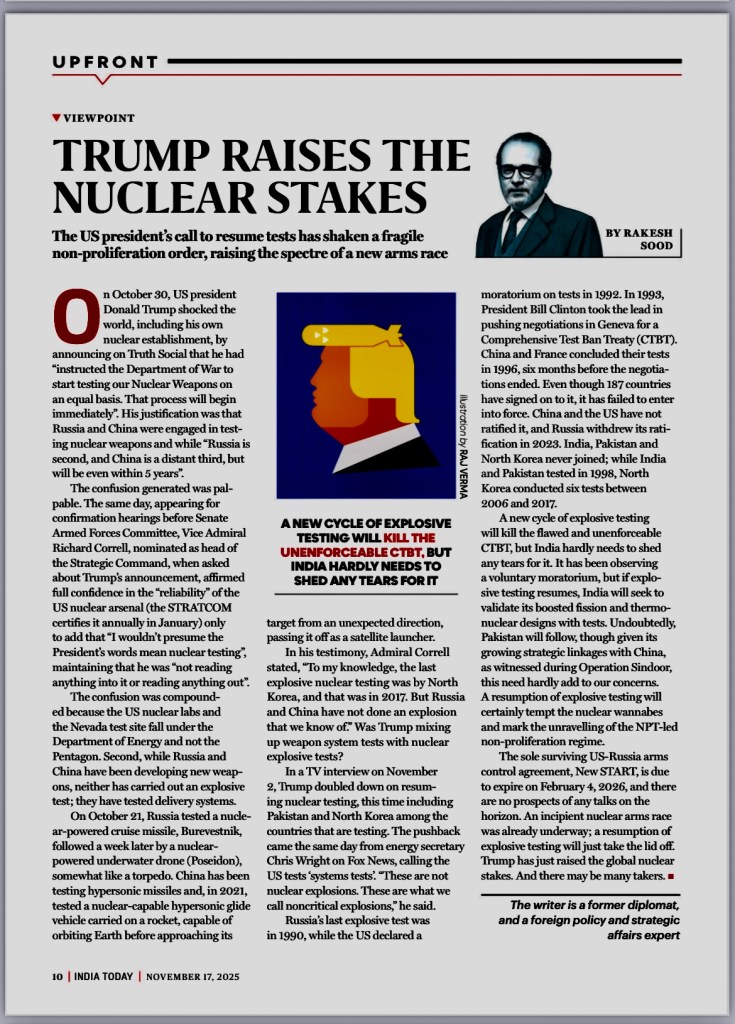
On October 30, 2025, on his way to a meeting with China’s President Xi Jinping in Busan, Mr. Trump announced on Truth Social, “Because of other countries testing programs, I have instructed the Department of War to start testing our Nuclear Weapons on an equal basis. That process will begin immediately.” He added, “Russia is second, China is a distant third, but will be even within 5 years.”
While it was clear that the message was directed at Russia and China, it was unclear whether Mr. Trump was referring to ‘nuclear explosive testing’ or testing of nuclear weapon systems. Second, the nuclear labs (Los Alamos, Lawrence Livermore, and Sandia) and the Nevada testing facilities fall under the Department of Energy and not the Department of War.
It is no secret that China, Russia, and the U.S. are designing and developing new nuclear weapons. On October 21, Russia tested a nuclear-powered cruise missile (Burevestnik) that travelled 14000 kms, following a week later, with a test of an underwater nuclear-powered torpedo (Poseidon). China has been testing hypersonic missiles and, in 2021, tested a nuclear capable hypersonic glide vehicle carried on a rocket, capable of orbiting the earth before approaching its target from an unexpected direction that was passed off as a satellite launcher. The U.S. is producing new warheads – a variable yield B61-13 gravity bomb, a low yield W76-2 warhead for the Trident II D-5 missile, while working on a new nuclear armed submarine launched cruise missile.
Yet they have refrained from explosive testing. Russia’s last explosive test was in 1990 while the US declared a moratorium on tests in 1992. In 1993, the U.S. created a Stockpile Stewardship and Management Programme under the National Nuclear Security Administration to work on warhead modernisation, life extension, and development of new safety protocols in warhead design. U.S. President Bill Clinton also took the lead in pushing negotiations in Geneva for a Comprehensive Test Ban Treaty (CTBT). China and France concluded their tests in 1996, six months begore the negotiations ended.
Why CTBT lacks a definition
Twenty-nine years later, the CTBT hasn’t entered into force despite 187 countries signing it. Among the necessary ratifications, the U.S., China, Israel, Egypt, and Iran have not done so, Russia did and withdrew its ratification in 2023, and India, Pakistan and North Korea have neither signed nor ratified it. India and Pakistan tested in 1998 and have since observed a voluntary moratorium, and North Korea conducted six tests between 2006 and 2017. Given today’s geopolitics, the prospects for the CTBT entering into force appear bleak.
Second, the CTBT obliges states “not to carry out any nuclear weapon test explosion or any other nuclear explosion.” The U.S. was opposed to defining the terms, and instead, worked out private understandings with Russia and China on ‘zero-yield-tests;’ this permitted hydro-nuclear tests that do not produce a self-sustaining supercritical chain reaction.
The U.S. had conducted over a thousand nuclear tests and Russia 727 tests, giving them an adequate data base. China though with only 47 tests, also went along with this understanding. Thus, the CTBT delegitimsed only nuclear-explosive testing, not nuclear weapons, the reason why India never joined it.
In 2019-20, the U.S. State Department assessed that Russia and China “may have conducted low yield nuclear tests in a manner inconsistent with the U.S. zero-yield standard” though this was negated by the CTBT organisation that declared that their monitoring network with over 300 monitoring stations spread over 89 countries had not detected any inconsistent activity.
In a TV interview on November 2, Mr. Trump doubled down on resuming nuclear testing, this time including Pakistan and North Korea among the countries testing. A clarification came the same day from energy secretary Chris Wright on Fox News, calling the US tests ‘systems-tests’, “These are not nuclear explosions. These are what we call noncritical explosions,” he said. However, Mr. Trump’s intention remains unclear.
Regional and global implications
The new low-yield warheads being designed make them more usable and the new systems (hypersonics, cruise and unmanned systems) are dual capable systems, leading to renewed research for missile defences like the U.S. ‘golden dome.’ Meanwhile doctrinal changes are being considered to cope with new technological developments in cyber and space domains. This raises doubts about the nuclear taboo in coming decades.
The sole surviving US-Russia arms control agreement, Ner Strategic Arms Reduction Treaty (New START) that limits the U.S. and Russian strategic forces to 700 launchers and 1550 warheads is due to expire on Feb 4, 2026 with no prospects of any talks on the horizon. China is not a party to any arms control and its nuclear arsenal that had remained below 300, is undergoing a rapid expansion, estimated at 600 today and likely to exceed 1000 by 2030. An incipient nuclear arms race was already underway; a resumption of explosive testing will just take the lid off.
Russia and China have denied Mr. Trump’s allegations regarding clandestine tests but will follow if the U.S. resumes explosive testing; China will be the biggest beneficiary because with only 47 tests (compared to over 1000 by the U.S.), resumed tests will help it to validate new designs and accumulate data.
India has been observing a voluntary moratorium but if explosive testing resumes, India will certainly resume testing to validate its boosted fission and thermonuclear designs, tested only once in 1998. Undoubtedly, Pakistan will follow but given its growing strategic linkages with China witnessed during Op Sindoor, this need hardly add to our concerns.
Though the CTBT is not in force, it did create a norm. But a resumption of explosive testing will lead to its demise. It will also tempt the nuclear wannabes to follow and mark the unravelling of the NPT led non-proliferation regime.
The taboo against use must remain intact
The U.S. has been the most significant player in shaping the global nuclear order; it would be ironical if Mr. Trump’s actions now become the catalyst for its demise. The reality is that the present global nuclear order was shaped by the geopolitics the 20th century; the challenge today is to craft a new nuclear order that reflects the fractured geopolitics of the 21st century while ensuring that the taboo against their use remains intact.
The UN Secretary General has cautioned that “current nuclear risks are already alarmingly high” and urged nations “to avoid all actions that could lead to miscalculation or escalation with catastrophic consequences.” But is anyone listening?
Last Friday, the Oval Office provided an unusual stage for diplomatic theatre that stunned audiences around the world. The live telecast of the unscripted exchange between Ukrainian President Volodymyr Zelensky, a former comedian and US President Donald Trump, a former reality TV star, with J D Vance playing a supporting role, has become the stuff of diplomatic legend, with reactions ranging from applause and awe to shock and horror.
Perhaps, there was a hint of what was to come when Trump remarked “Oh, you are all dressed up,” as he welcomed Zelensky to the White House. Or in an early question by a reporter about why he wasn’t wearing a suit in “United States’ highest office?” But if so, it didn’t register with Zelensky. When Vance praised Trump’s efforts at diplomacy and Zelensky questioned it, Vance belligerently accused him of being “disrespectful” instead of being “thanking the president.” Zelensky remonstrated but Trump intervened, telling him that he didn’t “have the cards” and blamed him for “gambling with World War III.” Minutes later, Trump ordered the media to leave but added that “This (their spat) is going to be great television.”
Since then, the signalling has continued through media and X. On 1 March, Trump said that “Zelensky is not ready for peace.” The following day, Zelensky said after his London meeting that a peace deal is “still very very far away” angering Trump, who responded that “America will not put up with this for longer.” On 3 March, US announced that it was pausing all aid to Ukraine, even as European leaders were finding ways of repairing the damage. Meanwhile, on Saturday, Elon Musk tweeted “I agree” to a post from someone who wrote, “It’s time to leave NATO and the UN.”
Political leaders make use of media, including social media, for signalling to different audiences, both at home and abroad. But there is a good reason why diplomatic discussions and negotiations are conducted in camera. It permits the parties concerned to protect the image of the leaders, allow diplomatic summitry to maintain the aura of gravitas of diplomatic summitry, and control the narrative. The Trump-Zelensky encounter is an example of how both sides lost control of the plot.
Some policy analysts feel that US outreach to Putin is to dilute the Russia-China bond, reminiscent of the 1971 Kissinger visit to China to divide the Communist bloc. But the parallel is misplaced. In 1971, cracks were visible in the China-Soviet relationship, and second, the US was not creating a divide within the Western bloc.
The substance of US diplomacy
Zelensky knew that he held the weaker hand. Had he kept it in mind in the Oval Office, he could have sidestepped the provocation. Trump and Vance revel in the in-your-face approach, both domestically and with other leaders. However, exposing a growing US-Europe divide on Ukraine and other issues only weakens the US hand by giving comfort to Putin and Xi Jinping.
Realism has always been an integral part of diplomacy. Political leaders, whether democrats or autocrats, instinctively know that idealism is not the strategy for survival. Writing in the fourth century B.C., Greek historian Thucydides described the powerful Athenian delegation bluntly informing the weaker Melians, “The strong do what they can and the weak suffer what they must.” Closer home, Kautilya elaborated how diplomacy and persuasion can amplify the effectiveness of power in the Arthashastra.
US presidents have never been idealists. Even President Roosevelt, the key architect of the United Nations, was clear that the real power would be exercised by the Security Council and within that, by the Permanent Members who enjoy veto powers. At the same time, he also realised that the principle of equality of sovereign states had to be respected to get a buy-in by all countries and so the General Assembly became the premier annual gathering. And this when the US accounted for 50 percent of global GDP!
Nixon extricated the US from Vietnam but needed the fig leaf of the Paris Peace Accords negotiated in 1973. Just as Biden used the agreement Trump had concluded with the Taliban to engineer the US exit from Afghanistan. Both were guided by realism but needed the diplomatic cover. During the Cold War, successive US presidents supported military dictatorships in pursuit of realism but couched it as a defence of democracy and the free world. Yet, when faced with the Soviet crackdowns in Hungary in 1956 or Czechoslovakia in 1968, the value-based diplomacy quickly yielded to realist prudence.
Therefore, Trumpian diplomacy is not a departure from US diplomatic practice in substance; its change is more in Trump’s style of diplomacy. He may desire to Make America Great Again but he presides over an America that no longer enjoys the primacy it enjoyed in 1945 or 1991. Though President Theodore Roosevelt’s advice “speak softly and carry a big stick” was given at the beginning of the 20th century before the age of TV and social media, it remains valid because as President Abraham Lincoln famously said, “You can fool all the people some of the time, and some of the people all the time, but you cannot fool all the people all the time.” Trump would do well to heed the advice of his predecessors and not be seduced by his own voice on Truth Social.
To gain legitimacy, any global order needs to fulfil two conditions. First, a convergence among the major powers of the day; and, second, successfully presenting the outcome as a global public good to the rest of the world. The global nuclear order (GNO) was no exception but, today, it is under strain.
Lessons of the Cold War
The GNO was created in the shadow of the Cold War, with the U.S. and the U.S.S.R., leading the Western and the Socialist blocs, respectively. Following the 1962 Cuban Missile Crisis, when the two came perilously close to launching a nuclear war, both President John F. Kennedy and General Secretary Nikita Khrushchev understood two political realities. First, as the two nuclear super-powers, they needed bilateral mechanisms to prevent tensions from escalating to the nuclear level. And, second, nuclear weapons were dangerous and, therefore, their spread should be curbed. This convergence created the GNO.
During the Cuban crisis, a secret back-channel between President Kennedy’s brother Robert Kennedy and Soviet Ambassador Anatoly Dobrynin, helped resolve the crisis. The first bilateral measure was the Hot Line, established in 1963, to enable the leaders to communicate directly. The Hot Line (later upgraded into Nuclear Risk Reduction Centres) was followed by arms control negotiations as the two nuclear superpowers sought to manage their nuclear arms race and maintain strategic stability.
To control proliferation, the U.S. and the U.S.S.R. initiated multilateral negotiations in Geneva in 1965 on a treaty to curb the spread of nuclear weapons. Three years later, the Nuclear Non-Proliferation Treaty (NPT), opened for signature. It began modestly with less than sixty parties but today, it is widely described as the cornerstone of the global nuclear order with 191 adherents.
The third element of the global nuclear order came into existence in 1975. India had chosen not to sign the NPT, and in 1974, stunned the world by conducting an underground nuclear explosion, or PNE. Seven countries (the U.S., U.S.S.R., U.K., Canada, France, Japan, and West Germany) held a series of meetings in London and concluded that ad-hoc export controls were urgently needed to ensure that nuclear technology, transferred for peaceful purposes, not be used for PNEs. London Club (as it was originally known) sounded inappropriate and later transformed into the Nuclear Suppliers Group, consisting of 48 countries today, which observe common guidelines for exporting nuclear and related dual-use materials, equipment, and technologies. Though Soviet Union and India enjoyed close relations, having signed the Indo-Soviet Friendship Treaty in 1971, U.S.S.R. was committed to upholding the GNO, and a founding member of the London Club.
Sustaining the nuclear order
The GNO has held reasonably well, particularly on two fronts. First, the taboo against nuclear weapons has held since 1945. It is a matter of debate how far the U.S.-U.S.S.R. arms control process helped preserve the taboo or whether it was just plain luck but the fact is that humanity has survived 75 years of the nuclear age without blowing itself up.
Second, non-proliferation has been a success. Despite dire predictions of more than twenty countries possessing nuclear weapons by the 1970s, (there were five in 1968 – the U.S., U.S.S.R., U.K., France, and China) only four countries have since gone nuclear, i.e., India, Israel, North Korea, and Pakistan. Even after the Cold War ended, non-proliferation remained a shared objective and Moscow and Washington cooperated to ensure that Belarus, Ukraine, and Kazakhstan that hosted Soviet nuclear weapons and possessed some capabilities, were denuclearised. In 1995, the NPT, originally concluded for 25 years, was extended into perpetuity.
On other counts, the record is mixed. Arms control did not end the U.S.-U.S.S.R. nuclear race; in fact, their arsenals grew from 28,000 bombs in 1962 to over 65,000 bombs in the early 1980s but the dialogue and some agreements provided a semblance of managing the arms race. Agreements like SALT I and II, ABM treaty, INF Treaty, START I and the New START were concluded. Since the late 1980s, the U.S. and Soviet arsenals have declined sharply, to below 12,000 bombs today, though much of this can be attributed to the end of the Cold War rivalry and the breakup of the U.S.S.R.
The two nuclear hegemons shared a notion of ‘strategic stability’ based on assured second strike capability, guaranteed by the enormous arsenals that both had built up. This eliminated any incentive to strike first ensuring deterrence stability. Arms control negotiations led to parity in strategic capacities creating a sense of arms race stability, and fail-safe communication links provided crisis management stability. These understandings of nuclear deterrence in a bipolar world outlasted the Cold War but are under question.
Changing geopolitics
Today’s nuclear world is no longer a bipolar world. The U.S. faces a more assertive China, determined to regain influence, regionally and globally. This rivalry is different from the Cold War because both economies are closely intertwined and further, China is an economic and technological peer rival. China has resented the U.S.’s naval presence in the South China and East China Seas and since the last Taiwan Strait crisis in 1996, has steadily built up its naval and missile capabilities. These were on display in August last year to demonstrate changing power equations following Speaker Nancy Pelosi’s visit to Taiwan.
Changing geopolitics has taken its toll on the treaties between the U.S. and Russia. In 2002, the U.S. withdrew from the Anti-Ballistic Missile (ABM) Treaty and in 2019, from the Intermediate-Range Nuclear Forces (INF) Treaty on grounds that Russia was violating it. The only remaining agreement, New START, will lapse in 2026; its verification meetings were suspended during the COVID-19 outbreak and never resumed. Strategic stability talks began in 2021 following the Geneva meeting between Presidents Joe Biden and Vladimir Putin, but collapsed with the Ukraine war. Last month, Russia de-ratified the Comprehensive Test Ban Treaty (CTBT) to bring it on a par with the U.S., raising concerns about the resumption of nuclear testing. As U.S. relations with Russia went into a nosedive, the U.S. is facing a new situation of two nuclear peer rivals who are exploring new roles for more usable weapons. Moreover, Russian nuclear sabre rattling to warn North Atlantic Treaty Organisation and the U.S. against escalation in Ukraine has revived nuclear concerns. The old definitions of strategic stability no longer hold.
The Cold War convergence on non-proliferation has run its course; also, nuclear weapons technology is a 75-year-old technology. The U.S. has always had a pragmatic streak shaping its policy approaches. It turned a blind eye when Israel went nuclear in the 1960s-70s and again, when China helped Pakistan with its nuclear programme in the 1980s. More recently, the nuclear submarine AUKUS deal (Australia, U.K., U.S.) with Australia, a non-nuclear weapon state, is raising concerns in the NPT community.
During the 1970s, South Korea began to actively consider a nuclear weapons programme, spurred by the U.S. withdrawal from Vietnam. However, France withdrew its offer to supply a reprocessing plant to South Korea under U.S. pressure in 1975-76 and South Korea was persuaded to join the NPT. Recent opinion polls indicate a 70% support for developing a national nuclear deterrent and 40% for reintroducing U.S. nuclear weapons (withdrawn in 1991) on its territory.
From 1977 to 1988, the U.S. actively subverted Taiwan’s nuclear weapons programme as it stepped up a normalisation of ties with China. As a nuclear victim, the Japanese public retains a strong anti-nuclear sentiment but there is a shift, visible in Japan’s decision to double its defence spending over next five years.
During the Cold War, the U.S.’s nuclear umbrella tied its European allies closer. Today, domestic compulsions are turning the U.S. inwards, raising questions in the minds of its allies about its ‘extended deterrence’ guarantees, especially in East Asia. Japan, South Korea, and Taiwan have the technical capabilities to develop their independent nuclear deterrents within a short time, given political will. It is only a matter of time before U.S. pragmatism reaches the inevitable conclusion that more independent nuclear deterrent capabilities may be the best way to handle the rivalry with China.
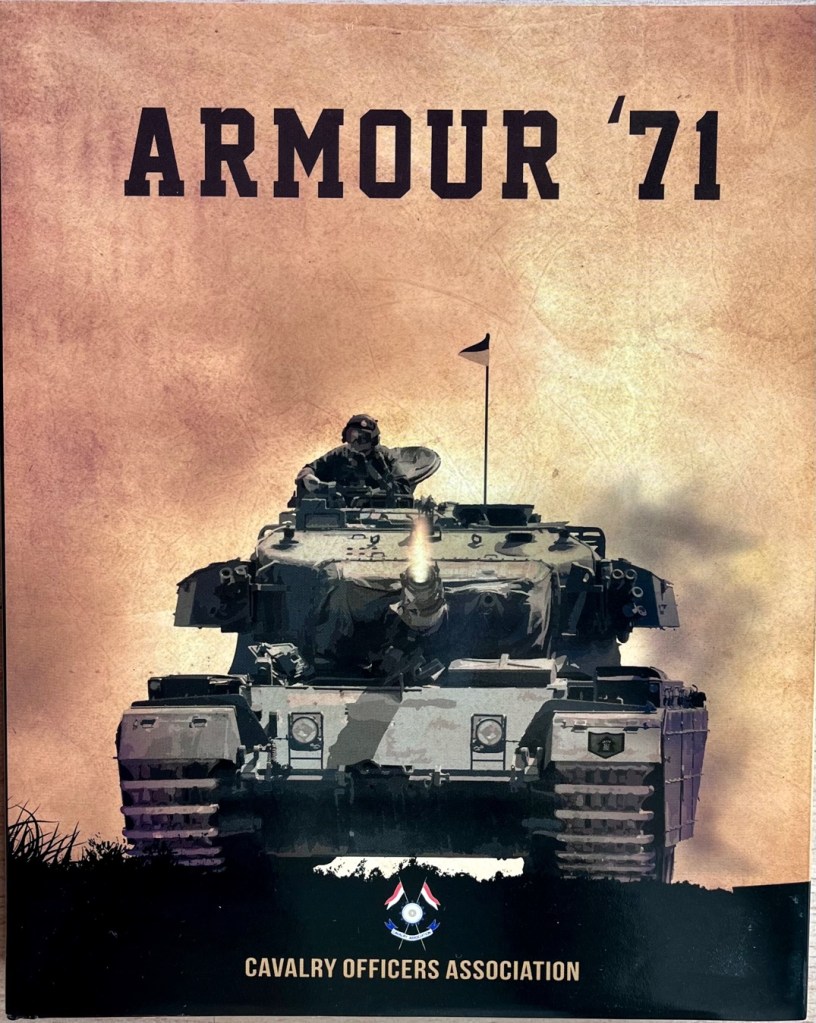
1971 is widely remembered as a liberation war, a war that led to the creation of a new country. It was not the first of the India-Pakistan wars; the two countries had been to war twice earlier, in 1947-48 and again in 1965. It was also not to be the last one, as Kargil war showed us in 1999. Yet, of all four, the 1971 war is remembered as the decisive one. All wars and battles lead to outcomes, invariably interpreted as victory or defeat by the protagonists and the India-Pakistan wars are no different. None of the four wars succeeded in ending the hostile relationship between the two because they remained inconclusive but the 1971 war is still accepted as a decisive victory for India. That is how history remembers it fifty years later; for it achieved an outcome that changed the map of the region forever.
Battles are fought on land, in the air and in the seas and oceans but outcomes of wars are also determined in meeting rooms and conference halls. 1971 is seen as a decisive victory for India because it reflected an Indian victory in shaping the narrative, domestically, regionally and globally. Yet, like in all wars, there were uncertainties and India had to cater for the unexpected. There were unanticipated developments that forced Indian leaders to adapt and modify goalposts but without losing control of the historical narrative. This article seeks to explore the dimensions of the 1971 war not on the battlefield but around conference tables and tension filled meeting rooms.
Seeds of the conflict
The war began in 1971 but the root causes go further back into history. A short appreciation illustrates how it helped Indian leaders shape the political narrative and take certain decisions. The seeds of differences between the leaders of East Pakistan and West Pakistan had been sown even before 1947. The ill-conceived partition of Bengal by Lord Curzon in 1905 provoked widespread resentment and agitations and had to be revoked in 1911. However, it heightened a sense of political awareness among the Muslims of Bengal. It is worth recalling that the Muslim League was founded in 1906 in Dhaka by the Nawab of Dhaka and included many prominent Bengali Muslims like Shaheed Suhrawardy, Khwaja Nazimuddin and Fazlul Haq. In subsequent years, the Muslim League leadership began to be dominated by Muslims from the north and west and very often, these leaders came from more elitist backgrounds.
In 1946, distance between the Bengali leaders of the League and Jinnah were surfacing and find mention in Suhrawardy’s letter to Chowdhary Khaliquzzaman. By this time, partition of India was emerging as a likely outcome, and while in the west, there were contiguous Muslim majority areas, the same was not the case in Bengal and Bihar. Suhrawardy reflected concerns about Muslims where they were in minority provinces and questioned Jinnah’s obsession with partition.
A key reason was that the Bengali Muslim identity was deeply rooted in the culture and linguistic traditions of Bengal. Bengali Muslims did not take to adoption of Urdu, Arabic or Persian instruments to emphasise their religious identity. In this sense, they were akin to the Muslim communities of Kerala and Tamil Nadu. They were influenced more by Bhakti and Sufi traditions than by Hanafi or Wahabi influences. However, the political tides took their toll and Pakistan emerged with two units – East and West Pakistan separated by 1500 miles of India in the middle.
After Liaqat Ali’s assassination in 1952, though both Shaheed Suhrawardy and Khwaja Nazimuddin served briefly as Prime Ministers, the power centre was shifting westwards. The erosion of East Pakistan’s autonomy began soon after 1947. Bengali Muslim League leaders were often given short shrift. Discussions on the constitution came to an impasse because West Pakistan was unwilling to accept a legislature that would have greater Bengali representation based on populations of the two wings. Jinnah’s fiat in 1951 about Urdu as the national language led to riots in Dhaka.
By 1954, the Awami faction of the Pakistan Muslim League had dropped the first two words and emerged as the Awami League. The growing marginalisation of the Muslim League at the hands of the Awami League led Gen Ayub Khan to overthrow the civilian government and declare martial law in 1958. A similar electoral outcome in 1970 eventually led Awami League to spearhead the call for independence in 1971.
Along with political discrimination, East Pakistan also suffered growing economic discrimination. The Planning Commission of Pakistan provided the most conclusive data in its reports. In 1949-50, the per capita income in East Pakistan was Rs 288 compared to Rs 351 in West Pakistan. By 1969-70, the disparity had widened and East Pakistan’s figure had risen to Rs 331, while West Pakistan’s per capita income had grown to Rs 533. Similar discrepancies were visible in terms of infrastructure, health and educational facilities. East Pakistan received 25 percent of investment despite being home to over half the population. Its share of Pakistan’s export earnings was between 50 and 70 percent during this period but its share of imports ranged between 25 and 30 percent. According to the Planning Commission, the net transfer of resources during these two decades from East to West was $ 2.6 billion.
The economic domination was made easier by the military rule that reinforced the West Pakistani domination in the military forces and the civil services. By 1970, 84 percent of the civil service and 85 percent of the diplomatic service was West Pakistani as was 95 percent of the army. Among the air force pilots, 89 percent were from the West. It is this frustration that led Sheikh Mujibur Rahman as President of the Awami League to announce the 6-point demand in 1966 for restructuring of the Pakistani state in a manner that would provide autonomy to the East.
The points included a federal parliamentary government; devolution of power with federal government authority restricted to defence and foreign affairs; effective measures to prevent flight of capital from East to West or two separate and freely convertible currencies; revenue and taxation powers with federating units and a percentage of the revenue to be given to the centre; separate accounts for foreign exchange earnings of the two wings; and, the setting up a separate para-military force for East Pakistan. As the 6 points gained greater traction, the groundswell of protests grew and Gen Ayub Khan was forced to resign in 1969.
His successor Gen Yahya Khan initially declared martial law but was then forced to convene general elections in December 1970. In a National Assembly of 313 members, Awami League made a clean sweep in the east, winning 167 seats; Zulfikar Ali Bhutto’s PPP was a distant second with 88 seats. It was clear that Sheikh Mujib would be the next PM while his party would also provide the Chief Minister for East Pakistan. Bhutto began to raise questions about Sheikh Mujib’s authority to change the constitution in keeping with the 6-point agenda and demanded equal authority as a representative of the West though his party had not won any seat in NWFP or Balochistan. The election outcome was a perfect reflection of the polarisation of the political structures.
Till this point, India had made no comments on the situation except to welcome the holding of the general elections so that a democratically elected government would take over from the military rulers. However, the National Assembly was never convened. Protests broke out in march against the delays, leading to firing and casualties in East Pakistan. As protests spread, martial law provisions were implemented ruthlessly. Sheikh Mujib refused to enter into a power sharing arrangement at the centre that Bhutto proposed or dilute his demands for autonomy. The last round of talks ended on 25 March and Bhutto returned to Karachi even as the National Assembly was to convene the following day. That night Operation Searchlight was launched, a brutal, genocidal crackdown, across the board aimed at crushing any dissent. Sheikh Mujib was arrested and flown out to Rawalpindi.
India gets involved
Prime Minister Indira Gandhi addressed the issue in parliament, criticising the military repression, expressing concern and urging restoration of democratic processes. Supportive resolutions were adopted by consensus. Overflights of Pakistani aircraft were suspended. After Sheikh Mujib’s arrest, the other members of the Awami leadership escaped entering border districts of West Bengal. In early April, an independent government of Bangla Desh was established on the border, its location was named Mujibnagar. Sheikh Mujibur Rahman was declared President in absentia; Syed Nazrul Islam and Tajuddin Ahmed were appointed Vice President and Prime Minister respectively. Further, India gave refuge to the East Pakistani military and para-military elements who were escaping the brutal crackdown overseen by Lt Gen Tikka Khan.
The few East Pakistani army officers deployed in the east defected; the two senior most were Col M A G Osmani and Major Ziaur Rahman and the others in West Pakistan were put under house arrest. An underground resistance took shape under the leadership of Major Rahman. The youth wing of the Awami League reconstituted themselves as the Mukti Bahini under the leadership of Sheikh Fazlul Haq Moni (Sheikh Mujib’s nephew), Tofail Ahmed and ‘Tiger’ Kader Siddiqui. Together, they formed the core of the resistance. In some of the sub-districts, they captured treasuries and acquired some weapons. With these resources, they turned to India for help and Indian intelligence agencies, led by the Research and Analysis Wing (R&AW) got involved.
The outflow of refugees that had been a trickle soon turned into a torrent. By mid-May, neighbouring states of Assam, Tripura and West Bengal were hosting over five million refugees stretching the local resources. India began to agitate the East Pakistan issue as a humanitarian and refugee crisis in the relevant United Nations bodies in New York and Geneva. Internally, a Core Group was set up under Principal Secretary to PM P N Haksar, including Chairman of the Policy Planning Committee D P Dhar, Foreign Secretary T N Kaul, R&AW chief R N Kao and PN Dhar, Secretary to PM. At the cabinet level, Mrs Indira Gandhi consulted Defence Minister Jagjivan Ram, Finance Minister Y B Chavan and Foreign Minister Swaran Singh.
Initially, Mrs Gandhi favoured the idea of giving immediate recognition to Bangla Desh as a free country with a government in exile but others including Swaran Singh felt that India needed time to prepare the ground for gaining broad international acceptance; otherwise, India ran the risk of being blamed for interfering in the internal affairs of a neighbouring country and encouraging secession. It was also clear that immediate recognition would very likely lead to military operations in East Pakistan and Jagjivan Ram and Army chief Gen S H F J Manekshaw both sought time for adequate planning and resourcing as the conflict could also escalate into the western theatre, leading to a two-front situation.
Accordingly, an evolutionary policy approach was adopted with the necessary preparations to exercise the military option at a later date. The political understanding was that the Pakistan regime needed to respect the outcome of the December election and for this, the first step is the release of Sheikh Mujibur Rahman and commencement of a political dialogue. The second decision was to demand an end to the military crackdown in East Pakistan and a return of the troops to their barracks so that conditions for the return of the refugees could begin to be created. While the international community, especially key major powers needed to be approached to use their influence with Pakistan for the above two points, UN and its agencies would be sensitised to the refugee crisis to generate relief and rehabilitation assistance. Finally, resources for the military option were cleared so that necessary procurement could be fast tracked. Gen Manekshaw had the lessons of 1962 war with China and the 1965 war with Pakistan in mind and needed a better trained and better equipped force. Further, he also needed far greater coordination with the Air Force and Navy than had been in evidence earlier.
From June to December, the Ministry of External Affairs became the instrument for the campaign on the first two points, even as senior political leaders led by Mrs Gandhi visited selected capitals. Following closure of Indian air space, Pakistani aircraft had been using Colombo as a transit point. After some reluctance, Sri Lanka was finally persuaded in end-July to withdraw this facility. By this time the number of refugees had crossed eight million. Pakistan refused to release Sheikh Mujib, accused India of seeking a break-up of Pakistan, called the refugees as ‘rebels and secessionists’ and continued its crackdown.
The first fortnight of July unveiled a new surprise. On 6 July, US National Security Adviser Henry Kissinger landed in Delhi for talks. His message was to urge India to be patient even as news were breaking about US having resumed military supplies to Pakistan. After two days of bruising meetings in Delhi he took off for Islamabad. After a day, he feigned illness, ostensibly went to Nathiagali to recover, while he took off for his secret visit to Beijing that had been in the making and for which, Gen Yahya Khan had played the go-between. After returning to Islamabad, having recovered from his illness and returned to the US. On 15 July, US president Richard Nixon announced to a stunned world that he had accepted an invitation to visit China. As the details of Pakistan’s role emerged, Indian leaders were forced to review their options.
As we now know, Washington was fully aware of the developments in East Pakistan. The US Consul General in Dhaka Archer Blood sent a telegram to Washington in end-March, days after the beginning of Operation Searchlight, titled ‘Selective Genocide’. When it did not elicit a response, it was followed up in subsequent weeks with more details of the killings and then finally he and twenty of his colleagues sent the now famous ‘Dissent Telegram’, conveying disagreement with US policy on Pakistan and describing it as ‘moral bankruptcy’. By end-April, he was sacked from the post and returned to the US where he was assigned to the Personnel Department. US never asked for the release of Sheikh Mujib or criticised Gen Yahya Khan for the military crackdown; it merely asked him to seek a political solution.
Even when US Ambassador in Islamabad Joseph Farland reported that Pakistan could not hold on to its eastern wing, Kissinger’s response was that the US needed six months to pull off the China visit. The US effort therefore was to prevent India from going for the military option. The last straw was the message conveyed by Kissinger to Indian Ambassador L K Jha on 17 July that in case a war broke out between India and Pakistan and China got involved on Pakistan’s side, US would be unable to help India.
The Indo-Soviet Treaty for Peace, Friendship and Co-operation had been under discussion for a couple of years. There was already movement to fast track it and D P Dhar had been following it up. It was now finalised and Soviet Foreign Minister Andrei Gromyko flew to Delhi for the signing on 7 August. It included a significant clause calling for mutual consultations in the event of a threat to either party. Indian military planners had to factor in not just a two-front war with Pakistan but also the possibility of China upping the ante in the north-east. This was not an exaggerated notion. After the 1965 war, Bhutto had visualised that in the next conflict, coordination with China would be essential, in the north-east and particularly close to Sikkim down to the ‘chicken’s neck’. Bhutto was an influential leader and his own political ambitions had contributed to the East Pakistan crisis. From India’s point of view, a non-hostile Bangla Desh was strategically preferable to a hostile East Pakistan. Further, it was a negation of the two-nation theory that had formed the basis of the creation of Pakistan in the first place. The die was cast.
Setting the stage
Swaran Singh resumed his travels to key European capitals and US and Canada. K C Pant visited a number of Asian and Latin American capitals. Mohammed Yunus took on the responsibility of covering the Arab countries. The response was disappointing. Even where there was sympathy, there was a reluctance to get drawn into an issue that had larger ramifications. Territorial break-up of a state was difficult to accept and Pakistan was a member of Western military alliances, SEATO and CENTO. China and the US were openly supporting Pakistan and the Islamic world displayed a clear sympathy for Pakistan. NAM was moribund.
However, international public opinion was getting energised. Media had begun to carry harrowing stories and pictures of the refugee camps. Joan Baez took up the cause in a series of concerts called Song for Bangla Desh. Pandit Ravi Shankar and George Harrison organised the Concert for Bangla Desh bringing together the Beatles, Eric Clapton and Bob Dylan, among others. In October-November, visits to the refugee camps by people like Prince Sadruddin Aga Khan, Senator Edward Kennedy and prominent French intellectual Andre Malraux kept the world opinion sensitised to the humanitarian tragedy.
Meanwhile, at home, arrangements were made to enable the government in exile to establish contact with East Pakistani diaspora in other countries. The entire Bengali component of the Pakistani consulate in Calcutta had resigned and had joined the establishment in Mujibnagar. A Branch Secretariat of the MEA to coordinate the different needs and requirements of the growing refugee camps as well as the government in exile, was established in Calcutta, with representation from other branches of the government. Indian missions abroad were receiving requests for asylum from East Pakistani diplomats and officials that needed vetting. Gen Yahya Khan was threatening to charge Sheikh Mujib with treason and subject him to a court martial.
A last-ditch diplomatic exercise was set to unfold at the UN General Assembly in the third week of September. It was vital to ensure that India’s options not be constrained by any move by Pakistan, in concert with the US, through the Security Council. Even delaying tactics were to be blocked. Pakistan’s appeal was for preserving the territorial integrity of a member state. It was mooted that Pakistan may be receptive to taking back only the Muslim refugees provided the international community paid for their resettlement. The 1970 election was forgotten. Awami League was declared a secessionist party and therefore to be disbanded. Once West Pakistan’s authority was restored, a civilian government would be put in place. In the UN, the majority of the countries only addressed the humanitarian aspect and shied away from addressing the political issues. Some suggested that India and Pakistan should settle it bilaterally. Less than half a dozen countries supported the idea of respecting the will of the people reflected in the electoral outcome. The idea of a liberation struggle found no takers.
Even as India explored the possibility of a delegation of the Bangla Desh government in exile to visit New York to address the UN and engage directly with people, US Consulate in Calcutta was seeking to establish its own links with some members of the government in exile in order to explore if they were open to direct talks with the Yahya regime and create an embarrassing split. Meanwhile the Mukti Bahini had stepped up its activities in East Pakistan. Domestic public opinion in India was urging Mrs Gandhi to be more forthcoming in supporting the Mukti Bahini and recognising the government in exile. By mid-November it was clear that operational support for the freedom fighters needed to be stepped up, the liberation war could not be a prolonged affair and, Indian military action was inevitable.
In October-November, Mrs Gandhi undertook a series of foreign visits covering Moscow, Bonn, Paris, London and concluding with Washington on 4-5 November. The responses were along predictable lines. US had opened links to the Soviet Union suggesting that détente could be jeopardised if they encouraged India to declare war on Pakistan. In Moscow, Soviet leaders supported the calls for an end to the military crackdown and the killings as also release of Sheikh Mujib to enable a political settlement; in private talks, Premier Kosygin cautioned that a war might worsen the situation for India. She got a sympathetic hearing in Paris and Bonn from President Pompidou and Chancellor Willy Brandt respectively but a lukewarm reception in London. By this time, a Pakistani military build up on the western front had raised the prospects of war. After a frosty meeting with President Nixon in White House on 4 November, Mrs Gandhi decided to use the second meeting the following day on other global issues, completely bypassing the East Pakistan crisis.
The last of the doubts in Mrs Gandhi’s mind about avoiding war had vanished. She realised that that the international community could not support a return of the refugees. Moreover, the Mukti Bahini was becoming resentful at the restraints imposed on them by India. Pakistan adopted a policy of hot pursuit into India in the eastern sector, including using its airplanes. India responded in kind. Conflict broke out at Boyra on 22 November. The western sector was put on high alert. After some reservations on the part of Eastern Command the political decision was taken to set up a joint command with Col Osmani leading the freedom fighters. Mrs Gandhi was flying back from Calcutta to Delhi on 3 December when she learnt that Pakistani airplanes had undertaken pre-emptive strikes against Indian airfields in the western sector.
After landing in Delhi, an emergency meeting of the Cabinet was convened. A state of war with Pakistan was declared. Formal recognition was given to the state of Bangla Desh and they were invited to open a diplomatic mission in Delhi.
The 14-day war of 1971
The objectives of the military campaign were clear. In the east, it had to be the decisive defeat of the Pakistan army ensuring the transformation of East Pakistan into a free republic of Bangla Desh; in the west, it was to ensure that Pakistan was unable to make any gains in Jammu and Kashmir while exploring any possibilities for capturing territory in Rajasthan and Sindh that could be politically useful at the negotiating table. The force levels were deployed accordingly. Eastern Army Commander Lt Gen J S Aurora had a little over three corps assisted by two divisions of Mukti Bahini and the irregulars. This enabled the opening up of four fronts – from the west, north, north-east and east, simultaneously. The aircraft carrier INS Vikrant along with two frigates and other supporting vessels was deployed on the eastern front. A significant force multiplier was the nearly 12 squadrons of the Indian Air Force deployed along the nine airfields in the east for supporting each of the four ground attack lines whose strategy was to bypass the major the major urban centres thereby cutting off the Pakistani forces and surround Dhaka. The Mukti Bahini played a key role in providing intelligence and undertaking sabotage for shaping the battlefield. In contrast, force levels in the west were more evenly balanced.
On the diplomatic front, the action shifted in the UN from the General Assembly to the Security Council. Pakistan accused India of creating and supporting a separatist movement in East Pakistan and now giving it open military support. India emphasised the socio-economic and political reasons for the growth of the liberation movement, the influx of the refugees and Pakistan’s aggression with air strikes on 3 December. Most states urged an immediate ceasefire and opening of a political dialogue without addressing the deeper political causes.
More than twenty resolutions were introduced in the Security Council. The US resolution called for an immediate ceasefire, withdrawal of the forces to their own borders to create an environment conducive to the return of the refugees with the help of the UN Secretary General. Many western country resolutions were similar to the US resolution. The USSR resolution called for a political settlement in East Pakistan that could end the hostilities and urged Pakistani forces from violence against its citizens. A Polish resolution urged that power be transferred to the elected representatives. China’s resolution condemned Indian aggression and demanded the withdrawal of Indian forces. Between December 4-16, USSR exercised a veto in support of India on seven occasions. The result was that the Security Council was prevented from taking any punitive actions against India that could have interfered with the liberation struggle and been a strategic setback for India.
Foreign Minister Swaran Singh arrived in New York on 10 December to present India’s case to the Security Council. Pakistan was represented by Zulfiqar Ali Bhutto. Swaran Singh delivered his speech over two days as he sought consecutive translation instead of simultaneous translation, in view of the gravity of the situation. By 14 December, that the conflict in the east would end within the next 48 hours. Even USSR was urging India to move towards an end to the conflict. On 16 December, Swaran Singh informed the Security Council about the surrender of Dhaka and the following day at 2000 hrs (IST), India declared a unilateral ceasefire on the western front. Swaran Singh urged the Security Council to ensure that Pakistan reciprocated the unilateral ceasefire. After a dramatic tearing up of the draft resolutions, Bhutto blamed the Security Council for its inaction and staged a walk out. On his return to Pakistan, he took over as President and Civilian Martial Law Administrator from Gen Yahya Khan on 20 December. The following day, the Security Council adopted the resolution (UNSCR 307 of 1971) noting the ceasefire and urging both sides to ensure its durability.
While the fighting was on, US pulled out all the stops to put pressure on India. Chinese leadership was informed by Kissinger that US would support China if China were to take measures to neutralise any threat perceptions from India. On 12 December, China conveyed that having considered the options, it would be best to get a ceasefire through the Security Council. US also told USSR that détente process could be jeopardised if USSR did not use its influence on India to de-escalate the situation. To add to it, an 11-warship group, including the nuclear-powered aircraft carrier USS Enterprise from the Seventh Fleet entered the Bay of Bengal on 13 December in an exercise in coercive diplomacy. The justification used that it was needed to safeguard the foreigners and evacuate them from Chittagong if necessary. Soviet Deputy Foreign Ministers Firyubin and Kuznetsov visited Delhi for consultations. The message was that USSR would deal with the Seventh Fleet incursion, India should wrap up its operations in East Pakistan and immediately thereafter, announce a ceasefire on the western front. A Soviet naval task force including at least one nuclear submarine was directed to the area, with appropriate signalling. Eventually, the USS Enterprise departed just as Dhaka surrendered.
Such was the extent of self-delusion in the White House that immediately after the ceasefire, Kissinger congratulated Nixon for having saved West Pakistan. There had been no evidence that India had the resources or plans to dismember West Pakistan. However, flawed intelligence assessments were employed by the White House to deceive US friends and convince China that it was credible US military threats that had thwarted Indian plans.
The return to politics
In many ways wars become more interesting when the fighting stops. Negotiations begin. The spoils of war have to be legitimised. Negotiations are critical even though media attention moves on in search of new headlines. The 1971 war was no different. Keeping 93000 prisoners of war in safe custody while managing the post-war situation in terms of ensuring Sheikh Mujib’s return to Dhaka and keeping the logistics chains moving was a challenge. Pakistani prisoners were vulnerable to the Mukti Bahini, some of whom wanted to exact revenge, and they knew it.
In Pakistan, Bhutto was negotiating with Sheikh Mujib, asking him to intercede with India for the return of the POWs and give an assurance that no war crimes trials were conducted. Sheikh Mujib was flown to Ankara and then to London on January 8, 1972. He conveyed a message that he would fly back on a British airways special flight to Dhaka but would like to stop in Delhi to thank Mrs Gandhi and the people of India personally. On 9 January, he landed at Palam and after being received by Mrs Gandhi and the entire cabinet, the two leaders proceeded to the Parade Ground where a hundred thousand people had assembled to felicitate him. A couple of hours later, he left for Dhaka, landing in his own free country in the afternoon, to a tumultuous welcome by millions of his citizens.
India established its diplomatic presence in Bangla Desh when J N Dixit (later to become Foreign Secretary and NSA) presented his Letter of Commission as Minister in-charge of the Indian diplomatic mission, on 17 January to President Sheikh Mujibur Rahman in Dhaka. Bangla Desh was facing acute shortages of food supplies and health facilities; there was a breakdown in administrative structures and elements of Pakistan army had escaped and assembled into groups in the Chittagong hill tracts. Sheikh Mujib made three requests to Mrs Gandhi, for deputing Indian civil servants to run the district administrations for six months till Bangla Desh officials could take over, a continuing presence of Indian military to mop up the remnants of the Pakistan army, and across the board economic assistance for rebuilding the destroyed infrastructure and setting up a national airline and shipping line. All these were accepted. The Indian Navy helped clear the mines at Chittagong port. A brigade was deployed at Cox’s Bazaar. In February, Sheikh Mujib visited Calcutta to thank the people and in March, Mrs Gandhi became the first leader to visit Dhaka. Both visits were resoundingly successful.
Bhutto had set about repairing ties with the Islamic world by undertaking visits to Iran, Turkey, Morocco, Algeria, Tunisia, Libya, Egypt and Syria in January 1972. He also swallowed his disappointment with US and China and set about strengthening his diplomatic position for the negotiations with India. He withdrew from the Commonwealth but maintained cordial relations with UK. Two rounds of bilateral talks were held in Murree in February and April and the Simla summit was convened in July 1972. Bhutto’s objectives were – to secure the release of POWs, to prevent any war crimes trials, to maintain Pakistan’s stand on Jammu and Kashmir undiluted, and manage the optics to appear as an equal and not a vanquished party. On the Indian side, there were two views on whether to drive through a final settlement on Kashmir or set a process in motion. The negotiations were often on the verge of a breakdown. It is known that on 2 July Bhutto sought a long private meeting with Mrs Gandhi where some of the outstanding issues were ironed out. The Simla Agreement was signed late that night. There has been considerable speculation about whether there was a secret text or verbal assurances but so far, there is no conclusive evidence. The POWs were released. Kashmir was to be settled bilaterally and a Line of Control came into being.
Bhutto also was moving to normalise relations with Sheikh Mujib. OIC countries linked Bangla Desh’s admission to this and Sheikh Mujib visited Lahore in February 1974 to participate in the OIC summit. Pakistan recognised Bangla Desh and in July 1974, Bhutto paid an official visit to Dhaka. It was clear that Bhutto was seeking to play on the Islamic sentiments to reduce the extent of the Indian influence. It also opened an option for Bangla Desh to navigate between India and Pakistan when needed.
Later in 1974, India conducted a Peaceful Nuclear Explosion creating ripples across the globe and in the region. Sikkim was integrated into India in 1975. Later that year, political imperatives led Mrs Gandhi to declare a state of national emergency that lasted 21 months. In the elections held in 1977, she lost power. In Bangla Desh, Sheikh Mujib was assassinated in August 1975 and by the end of the year, military rule had been established in Bangla Desh by Gen Ziaur Rahman, earlier a key leader of the Mukti Bahini. In Pakistan, Bhutto won the elections in 1977 but allegations of rigging led to a military coup and later that year, he was deposed by Gen Zia ul Haq and executed two years later.
History had moved on.
Conclusion
Looking back, it is only fair to judge that 1971 reflected a combination of strategic decisiveness among the political leadership, a responsiveness to the changing ground reality, unity across the party lines, a setting out of clear political objectives and a relationship of trust in the advice rendered by the military leadership. An objective assessment of military strength was made as also its application in the different zones of war, the diplomatic, military and political actors worked on a common script, that enabled India to claim that it was on the right side of history.
The best laid plans are often the first casualty when conflict begins. However, in 1971, the military plans had been backed by training and where necessary, the local commanders exercised initiative. Covert operations by the committed Mukti Bahini in the east provided valuable insights to the Indian army as it progressed without getting bogged down in attrition warfare. The Indian Air Force had understood the lessons from the 1965 war and was able to integrate much more closely with the army operations in both sectors. The psychological impact of strikes on the Governor’s House in Dhaka, oil refineries in Karachi and Sui gas fields in Balochistan was considerable. The navy’s strategy of keeping INS Vikrant in the Andamans while the PNS Ghazi was prowling the Bay of Bengal was a clever tactic that yielded rich dividends once PNS Ghazi was neutralised.
Taking on an adversarial US and understanding the limits of Soviet political support also demanded taking political calls at appropriate times.
Finally, the 1971 war provided an important chapter in shaping India’s strategic culture.
*****
Selected Background Readings:
Srinath Raghavan, A Global History of the Creation of Bangla Desh (Harvard University Press, 2013)
J N Dixit, India-Pakistan in War and Peace (Books Today, India Today Group, 2002)
Arjun Subramaniam, India’s Wars – A Military History 1947-1971 (Harper Collins, 2016)
John Gill, An Atlas of the 1971 India-Pakistan War (National Defence University Press, 2003)
Husain Haqqani, Magnificent Delusions: Pakistan, the United States and an Epic History of Misunderstanding (Public Affairs, 2015)
Gary J Bass, The Blood Telegram (Random House, 2013)
While these provide a broad perspective, there are, in addition, numerous accounts and memoirs of the personalities directly involved in the political and military decision making.

 RAKESH SOOD