Published in Hindustan Times on September 13, 2021


Published in Hindustan Times on September 13, 2021
Recorded on September 21, 2021
Ward | Sood | Lieven | McGlynn | Chernenko: “The Return of the Taliban”
Published in Hindustan Times on September 25, 2021
Last week witnessed the aukward birth of a new security alliance – AUKUS – bringing together Australia, United Kingdom (UK) and the United States (US), coupled with a deal involving US and UK building eight nuclear attack submarines for Australia. The announcement was guaranteed to create waves in the Indo-Pacific but the fall out of Australia cancelling the five-year old deal with France for a dozen diesel powered attack submarines created bigger waves across the Atlantic.
The objective of AUKUS is “to deal with rapidly evolving threats” and it envisages closer intelligence sharing and cooperation in areas of AI, cyber warfare and quantum computing. The three are already part of the ‘Five Eyes’ intelligence network, together with Canada and New Zealand. Up to this point, it would have been seen as an attempt to shore up an Anglo-Saxon grouping in the Indo-Pacific, attracting dismissive commentary from Beijing and mild speculation about how AUKUS would engage with the Quad. It is the abrupt cancelling of the submarine deal that has shocked and angered France.
There is more than just the Euros 31 billion at stake. Both Australia and France saw it then as a long-term investment and recognition of shared interests in the region. It is true that there was some unhappiness about growing costs and time delays. The hard fact is that in last five years Australia’s threat perceptions about China have radically changed. Relations have nosedived with Australia curbing Chinese influence activities and cutting out Huawei and China has retaliated with significant sanctions on Australian imports.
Yet the reason that France reacted angrily and Foreign Minister Jean-Yves Le Drian described it “a stab in the back” is because Prime Minister Scott Morrison had visited Paris in June. The outcome was a highly publicised Vision Statement, a long-term strategy for enhancing partnership through the Australia-France Initiative (AFiniti). It was followed by the inaugural session of the 2+2 Strategic Dialogue between the Foreign and Defence Ministers on 29-30 August. For Le-Drian, it was a blow because he had negotiated and concluded the deal in 2016 as Defence Minister during the Hollande period.
In 2015, Australia had specifically sought diesel-electric boats. France outbid competition from Germany and Japan with the Barracuda nuclear attack submarine, modified into a conventionally powered Shortfin Barracuda Block 1A design. An unwritten understanding was that if the nuclear-power option was to be explored, it would be available. Former Australian PM Tony Abbott has been urging a switch since 2017. In 2016, Australia concluded that US would not share nuclear propulsion technology. USA has shared it only with UK but that relationship is different as the US even supplies UK the Trident SLBMs.
In a biting comment about the US, Le Drian complained that “this brutal, unilateral and unpredictable decision looks very much like what Mr Trump used to do, Allies don’t do this to each other, it’s rather insufferable”. France has recalled its ambassadors from US and Australia for ‘consultations’ to convey its displeasure. Asked about UK, he dismissively said that it was just “the third wheel” and UK’s “opportunism had been a characteristic trait”.
The reactions in the region have been along predictable lines. China has called it “irresponsible” and warned that it can “exacerbate an arms race”. Japan and Taiwan have welcomed the submarine deal while South Korea has been muted. Indonesia and Malaysia have voiced concerns.
With the Quad summit taking place in Washington, Foreign Secretary Shringla distanced the Quad – “a plurilateral grouping of four countries that have a shared vision of their attributes and values” from AUKUS – “a security alliance between three countries”, adding that “from our perspective, it is neither relevant to the Quad nor will it have any impact on its functioning”.
Following a telephone conversation between Joe Biden and Emmanuel Macron, both sides have tried to put a lid on the issue; both leaders will meet next month and the French ambassador will return to Washington. However, the French will recalibrate its ties with the Anglosphere. Unlike UK, France has always seen itself as an independent global player and preferred greater autonomy while being pragmatic about the US lead. This attribute has been a key factor underlying its close strategic partnership with India that dates back to 1998.
India’s nuclear submarine programme (ATV) began in the 1980s but progress has been slow. That is why India has been leasing Russian nuclear attack submarines (INS Chakra I and II) since the 1980s and Chakra III is due in 2025. India’s programme switched after 1998 to the ballistic missile submarine (SSBN) class with Arihant deployed, and Arighat now on trials. It will move in tandem with development of longer range SLBMs, K-5 and K-6 with 5000 kms and 6000 kms range respectively.
The shortfall is in achieving the target of 24 submarines, 18 diesel-electric and six nuclear-powered, originally set out in 1999. Six conventional boats are being built under Project 75; six more conventional vessels were cleared by Cabinet Committee on Security (CCS) earlier this this year under Project 75 I with deployments scheduled for 2030s.
The Navy has agreed to give up the third aircraft carrier in order to fast-track the six nuclear attack submarines project. Now that US has breached the taboo regarding nuclear propulsion and cleared the way, the time has come for India and France to set a new milestone for strengthening their strategic partnership. As French strategist Bruno Tertrais explained, “Trump didn’t care about allies; Biden does, but perhaps not all of them equally”.
*****
September 9, 2021
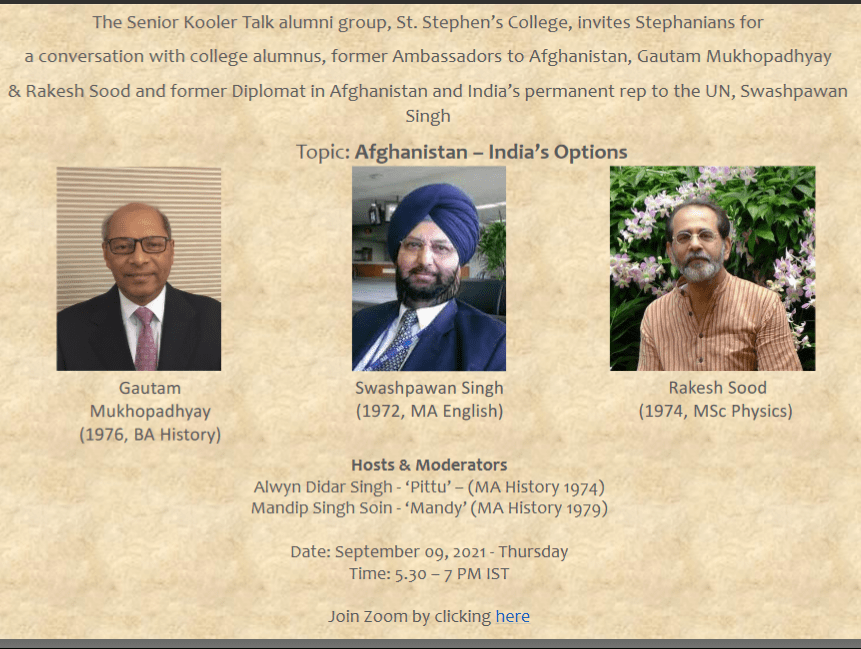
Can be seen by clicking on the YouTube link above.
Published by ORF-America on September 11, 2021
(Part of its series at https://orfamerica.org/newresearch/the-united-states-in-afghanistan-an-indian-perspective)
As dawn broke on 31st August, Afghans awoke to a sense of growing uncertainty and anxiety about what comes next. The last US evacuation flight had taken off hours earlier and on board were Ambassador Ross Wilson and Maj Gen Chris Donahue, closing the chapter that began on 7th October 2001 when US launched Op Enduring Freedom with air strikes against the Taliban.
In 2001, nobody could imagine this is how it would end 20 years later. There is no getting away from the fact that the images of the messy exit will stay etched in our collective conscious for a long time, just as the iconic image of US marines being evacuated from Saigon by a helicopter from a rooftop in April 1975 have never been forgotten.
Even though the US intervention ended ignominiously on President Joe Biden’s watch, there were a series of cumulative mistakes by each of his three predecessors – Presidents Donald Trump, Barack Obama and George W Bush, that contributed to this outcome.
Later in the day, Biden came out with a defiant speech, defending both the decision to exit and also the manner in which the exit was conducted. He claimed that the Doha Agreement signed on 29th February last year when Trump was in the White House, left him with the “choice between leaving or escalating”. What Biden ignored was that after having called it ‘a bad deal’, he had retained Ambassador Zalmay Khalilzad, the architect of the deal, in the same role. His own inclination had always been to exit and as Obama’s Vice President, he had opposed the ‘surge’ but was over-ruled by Obama and the generals.
He maintained, “I am not going to extend this forever war and I was not extending a forever exit”. However, as many have pointed out, US did not fight a twenty year war, it merely fought a one year war, twenty times over. Biden insisted that there was no way of doing a more orderly exit because had he started it earlier while the civil war was still going on, there would still have been a rush for the airport and it would have led to a crisis of confidence in the government, making it a difficult and dangerous mission. He is perhaps right in that the evacuation only commenced after Kabul fell and President Ashraf Ghani fled the country on 15th August. Yet, it overlooks the fact that as late as 23rd July when he spoke on the phone with Ghani, it is clear that neither leader foresaw the impending collapse though the trends were visible.
Biden identified two key lessons, “setting missions with clear achievable goals and staying focused on fundamental national security interests”. These are valid lessons and he was pointing to the beginning of Op Enduring Freedom. Even while denying it, the US and the international community had embarked on a nation-building exercise in 2001 because Bush’s global war on terror demanded it. Preventing a return of Taliban demanded building a new constitutional democratic state, or so the Americans believed. However, even as the Taliban found sanctuary and safe-havens in Pakistan that enabled them to regroup and re-establish their financing mechanisms, US got distracted with the war in Iraq from 2003 onwards.
The Pakistan ISI resumed their old game with the US, running with the hares and hunting with the hounds, emerging as the front-line state partnering the US in Afghanistan while subverting US efforts by aiding and abetting the Taliban and the Haqqani network as they unleashed a spate of IED attacks and suicide bombings in Afghanistan, aimed at undermining the Afghan government and drawing the US forces into a counter-insurgency from what had initially been a counter-terrorism mission. Every US commander beginning with Gen Dan McNeill in 2008 has acknowledged sooner or later that it is impossible to defeat an insurgency that enjoys safe-havens.
In public testimony, US CJSC Admiral Mike Mullen called the Haqqani network “a veritable arm of the ISI”. Secretary of State Hillary Clinton, on a visit to Islamabad, warned her hosts, “You can’t keep snakes in your backyard and expect them only to bite your neighbours”. Feeling boxed in by the generals, Obama finally gave into demands for a ‘surge’ in US troop presence on the assurance that things would turn around in 18 months. He raised US troop levels to over 100000 but also announced the drawdown that ended combat operations in end-2014. President Karzai warned that the US was fighting the wrong enemy in the wrong place and Carlotta Gall came out with a provocatively titled book, “The Wrong Enemy”, highlighting failures of US military strategy. Obama’s change of policy was evident in the opening of the Taliban’s office in Doha, marking the beginning of their legitimisation from an insurgent force to a political actor.
Trump called out Pakistan, tweeting that US had “foolishly given Pakistan more than $33 billion over the last 15 years and they have given us nothing but lies and deceit, thinking of our leaders as fools and giving safe haven to terrorists”. By mid-2018, he reversed policy and authorised direct negotiations with the Taliban further adding to their international acceptance. By February 2020, the US withdrawal deal in return for safe passage was signed and presented to the international community as a peace deal. The process of legitimisation was complete and the last favour the US did was to ‘persuade’ the Afghan government to release over 5000 Taliban prisoners, adding to its marginalisation.
This was the policy maze that Biden found himself trapped in. He could have tried to change the flawed narrative of ‘forever wars’ or taken action against the safe havens but he chose to cut the Gordian knot by redefining the objective, by declaring that the mission had been accomplished by killing Osama bin Laden and decimating Al Qaeda and assuring the American people that their security could be ensured by over-the-horizon kinetic options. The problem is, it doesn’t smell like victory.
Once Biden set an expiry date for US presence, Taliban began their military operations. The collapse of the Afghan state authority happened like Ernest Hemingway’s explanation of how you go bankrupt – it happens in two ways, first gradually and then suddenly.
The Afghan army had been built on the US model, based on sophisticated reconnaissance units, real time intelligence using drone and aerial surveillance and monitoring, and air support. During the last six years when they had the lead in combat, they had lost over 50000 security forces compared to less than a hundred US and NATO troops killed in action proving their fighting mettle. It is true that there was corruption and this impacted morale but institution building takes time. However, with the withdrawal, especially the contractors, all support systems disappeared. Ammunition replenishment to forward bases dried up as supply chains collapsed. Medical evacuation was no longer feasible. Aircraft, helicopters and drones were grounded. GPS tracking and targeting ended as proprietary software from weapon systems was removed. The soldiers had been trained to fight like an army, not as a guerrilla force, and now, they were crippled. Perhaps the most succinct explanation of the collapse was in the recent op-ed in the New York Times by a three star general of the Afghan army Samy Sabet, “We were betrayed by politics and presidents”.
What happens now? Unlike in other places, wars in Afghanistan become serious when the fighting stops. The Taliban emerged as an Islamist Pashtun force in the 1990s and that remains its DNA. It has again achieved power through military means and not through negotiations. Statements about creating an inclusive and representative government remain vague and ambiguous. How does Taliban manage its relationships with its principal benefactor, the ISI and other collaborators, the foreign militant groups like Al Qaeda, IS-K, IMU, ETIM, TTP etc? How long before the fighting begins again?
Biden has ended America’s ‘longest war’ but peace is yet to appear on the Afghan horizon.
*****
 RAKESH SOOD